
|
SCALEMIUM™ — Strategic systems for modern operators. |
€ 6997
Strategy and tactics are not the same thing, and the confusion between them produces some of the most consequential errors observable across institutional contexts.
Tactics concern immediate situations — specific decisions, individual transactions, particular conflicts, discrete operations. Strategy concerns the architecture within which tactics operate — the relationships between resources, positions, and outcomes that persist across time, that shape what tactical options become available, and that determine whether tactical victories accumulate into sustained strategic advantage or dissipate without producing lasting positional improvement. Tactics can be executed brilliantly within strategically inadequate frameworks, producing the recurring pattern of operators who consistently win specific encounters while systematically losing the longer competitions within which those encounters occur.
The distinction is foundational, and it operates as one of the most consequential analytical capacities for strategic operators of significance.
Most contemporary institutional discourse confuses tactics and strategy systematically. Investment commentary discusses market movements and specific trades as “strategy” when the actual frameworks operating are tactical. Corporate planning documents describe quarterly initiatives as “strategy” when the timescales involved are operational rather than strategic. Political analysis discusses election cycles and policy decisions as “strategy” when the dynamics operating belong to substantially shorter temporal horizons than strategic analysis requires. The conflation has substantial consequences: operators with substantial tactical sophistication operate strategically inadequate frameworks, and the resulting strategic inadequacy compounds across the timescales within which actual strategic positioning is determined.
Grand strategy operates differently from both tactics and strategy.
Where strategy concerns the architecture within which tactics operate, grand strategy concerns the architecture within which strategies themselves operate — the relationships between institutional positioning, resource development, alliance construction, narrative infrastructure, and the broader civilizational context that determines whether strategies adopted in specific periods produce sustained positional improvement across substantially longer timescales. Grand strategy is the discipline of integrating the multiple dimensions of strategic operation — military, economic, technological, narrative, institutional, demographic, geopolitical — into coherent positioning that operates across decades, generations, and in the most ambitious cases across centuries.
The strategic operators of significance who engage grand strategy as discipline operate with substantial advantages.
They understand that tactical excellence does not produce strategic victory unless tactics operate within adequate strategic frameworks. They understand that strategic positioning across specific periods does not produce sustained advantage unless those strategies operate within adequate grand-strategic frameworks. They understand that the construction of power infrastructure that endures requires temporal perspective substantially longer than typical institutional planning addresses. They understand that strategic patience — the capacity to operate across timescales exceeding immediate gratification, immediate vindication, or immediate visible progress — operates as one of the most consequential capabilities distinguishing operators who achieve sustained strategic positioning from operators who achieve tactical brilliance without lasting accumulation.
The operators who do not engage grand strategy as discipline operate primarily within tactical and short-strategic frameworks, regardless of the formal sophistication of their planning documentation. The structural difference between operators with grand-strategic infrastructure and operators without it produces the consistent pattern observable across institutional contexts: certain operators sustain advantage across substantial periods while comparable operators in comparable positions fail to sustain advantage across comparable periods, despite frequent tactical brilliance and apparent strategic sophistication during specific phases.
This collection addresses that distinction.
Strategy as long-term discipline is not new. It is, in fact, ancient — engaged by Sun Tzu in the 5th century BC, by Thucydides through the History of the Peloponnesian War, by Kautilya through the Arthashastra, by Clausewitz through On War, by Bismarck through decades of state construction, by the architects of British, Roman, Chinese, and other long-enduring civilizational positioning across periods substantially exceeding the operational horizons of typical contemporary institutional thinking. The accumulated body of grand-strategic analysis represents one of humanity’s most substantial intellectual achievements, available to operators who engage it but largely absent from the analytical infrastructure most operators bring to strategic decisions.
This collection addresses that engagement.
The strategic environments of the coming decades require grand-strategic thinking to a degree that recent decades did not. The relatively stable post-Cold War period within which much contemporary institutional positioning developed permitted strategic frameworks calibrated to substantially shorter timescales than would have been viable during earlier periods of greater institutional instability. The conditions producing that permissive environment no longer apply. The strategic operators positioning across the coming decades navigate environments characterized by structural restructuring, accelerating complexity, technological transformation, and the broader civilizational dynamics that require grand-strategic frameworks for sustained strategic positioning.
Most operators engage strategy fragmentarily — through specific situations, particular competitions, discrete planning exercises. The strategic operators of significance recognize strategy as integrated discipline operating across the multiple dimensions of strategic existence — power construction, conflict management, alliance architecture, narrative positioning, institutional design, multi-generational positioning, and the broader temporal architecture within which strategic operation actually occurs.
This collection addresses that recognition.
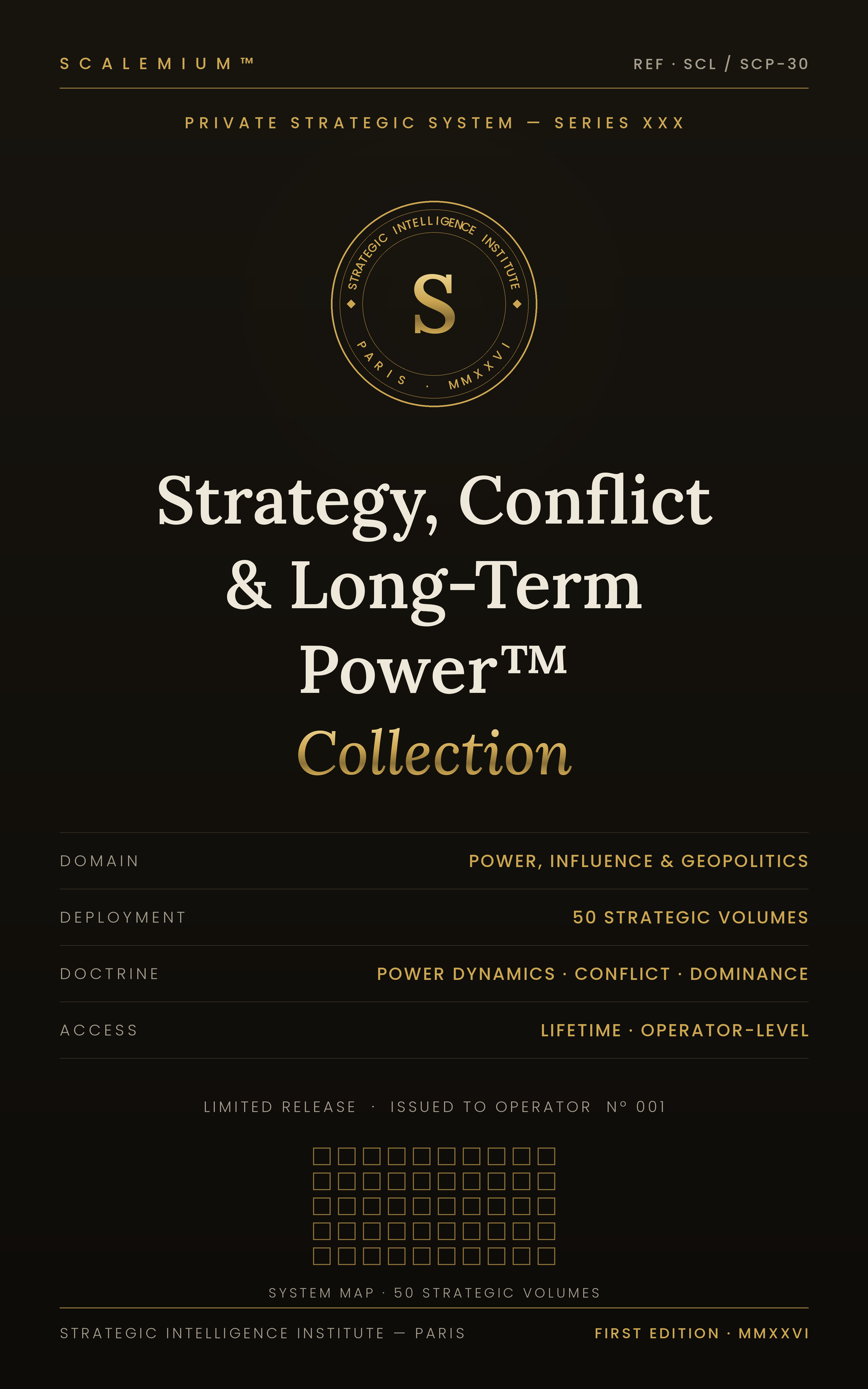
Strategy, Conflict & Long-Term Power operates as comprehensive institutional intelligence on strategy as long-term discipline. The collection extends across 50 volumes covering the architectural dimensions of strategic thinking — from grand strategy in the 21st century through the structural mechanics of asymmetric power, from the architecture of conflict below the threshold of violence through the strategic significance of patience and silence, from power transitions across decades through the foundational construction of strategic legitimacy across centuries.
The collection addresses the foundational dimensions of strategic operation across institutional, geopolitical, and civilizational horizons.
The collection articulates grand strategy as integrated discipline operating across the multiple dimensions of contemporary strategic existence. The 21st century operating environment requires grand-strategic frameworks substantially different from those operating during earlier periods, and the collection addresses these contemporary requirements with appropriate analytical depth.
The collection addresses strategic patience as foundational strategic capability. Strategic patience operates as one of the most consequential capabilities distinguishing operators who achieve sustained strategic positioning from operators who achieve tactical brilliance without sustained accumulation. The collection articulates strategic patience as discipline rather than as merely temperament.
The collection articulates asymmetric power as integrated strategic capability. Smaller operators can defeat larger competitors when asymmetric strategies are properly constructed. The structural mechanics of asymmetric strategic operation operate with substantial consistency across historical periods and contemporary contexts.
The collection addresses conflict as occurring substantially below the threshold of overt violence. Contemporary strategic competition occurs predominantly in domains — economic, informational, technological, institutional — that operate below traditional military categories but produce strategic effects comparable to or exceeding those produced by traditional military conflict.
The collection articulates strategic deception as integrated strategic capability operating across institutional, political, and competitive contexts. Strategic deception operates differently from lying and produces effects that direct misrepresentation cannot produce.
The collection addresses operations in the grey zone — the operational space between formal peace and formal war, between cooperative engagement and overt conflict. Substantial contemporary strategic operation occurs in the grey zone, and traditional frameworks calibrated to formal peace-war distinctions inadequately address grey zone dynamics.
The collection articulates the escalation ladder as integrated strategic capability. The capacity to manage conflict intensity — to escalate when strategic advantage requires escalation, to de-escalate when strategic advantage requires de-escalation, to operate at intensities calibrated to strategic objectives rather than to emotional responses — operates as foundational strategic discipline.
The collection addresses deterrence as integrated strategic capability under contemporary conditions. The structural conditions affecting deterrence — technological, informational, geopolitical — have evolved substantially from those operating during the formative periods of deterrence theory. Contemporary deterrence requires frameworks calibrated to current conditions.
The collection articulates strategic ambiguity as integrated strategic capability. Strategic operators of significance frequently maintain calibrated uncertainty regarding their positions, capabilities, intentions, and likely responses. The strategic value of calibrated ambiguity operates as foundational dimension of sophisticated strategic operation.
The collection addresses power transitions as integrated strategic situations. Operators positioned on either side of power transitions — declining or rising — face structural strategic challenges that traditional strategic frameworks frequently inadequately address.
The collection articulates strategic culture as foundational institutional reality. Different operators, institutions, and civilizations think about strategy differently. The strategic cultures within which strategic operation occurs shape strategic possibility in ways that culture-blind analysis cannot adequately address.
The collection addresses strategic operations occurring substantially outside public view. Much consequential strategic operation occurs in domains — institutional, financial, intelligence-related, network-based — that operate substantially beyond the visibility of typical contemporary discourse.
The collection articulates strategic resilience as foundational strategic capability. The construction of strategic positioning that survives shocks, transitions, and the broader instabilities affecting contemporary environments operates as discipline substantially more demanding than initial strategic positioning.
The collection addresses strategic adaptation as continuous strategic operation. Static strategic positioning fails over time even when initially excellent. Strategic adaptation — the capacity to evolve strategic positioning continuously while maintaining strategic coherence — operates as foundational strategic discipline.
The collection articulates power dynamics in non-linear complex systems. Traditional strategic frameworks frequently assume linear dynamics that contemporary strategic environments do not exhibit. Operating strategically within non-linear complexity requires frameworks calibrated to actual conditions.
The collection addresses strategic overreach as recurring pattern across institutional and geopolitical contexts. The dynamics through which power destroys itself operate with substantial consistency across historical periods and contemporary contexts. Operators positioning strategically for long-term endurance require frameworks for recognizing and avoiding overreach.
The collection articulates strategic legitimacy as foundational dimension of enduring power. Power without legitimacy operates expensively through enforcement mechanisms that consume substantial resources. Power with legitimacy operates through voluntary compliance that requires minimal enforcement. The strategic implications affect operators across institutional contexts.
The collection addresses the institutional construction of strategic intelligence capability. Operators of significance increasingly recognize that strategic intelligence operates as institutional discipline requiring dedicated infrastructure rather than as occasional individual capability.
The collection articulates civilization-level strategic operation. The most ambitious contemporary strategic operators engage strategic questions at civilizational scale — questions affecting humanity rather than merely affecting specific institutional or national positioning. The collection addresses these civilizational dimensions with appropriate gravity.
The collection operates across 50 volumes structured through five strategic doctrines — each addressing a foundational dimension of strategy as long-term discipline.
The opening doctrine establishes the foundational architecture of strategic thinking — grand strategy, strategic patience, asymmetric power, and the broader temporal architecture within which sustained strategic operation occurs.
Volume 1 — Grand Strategy in the 21st Century: Power Across Time
Volume 2 — Strategic Patience: Winning by Waiting
Volume 3 — Power and Long-Term Thinking: Why Time Beats Force
Volume 4 — Asymmetric Power: Winning Without Size
Volume 5 — Conflict Without War: Competition Below Violence
Volume 6 — Strategic Deception: Misleading Without Lying
Volume 7 — The Grey Zone: Power Between Peace and War
Volume 8 — Power Projection: Influence Beyond Borders
Volume 9 — The Escalation Ladder: Managing Conflict Intelligently
Volume 10 — Deterrence in the Digital Age: Preventing Conflict Without Weapons
The second doctrine addresses the structural dimensions of long-game strategic operation — strategic ambiguity, the management of stability and rivalry, power transitions across substantial periods, and the strategic culture that shapes institutional approaches to power.
Volume 11 — Strategic Ambiguity: Power Through Uncertainty
Volume 12 — The Stability Paradox: Why Balance Is Fragile
Volume 13 — The Logic of Rivalry: Why Competition Never Ends
Volume 14 — Power Transitions: Managing Decline and Rise
Volume 15 — Strategic Culture: How Nations Think About Power
Volume 16 — The Long Game of Influence: Decades, Not Headlines
Volume 17 — Power and Collapse: Why Systems Fail Suddenly
Volume 18 — The Resilience Advantage: Surviving Power Shocks
Volume 19 — Strategic Adaptation: Evolving Under Pressure
Volume 20 — Power and Complexity: Control in Non-Linear Systems
The third doctrine addresses strategic operations outside public view, the management of strategic uncertainty, the evolution of conflict under AI-era conditions, and the structural dynamics of strategic overreach and renewal.
Volume 21 — The Shadow Game: Influence Outside Public View
Volume 22 — Strategic Silence: Power of Not Acting
Volume 23 — Power Under Uncertainty: Decisions Without Clarity
Volume 24 — Conflict in the AI Era: Speed, Scale, Autonomy
Volume 25 — Strategic Overreach: When Power Destroys Itself
Volume 26 — The Future of Deterrence: AI and Stability
Volume 27 — Power and Narrative Collapse: When Belief Systems Fail
Volume 28 — The Strategy of Survival: Enduring Through Chaos
Volume 29 — The Multipolar Trap: Managing Many Rivals
Volume 30 — Strategic Renewal: Rebuilding Power After Decline
The fourth doctrine addresses the foundational dimensions of leverage, strategic foresight, the endurance doctrine of long-term power preservation, and the structural ethical and practical limits affecting strategic operation.
Volume 31 — The Ultimate Leverage: Control the Rules, Not the Game
Volume 32 — Power as Adaptation: Evolution Beats Strength
Volume 33 — Strategic Foresight: Seeing Power Moves Before They Happen
Volume 34 — The Endurance Doctrine: Long-Term Power Preservation
Volume 35 — Strategic Intelligence: Knowing What Matters
Volume 36 — Power and Ethics: Limits of Control
Volume 37 — The Final Constraint: Why Power Is Never Absolute
Volume 38 — Strategic Collapse Prevention: Avoiding System Failure
Volume 39 — Power Beyond the State: Networks, Platforms, Movements
Volume 40 — The New Grand Strategy: Intelligence, Influence, Infrastructure
The closing doctrine synthesizes the collection’s architecture — addressing post-hegemonic order, strategic restraint, civilization-level strategy, and the institutional construction of strategic intelligence for the coming century.
Volume 41 — Power After Hegemony: Order Without Dominance
Volume 42 — Strategic Restraint: Winning by Limiting Action
Volume 43 — The Power Century: Why the 21st Century Is Different
Volume 44 — Strategic Legitimacy: Power That Endures
Volume 45 — The End of Naive Power: Complexity Changes Everything
Volume 46 — Civilization-Level Strategy: Managing Power for Humanity
Volume 47 — The Ultimate Power Question: Who Controls the Future?
Volume 48 — Power in the Machine Age: Humans vs Systems
Volume 49 — Strategic Intelligence Institutions: Educating Power Elites
Volume 50 — The Power Institution: Teaching Influence for a New World Order
The collection delivers institutional intelligence value across the structural dimensions of long-term strategy.
Operators receive grand strategic frameworks calibrated to contemporary conditions rather than to frameworks developed during substantially different historical periods. The frameworks support strategic operation across the integrated dimensions of contemporary strategic existence.
The collection provides strategic patience as institutional discipline rather than as merely temperamental disposition. Operators whose strategic effectiveness depends on operating across substantial timescales receive analytical infrastructure supporting this operation systematically.
The collection provides asymmetric strategy capability for operators whose strategic positioning requires operating against larger competitors. The structural mechanics of asymmetric operation support strategic operation that traditional comparative-capability analysis inadequately addresses.
The collection provides frameworks for operating in the grey zone and below the threshold of overt conflict. Contemporary strategic competition occurs substantially in these domains, and the strategic operators of significance benefit from intelligence calibrated to grey zone realities.
The collection provides frameworks for the strategic uses of deception, ambiguity, and silence. These capabilities operate as foundational dimensions of sophisticated strategic operation that traditional transparency-focused frameworks inadequately address.
The collection provides frameworks for navigating power transitions — whether positioned on the declining or rising side of transitions. Multi-generational positioning under conditions of geopolitical and institutional transition requires frameworks calibrated to transition dynamics.
The collection provides strategic resilience and adaptation infrastructure for operators whose strategic positioning must survive across the substantial instabilities affecting contemporary environments. The capacity to evolve continuously while maintaining strategic coherence operates as foundational strategic discipline.
The collection provides strategic foresight capability — the analytical infrastructure supporting recognition of strategic developments before they become visible to operators with less developed foresight infrastructure. Strategic foresight produces strategic advantages that reactive engagement cannot match.
The collection provides endurance doctrine for operators positioning across multi-generational timescales. The construction of strategic positioning that endures across generations operates as substantially different discipline than positioning across individual operator lifetimes.
The collection provides civilization-level strategic frameworks for operators engaging strategic questions at civilizational scale. The most ambitious contemporary strategic operators benefit from frameworks calibrated to the actual scale of their strategic ambition.
The collection serves as integrating synthesis across the complete Power, Influence & Geopolitics edition. Operators having engaged the foundational canon, the geopolitical reality, the influence infrastructure, and the algorithmic transformation receive integrating frameworks supporting strategic operation across all these dimensions.
The collection operates as reserved infrastructure for operators whose strategic positioning requires long-term strategic capability.
Senior strategic operators in positions requiring grand-strategic thinking — institutional principals, sovereign operators, dynastic architects, civilizational thinkers. The collection provides institutional-grade intelligence on grand strategy at the depth these positions require.
Investment principals whose strategic positioning operates across multi-decade timescales — sovereign wealth fund principals, large family office investment committees, foundation investment principals, capital allocators whose investment thesis requires strategic frameworks substantially exceeding typical investment horizons.
Family office principals navigating multi-generational positioning across the coming century. The strategic positioning of substantial family architecture requires grand-strategic frameworks calibrated to multi-generational timescales rather than to operational planning timescales.
Senior governmental operators, sovereign principals, foreign policy architects engaged with strategic positioning at multi-decade and civilizational scales. The collection provides institutional-grade intelligence on grand strategy for sovereign-level operation.
Senior leadership of strategic intelligence institutions, think tank principals, foreign policy institute leadership, and operators engaged with the institutional construction of strategic intelligence capability.
Senior corporate leadership whose strategic responsibility extends substantially beyond quarterly and annual operational planning — particularly principals of multi-generational family companies, foundation-controlled institutions, and corporations whose strategic positioning operates across multi-decade timescales.
Philosophers of strategy, civilizational analysts, grand strategists, and intellectual operators whose work engages strategy at the depth the collection addresses. The collection provides institutional-grade infrastructure for work at this depth.
Academic researchers in strategic studies, international relations, geopolitics, and adjacent fields whose work requires institutional-grade synthesis of long-term strategy as foundational research infrastructure.
Operators completing systematic engagement across the Power edition benefit from this collection as integrating synthesis. The collection operates with substantially greater depth when engaged after the foundational canon, the geopolitical reality, the influence infrastructure, and the algorithmic transformation collections.
The collection does not operate as popular commentary on strategy, fragmentary strategic analysis, or general-audience content on power and geopolitics. The reserved positioning operates through strategic standards rather than through commercial accessibility.
This collection completes the Power, Influence & Geopolitics edition. The edition extends across five collections:
— Foundations of Power — the canonical foundation
— Geopolitics & Global Power Structures — the structural reality of contemporary global power
— Influence, Persuasion & Narrative Control — the architecture of influence
— Power, Technology & Algorithmic Control — the transformation of power through technology
— Strategy, Conflict & Long-Term Power — strategy as long-term discipline (this collection)
Each collection operates independently as comprehensive intelligence on its specific domain. The five collections together provide integrated intelligence on the institutional, geopolitical, narrative, technological, and strategic dimensions of contemporary power.
Operators considering systematic engagement with the Power, Influence & Geopolitics library benefit from access across multiple collections. Multi-collection institutional access addresses operators planning systematic engagement across the full edition or across the broader Strategic Intelligence library.
Access: €6,997
Access operates through institutional channels. The collection delivers across the 50 volumes with continuing institutional support for operators integrating the intelligence into their strategic and institutional infrastructure.
Reserved for operators recognizing that strategy as long-term discipline operates as foundational strategic dimension across institutional, dynastic, and civilizational horizons. Not all applications warrant access.
→ Access This Collection — €6,997
Submit access request for institutional review.
→ Multi-Collection Institutional Access
For operators considering institutional access across the complete Power, Influence & Geopolitics edition (five collections) or across the broader Strategic Intelligence library.
→ Private Advisory
For operators whose strategic situations warrant direct engagement at substantial depth.
Full access, delivered instantly upon acquisition.
For operators acquiring several collections within the Strategic Intelligence library. Submit your selection — we structure a single institutional access, priced accordingly.
For operators whose strategic situation warrants direct counsel at substantial depth.
SCALEMIUM™
Collections → Power, Influence & Geopolitics → Volume 5
This is not tactics.
This is:
 long-term strategic thinking
If you understand strategy:
you anticipate moves
you navigate conflict
you build durable systems
That’s long-term power.
Most people react.
Very few think ahead.
This collection gives you:
a framework to understand and build power over time
We use cookies to ensure the site functions properly, understand how it is used, and improve your experience. You can accept, reject, or manage your preferences at any time.