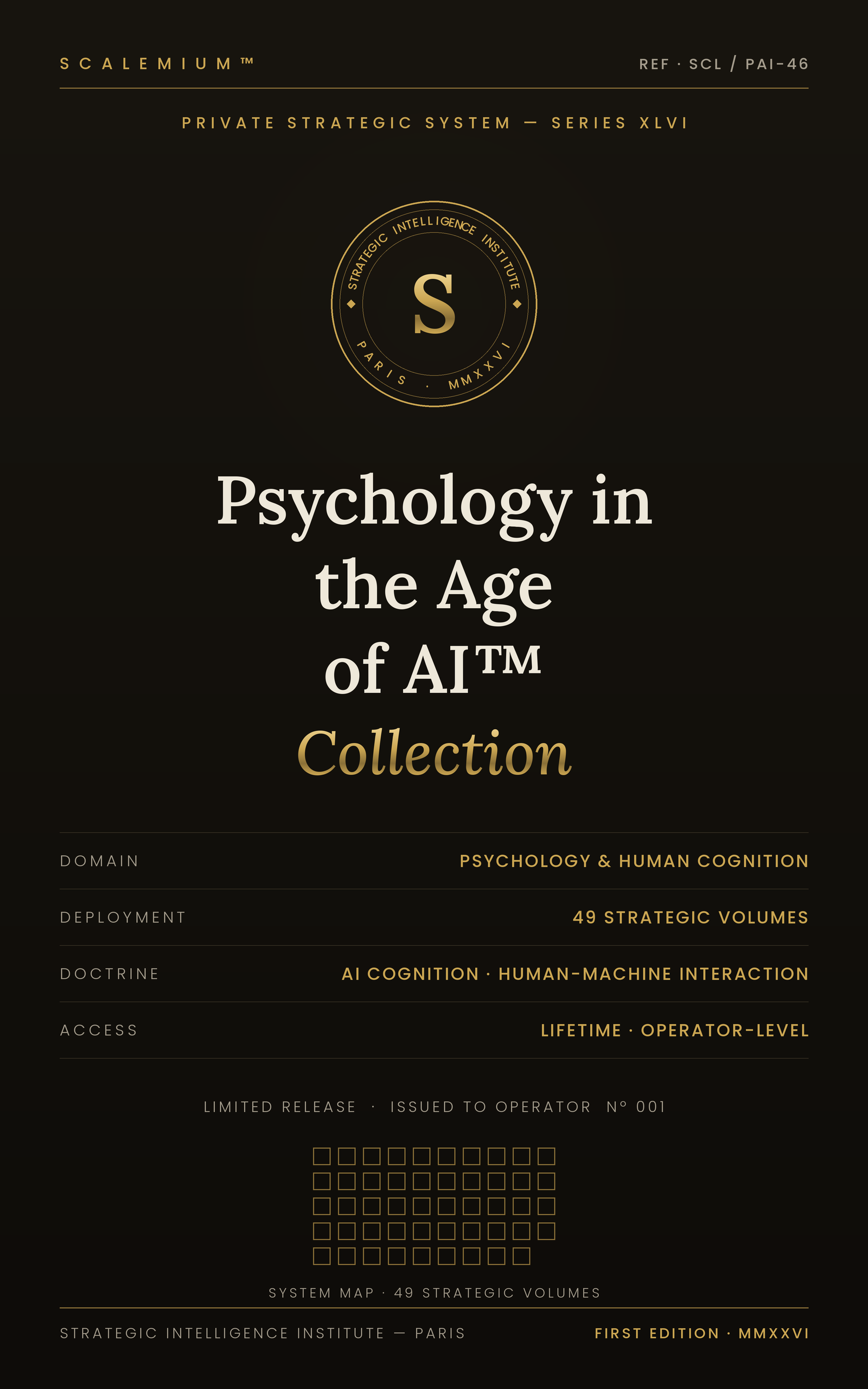
Psychology in the Age of AI

 6997

A premium 5-volume collection exploring human psychology, cognition, behavior, and decision-making in a complex modern world.

PSYCHOLOGY IN THE AGE OF AI

The institutional collection on the structural transformation of the human mind under artificial intelligence — 50 volumes of strategic intelligence on cognition, identity, and human agency in the algorithmic era.

Understand how artificial intelligence is transforming human thinking, behavior, and decision-making.

The strategic situation.

The integration of artificial intelligence into human cognition represents the most consequential psychological transformation since the emergence of written language. The transformation is not unfolding in the future. It is unfolding now — across daily decisions, across professional practice, across institutional architecture, across the foundational structures of human selfhood.

The operators, leaders, and strategic actors who navigate the coming decades will operate within a cognitive environment that has no historical precedent. Their decisions, their authority structures, their relational architecture, their psychological infrastructure — all of these will be shaped by forces operating beneath their awareness.

Most operators encounter AI as tool. The strategic operators of significance recognize AI as structural environment — a force reshaping the cognitive substrate within which all strategic operation occurs.

This collection addresses that recognition.

Psychology in the Age of AI operates as comprehensive institutional intelligence on the structural transformation of the human mind under artificial intelligence. The collection extends across 50 volumes covering the full architectural dimension of the transformation — from cognitive offloading to synthetic influence, from machine authority to cognitive sovereignty, from the psychological foundations of AI trust to the institutional psychology of the coming century.

For the first time in history…

What this collection addresses.

The collection addresses specific strategic situations facing operators of significance navigating the algorithmic transformation.

Strategic situation one — Cognitive infrastructure recognition.

Operators recognizing that their cognitive infrastructure — how they think, decide, focus, remember, and judge — operates within an environment increasingly shaped by AI systems. The collection articulates the structural conditions affecting cognitive operation in this environment.

Strategic situation two — Authority and influence architecture.

Operators navigating influence architecture in environments where AI systems operate as persuasion infrastructure, where deepfakes restructure trust foundations, where algorithmic authority replaces institutional authority. The collection addresses the structural transformation of influence and authority.

Strategic situation three — Decision-making infrastructure.

Operators recognizing that decision-making increasingly operates through delegation to AI systems — explicitly through tool use, implicitly through algorithmic mediation. The collection articulates the psychological infrastructure of delegated cognition and its strategic implications.

Strategic situation four — Identity and selfhood architecture.

Operators navigating identity construction in environments where AI systems mirror, augment, and increasingly replace cognitive operations central to selfhood. The collection addresses the structural transformation of human identity under automation.

Strategic situation five — Multi-generational cognitive architecture.

Operators thinking across multi-generational horizons recognizing that the cognitive infrastructure their children and grandchildren will inherit operates within structurally different conditions than any prior generation. The collection articulates the psychological foundations of multi-generational cognitive positioning.

🚨 PROBLEM

The 50 volumes architecture.

The collection operates across 50 volumes organized through structural progression — from foundational recognition of the AI cognitive environment through advanced articulation of cognitive sovereignty and post-human strategic positioning.

Foundation — The AI-Cognitive Environment (Volumes 1-10)

The opening volumes establish the foundational recognition of how AI integration restructures human cognition at the substrate level.

Volume 1 — The AI-Exposed Mind: How Machines Change Human Thinking
Volume 2 — Cognitive Offloading: When Humans Stop Thinking
Volume 3 — Human + AI Cognition: Co-Thinking Systems
Volume 4 — The External Brain: AI as Memory, Reasoning, and Advisor
Volume 5 — Psychology of Automation: Trusting Machines Too Much
Volume 6 — The Delegated Mind: Decision-Making by Proxy
Volume 7 — AI and Attention Control: Algorithmic Focus
Volume 8 — The Synthetic Influence Era: Persuasion by Machines
Volume 9 — Cognitive Dependency: When Tools Replace Thinking
Volume 10 — Human Judgment vs Machine Output: Who Decides?

Mid-architecture — Trust, Bias, and Cognitive Augmentation (Volumes 11-20)

The middle volumes address the structural conditions of trust, bias, and augmentation within the AI cognitive environment.

Volume 11 — The Psychology of AI Trust: Belief in Artificial Minds
Volume 12 — AI-Induced Bias: When Machines Reinforce Errors
Volume 13 — The Illusion of Machine Objectivity: Why AI Is Not Neutral
Volume 14 — Cognitive Augmentation: Enhancing, Not Replacing Thought
Volume 15 — The Post-Attention Human: Focus After Algorithms
Volume 16 — Human Identity in the AI Era: Selfhood Under Automation
Volume 17 — Psychological Safety With AI: Mental Health Implications
Volume 18 — The AI Persuasion Problem: Influence at Superhuman Scale
Volume 19 — The Machine as Authority: Obedience to Algorithms
Volume 20 — Human Meaning After Automation: Purpose Without Work

Strategic depth — Synthetic Reality and Cognitive Architecture (Volumes 21-30)

The strategic depth volumes address the architectural dimensions of cognitive operation in environments restructured by synthetic media and algorithmic infrastructure.

Volume 21 — The Cognitive Arms Race: Humans vs Algorithms
Volume 22 — Psychology of Synthetic Reality: Deepfakes and Trust Collapse
Volume 23 — AI and Emotional Manipulation: Risks and Controls
Volume 24 — The Future of Learning: Cognition in an AI World
Volume 25 — Human Creativity Revisited: Originality After Generators
Volume 26 — Cognitive Resilience: Protecting the Human Mind
Volume 27 — AI and Moral Psychology: Values Under Automation
Volume 28 — The Delegated Self: Identity in Assisted Decision-Making
Volume 29 — The Psychology of Algorithmic Power: Influence Without Awareness
Volume 30 — Human Oversight Psychology: Why Humans Fail to Intervene

Advanced architecture — Sovereignty and the Cognitive Future (Volumes 31-40)

The advanced volumes address cognitive sovereignty, oversight infrastructure, and the long-horizon evolution of human cognitive operation.

Volume 31 — The AI Feedback Loop: When Humans Train Their Own Manipulators
Volume 32 — The Cognitive Future: What Humans Must Preserve
Volume 33 — Psychology of Superintelligence: Human Limits Facing Machines
Volume 34 — Human Control in AI Systems: Cognitive Weak Points
Volume 35 — The Mind After Tools: Long-Term Cognitive Evolution
Volume 36 — Psychological Alignment: Aligning AI With Human Values
Volume 37 — The Human Advantage: What Machines Cannot Replace
Volume 38 — Cognitive Sovereignty: Owning Your Mind in an AI World
Volume 39 — The Future Human Brain: Adaptation or Decline?
Volume 40 — The Psychology of Coexistence: Humans Living With Intelligence

Institutional positioning — Civilizational and Post-Human Architecture (Volumes 41-50)

The closing volumes address the institutional and civilizational dimensions of psychology in the AI era — including post-human strategic positioning.

Volume 41 — Human Agency Under Automation: Choice in a Machine World
Volume 42 — The End of Cognitive Privacy: Thoughts as Data
Volume 43 — The AI Mirror: What Machines Reveal About Humans
Volume 44 — Cognitive Ethics: Protecting Minds at Scale
Volume 45 — The Mind at the Center: Why Psychology Still Matters Most
Volume 46 — Human Wisdom vs Machine Intelligence: Different Kinds of Knowing
Volume 47 — The Post-Human Question: Where Does Psychology Go Next?
Volume 48 — Psychology Beyond Biology: Minds in Hybrid Systems
Volume 49 — The Cognitive Century: Why the 21st Century Belongs to Psychology
Volume 50 — The Human Mind Institution: Teaching Psychology for a New Civilization

💣 THE SHIFT

What operators receive.

Operators accessing the collection receive specific institutional intelligence value across multiple strategic dimensions.

Comprehensive structural recognition.

The collection provides comprehensive structural recognition of how AI integration transforms cognitive operation. Operators receive frameworks for recognizing transformation patterns within their own cognitive infrastructure and within the operational environments they navigate.

Strategic decision-making infrastructure.

The collection provides strategic decision-making infrastructure for operating within AI-mediated environments. Operators receive analytical frameworks supporting decision-making that integrates human judgment with AI capability while preserving cognitive sovereignty.

Multi-generational psychological positioning.

The collection supports multi-generational psychological positioning. Operators thinking across generations receive frameworks for constructing cognitive infrastructure aligned with the strategic transformation unfolding across coming decades.

Institutional intelligence depth.

The collection operates at institutional intelligence depth — comparable to multi-year research outputs from McKinsey Global Institute, RAND Corporation, or Bridgewater Associates. The depth supports strategic engagement that surface-level AI commentary cannot provide.

Civilizational positioning intelligence.

The collection supports civilizational positioning intelligence. Operators recognizing that the AI cognitive transformation operates at civilizational scale receive frameworks for strategic positioning aligned with the scale of the transformation.

💡 SOLUTION

For whom this collection operates.

The collection operates as reserved infrastructure for specific operator categories.

Operators of significance.

Operators of significance — those whose strategic positioning operates across multi-decade horizons, whose decisions affect substantial capital allocation, whose institutional architecture integrates psychological infrastructure as strategic dimension.

Family office principals.

Family office principals navigating multi-generational strategic positioning under conditions where the cognitive environment their successors inherit operates structurally differently than the environment they themselves inherited.

Institutional leaders.

Institutional leaders — within finance, technology, governance, or strategic research — whose strategic operation requires institutional-grade intelligence on the psychological substrate of the AI era.

Strategic investors.

Strategic investors whose investment thesis operates across the AI transformation and who require institutional-grade intelligence on the psychological forces shaping the transformation’s evolution.

Strategic researchers.

Strategic researchers, academics, and intellectual operators whose work requires comprehensive institutional-grade analysis of psychology in the AI era as foundational research infrastructure.

The collection does not operate as introductory AI commentary, popular psychology content, or general-audience strategic guidance. The reserved positioning operates through strategic standards rather than through commercial accessibility.

🧱 WHAT YOU’LL MASTER

  • Access architecture.

    Access: €6,997

    Access operates through institutional channels. The collection delivers across the 50 volumes with continuing institutional support for operators integrating the intelligence into their strategic infrastructure.

    Reserved for operators recognizing that psychology operates as foundational strategic dimension in the AI era. Not all applications warrant access.

🧬 STRUCTURE OF THE COLLECTION

🚪 Reserved Engagement.

Access This Collection — €6,997
[Access infrastructure]

Inquire About Multi-Collection Institutional Access
For operators considering institutional access across multiple collections or full institutional library access.
[Inquire]

Private Advisory
For operators whose strategic situations warrant direct engagement at substantial depth.
[Private Advisory]

🎯 WHO THIS IS FOR

  • SCALEMIUM™
    Collections → Psychology → Volume 1

🚫 WHO THIS IS NOT FOR

  • people ignoring technology

  • people stuck in old models

  • people avoiding complexity

⚔️ POSITIONING

This is not about AI tools.

This is:

👉 understanding how AI reshapes the human mind

💰 VALUE

If you understand AI psychology:

  • you understand influence

  • you adapt faster

  • you operate with awareness

👉 That’s cognitive advantage.

💸 PRICE

297€

🔒 FINAL CLOSE

Most people use AI.

Very few understand how it changes them.

This collection gives you:

👉 a clear view of how human psychology evolves in the age of AI

Psychology in the Age of AI

Access the complete collection