
|
SCALEMIUM™ — Strategic systems for modern operators. |
€ 6997
Power has acquired a new substrate.
For approximately five thousand years of recorded political history, power operated through identifiable substrates whose mechanics were generally legible to those subject to them. Power operated through military force, whose exercise was visible and whose limits were geographically constrained. Power operated through economic resources, whose flows could be tracked and whose concentration could be observed. Power operated through institutional positions, whose occupants could be named and whose authority derived from frameworks established through public political processes. Power operated through narrative and persuasion, whose mechanisms were ancient and whose practitioners operated within recognizable categories — orators, propagandists, religious authorities, media institutions.
These substrates persist. But a new substrate has emerged that operates differently from any of them.
The new substrate is computational. It operates through the algorithmic infrastructure that increasingly mediates contemporary existence — the platform systems through which billions of people communicate and consume information, the data infrastructure through which institutions track and predict behavior, the artificial intelligence systems that increasingly make consequential decisions affecting individual lives and institutional operation, the surveillance architecture that operates continuously across digital infrastructure, and the broader computational systems whose decisions affect employment, credit, mobility, opportunity, expression, and the practical conditions of contemporary life.
This new power substrate operates with characteristics fundamentally different from traditional power substrates.
It operates invisibly. Traditional power frequently announced itself — through visible authority, identifiable institutions, recognizable hierarchies. Algorithmic power operates through systems whose decisions are produced by computational processes that those subject to them cannot observe, cannot understand, and frequently cannot even identify as power exercise. The shift from visible to invisible power has substantial implications for traditional governance frameworks that depended on visibility for accountability.
It operates at machine speed. Traditional power operated at human institutional speeds — legislative cycles, judicial deliberation, regulatory development, administrative process. Algorithmic power operates at speeds that exceed human oversight capability. The structural mismatch between machine-speed power exercise and human-speed oversight produces governance gaps that traditional frameworks were not designed to address.
It operates through concentration that exceeds traditional institutional categories. Traditional power concentration was constrained by the operational limits of human-staffed institutions — limits on geographic reach, processing capacity, decision velocity, and the practical mechanics of institutional operation. Algorithmic infrastructure operates without these limits. A small number of platform companies exercise practical authority over communication, commerce, information access, and increasingly governance across populations exceeding most national jurisdictions.
It operates through legitimacy mechanisms substantially different from traditional political legitimacy. Traditional power required legitimation through political processes — election, religious sanction, traditional authority, legal-rational frameworks. Algorithmic power operates through legitimacy mechanisms — convenience, network effects, ostensible neutrality, technical complexity — that traditional political theory does not adequately address.
The strategic implications are foundational.
The strategic operators of significance increasingly operate within environments where algorithmic infrastructure exercises substantial influence over their operational reality — over how they reach audiences, how they conduct commerce, how their reputations are constructed and challenged, how regulatory environments treat their operations, and how the broader strategic environment within which they operate is shaped. The operators who engage algorithmic power sophisticatedly position themselves with substantial advantages. The operators who engage it through traditional frameworks calibrated to substantially different power substrates operate at substantial strategic disadvantage.
Most operators encounter algorithmic power fragmentarily.
They engage it through specific products and platforms whose operation they engage as users rather than as sophisticated analysts of the infrastructure within which they operate. They retain technology consultants for specific technical problems. They engage commentary about algorithmic developments that operates predominantly at the level of news coverage rather than at the level of structural intelligence required for strategic engagement. The structural understanding of algorithmic power as integrated infrastructure — operating across platform companies, surveillance systems, AI infrastructure, data architecture, and the broader computational substrate of contemporary civilization — remains largely outside the analytical infrastructure of most strategic operators.
The gap is becoming consequential.
The algorithmic power infrastructure is not stabilizing. It is expanding, accelerating, and increasingly integrating into the foundational decision-making infrastructure of contemporary institutional operation. The strategic environments of the coming decades will operate increasingly within algorithmic infrastructure whose mechanics shape strategic possibility across every domain. The operators positioning strategically for these decades require structural intelligence on algorithmic power that current institutional discourse does not adequately provide.
The questions emerging are foundational.
How does algorithmic power actually operate — distinguished from how technology is described in popular media or how specific products are described by their developers? What is the structural significance of platform companies as governance entities exercising practical authority over populations exceeding most nation-states? How does surveillance infrastructure operate as power mechanism, and what strategic implications follow for operators whose operations are subject to it? What is the operational reality of AI systems exercising consequential decision-making authority — and what governance frameworks adequate to this authority exist or remain to be constructed? How does algorithmic infrastructure interact with traditional power substrates — military, economic, institutional, narrative — and what dynamics result from these interactions? How should strategic operators position themselves within environments increasingly mediated by algorithmic infrastructure whose continued expansion appears structurally certain?
These questions are not adequately engaged through technology product analysis, regulatory commentary on specific platform behaviors, or fragmentary engagement with specific technological developments. They require integrated structural intelligence on algorithmic power as new power substrate operating with characteristics fundamentally different from traditional substrates.
This collection addresses that intelligence.
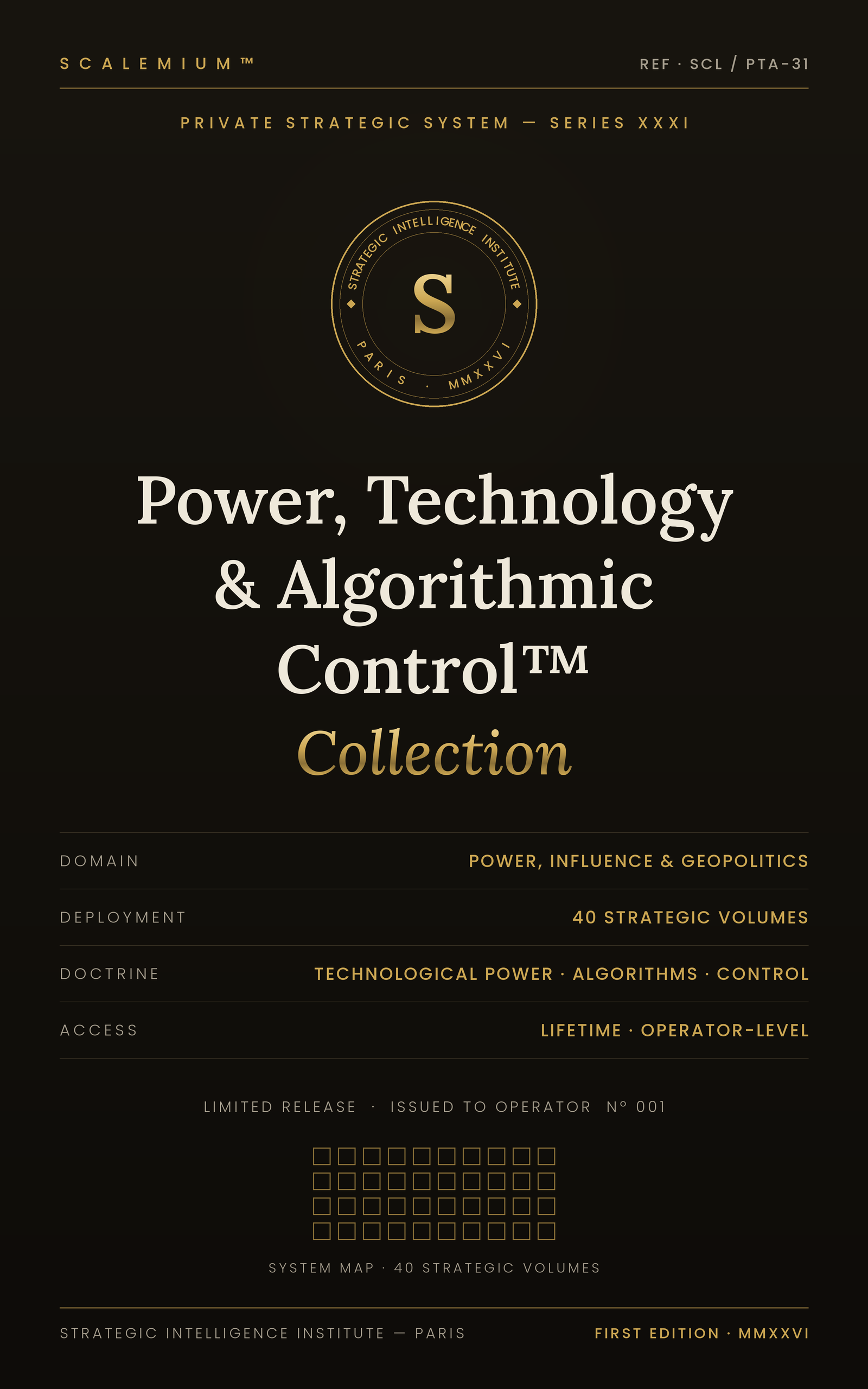
Power, Technology & Algorithmic Control operates as comprehensive institutional intelligence on the structural transformation of power through technology. The collection extends across 40 volumes covering the architectural dimensions of algorithmic power — from the operation of algorithmic governance through the structural emergence of platform sovereignty, from the mechanics of surveillance capitalism through the strategic implications of AI as political actor, from the architecture of digital identity through the foundational transition from traditional to systemic control.
The collection addresses the foundational dimensions of algorithmic power across institutional, technological, and civilizational horizons.
The collection articulates the structural emergence of algorithmic infrastructure as new power substrate operating with characteristics fundamentally different from traditional power substrates. The understanding of algorithmic power as integrated phenomenon — rather than as collection of specific technological developments — enables strategic engagement calibrated to actual operational reality.
The collection addresses the structural significance of major platform companies as governance entities. The practical authority these platforms exercise over communication, commerce, information access, and increasingly governance functions affects strategic operation across virtually all institutional domains. The collection articulates this authority with the analytical depth its strategic implications require.
The collection articulates surveillance capitalism as integrated power mechanism. The continuous observation of behavior across digital infrastructure produces both economic value and power capability that operate as foundational dimensions of contemporary institutional reality.
The collection addresses the emergence of data as governance asset and the structural significance of information accumulation as power infrastructure. Operators whose strategic positioning involves data — generating it, controlling it, being subject to it — receive intelligence calibrated to the actual dynamics of information power.
The collection articulates the structural emergence of AI systems as governance and political actors. AI systems increasingly make consequential decisions affecting individual lives and institutional operation. The political significance of these systems operates independently of any explicit political intent in their construction.
The collection addresses the structural emergence of algorithmic governance as integrated control mechanism. The infrastructure operating across credit systems, employment platforms, mobility infrastructure, financial systems, and increasingly across governmental administration produces governance effects that operate beyond traditional governance categories.
The collection articulates the structural challenges of algorithmic accountability. Traditional accountability mechanisms depended on visibility, comprehensibility, and human-speed deliberation. Algorithmic infrastructure operates through mechanisms that resist all three. The structural mismatch between traditional accountability frameworks and algorithmic operation produces governance gaps with substantial strategic implications.
The collection addresses the structural significance of technological sovereignty and the strategic implications of technological dependency. Operators whose strategic positioning depends on technological infrastructure controlled by entities operating across multiple jurisdictions face sovereignty considerations that traditional strategic frameworks did not adequately address.
The collection articulates the structural emergence of predictive governance — the operation of governance through prediction of behavior rather than through retrospective response to behavior. Predictive governance operates differently from traditional governance and produces strategic considerations operators must engage.
The collection addresses the emergence of digital identity as foundational governance infrastructure. The systems determining who individuals are online — and the access, opportunity, and constraint that follow from these determinations — operate as governance infrastructure with substantial strategic implications.
The collection articulates the structural significance of platform power dynamics — the strategic implications of platform-determined visibility, the kill-switch capability platforms exercise over operators dependent on their infrastructure, and the lock-in dynamics that constrain operator strategic flexibility across platform-dependent contexts.
The collection addresses the structural mismatch between machine-speed power exercise and human-speed oversight infrastructure. The mismatch produces governance gaps whose strategic implications affect operations across every domain involving algorithmic infrastructure.
The collection articulates the structural integration of data collection, predictive analysis, and influence operations into integrated control infrastructure. The control loop operates as integrated power mechanism whose strategic implications affect institutional positioning across domains.
The collection addresses the structural transition from human-gatekeeper governance to algorithmic-gatekeeper governance. The transition affects employment, credit, mobility, opportunity, expression, and increasingly the practical conditions of contemporary institutional operation.
The collection articulates the structural transition underway from traditional power infrastructure to systemic control infrastructure. The transition operates across multiple decades and produces strategic environments substantially different from those operating during the period of traditional power dominance.
The collection operates across 40 volumes structured through four control architectures — each addressing a foundational dimension of algorithmic power and technological control.
The opening architecture establishes the foundational reality of algorithmic power — the emergence of platform empires, the structural mechanics of surveillance capitalism, the data state, and the foundational dimensions of AI as power infrastructure.
Volume 1 — Algorithmic Power: Control Through Code
Volume 2 — The Platform Empire: How Tech Companies Govern
Volume 3 — Surveillance Capitalism: Power Through Observation
Volume 4 — The Data State: When Information Becomes Authority
Volume 5 — The Algorithmic Citizen: Life Under Machine Governance
Volume 6 — Digital Control Systems: Soft Domination at Scale
Volume 7 — The AI Leviathan: Centralized Intelligence and Power
Volume 8 — Technological Sovereignty: Independence in a Digital World
Volume 9 — The Automation of Authority: When Decisions Are Delegated
Volume 10 — Power Without Accountability: Algorithmic Black Boxes
The second architecture addresses the structural mechanics of algorithmic control — the political significance of code, the feedback dynamics shaping behavior, the predictive infrastructure of contemporary governance, and the emergence of digital identity as foundational infrastructure.
Volume 11 — The Code of Control: Who Programs the Rules
Volume 12 — The Feedback Society: Behavior Shaped by Metrics
Volume 13 — The Predictive State: Governing Through Forecasting
Volume 14 — AI and Social Scoring: Incentives as Control
Volume 15 — Digital Identity Power: Who You Are Online
Volume 16 — The Platform Kill Switch: Power to Silence
Volume 17 — Technological Lock-In: Dependency as Strategy
Volume 18 — The Invisible Hand of Code: Control Without Visibility
Volume 19 — The Algorithmic Elite: Who Understands the System Wins
Volume 20 — Power Through Infrastructure: Control the Pipes, Control the Flow
The third architecture addresses the mediation function of AI between state and citizen, the emergence of digital borders, the dynamics of prediction-based power, and the structural integration of bias and politics within algorithmic infrastructure.
Volume 21 — The Machine Mediator: AI Between State and Citizen
Volume 22 — Digital Borders: Control Without Territory
Volume 23 — Power and Prediction: Knowing Before Acting
Volume 24 — The Automation of Compliance: Rules Enforced by Machines
Volume 25 — The Algorithmic Bias Problem: Power Embedded in Code
Volume 26 — AI as Political Actor: Influence Without Intent
Volume 27 — The Control Loop: Data → Prediction → Influence
Volume 28 — The Platform State: Governance by Private Systems
Volume 29 — The Digital Panopticon: Visibility as Power
Volume 30 — Algorithmic Legitimacy: Why People Obey Machines
The closing architecture addresses the structural implications of machine-speed power, the end of human gatekeeper governance, the governance gaps emerging from algorithmic power, and the foundational transition from traditional to systemic control.
Volume 31 — Power at Machine Speed: Faster Than Human Oversight
Volume 32 — The End of Human Gatekeepers: Automation of Authority
Volume 33 — Technological Obedience: Trusting Systems Over Humans
Volume 34 — Power Failures: When Algorithms Collapse
Volume 35 — The AI Governance Gap: Power Without Rules
Volume 36 — The Control of Attention: Platforms as Cognitive Rulers
Volume 37 — The Digital Ruler: Authority Without Face
Volume 38 — Power and Black Box Systems: Control Without Explanation
Volume 39 — The Algorithmic Contract: Citizens vs Systems
Volume 40 — The End of Traditional Power: Transition to Systemic Control
The collection delivers institutional intelligence value across the structural dimensions of algorithmic power and technological control.
Operators receive structural understanding of algorithmic infrastructure as new power substrate — intelligence calibrated to its actual operational characteristics rather than to traditional frameworks calibrated to substantially different power forms. The understanding enables strategic operation aligned with actual conditions.
The collection provides frameworks for navigating platform power dynamics. Operators whose strategic positioning involves substantial platform dependency — virtually all operators with public-facing operations — receive intelligence on platform-specific dynamics and on integrated platform infrastructure as governance reality.
The collection provides intelligence on surveillance infrastructure as integrated power mechanism. Operators whose operations are subject to surveillance infrastructure receive frameworks for understanding the structural dynamics rather than engaging surveillance only through privacy-frame analysis that inadequately addresses the power dimensions.
The collection provides AI governance intelligence calibrated to actual conditions rather than to theoretical governance frameworks. The gap between formal AI governance discourse and operational AI governance reality has substantial strategic implications that the collection addresses.
The collection provides technological sovereignty frameworks for operators whose strategic positioning involves substantial technological dependency. Family principals, institutional operators, and sovereign-adjacent investors receive intelligence on the strategic dimensions of technological sovereignty across multi-generational positioning.
The collection provides intelligence on the structural challenges of algorithmic accountability. Operators whose strategic positioning depends on algorithmic infrastructure performing accountably receive frameworks for engaging accountability gaps and the strategic implications they produce.
The collection provides intelligence on predictive governance and the broader surveillance economy. Operators with substantial exposure to predictive systems — whether as operators of such systems, as subjects of such systems, or as institutional principals navigating environments shaped by such systems — receive analytical infrastructure calibrated to these dynamics.
The collection provides frameworks for strategic operation within environments substantially mediated by algorithmic infrastructure. Virtually all contemporary institutional operation increasingly occurs within such environments, and the strategic operators of significance benefit from intelligence calibrated to this reality.
The collection supports multi-generational positioning calibrated to the continuing expansion of algorithmic infrastructure across the coming decades. Family principals and dynastic operators receive intelligence for engaging the structural transition from traditional to systemic control infrastructure.
The collection operates as reserved infrastructure for operators whose strategic positioning involves substantial algorithmic and technological dimensions.
Senior institutional principals whose operations involve substantial platform exposure — through commerce, communication, reputation, regulatory environment, or strategic positioning affected by platform dynamics. Virtually all contemporary institutional operation involves substantial platform exposure that benefits from systematic engagement.
Investment principals with substantial technology infrastructure exposure — venture capital partners, family office technology investments, sovereign wealth fund AI positions, public market technology exposure. The structural dynamics of algorithmic power affect strategic positioning across technology investment.
Senior leadership of AI organizations, technology platforms, and digital infrastructure entities whose operational positioning involves substantial governance, accountability, and power considerations. The collection provides institutional-grade intelligence on the structural dimensions of operations at this level.
Senior governmental operators, sovereign principals, regulatory architects, and operators engaged with the construction of algorithmic governance frameworks. The collection provides intelligence on algorithmic power dynamics calibrated to operators engaged with their governance.
Family office principals navigating multi-generational positioning under conditions where algorithmic infrastructure will substantially shape the institutional environments their successors inherit. The structural significance of the algorithmic transition affects multi-generational planning across timescales no individual position can fully oversee.
Senior legal practitioners, policy architects, and institutional principals whose work engages algorithmic governance, platform regulation, AI policy, and adjacent domains. The collection provides institutional-grade synthesis supporting professional engagement at substantial depth.
Senior operators in strategic intelligence functions, corporate strategy, and institutional risk management whose work requires institutional-grade synthesis of algorithmic power dynamics as foundational professional infrastructure.
Academic researchers in political theory, technology studies, surveillance studies, AI ethics, and adjacent fields whose work requires institutional-grade synthesis of algorithmic power as foundational research infrastructure.
The collection does not operate as popular commentary on technology, ideologically-positioned analysis of platform companies, or general-audience content on AI and surveillance. The reserved positioning operates through strategic standards rather than through commercial accessibility.
Access: €6,997
Access operates through institutional channels. The collection delivers across the 40 volumes with continuing institutional support for operators integrating the intelligence into their strategic and institutional infrastructure.
Reserved for operators recognizing that algorithmic power operates as foundational strategic dimension across institutional, technological, dynastic, and civilizational horizons. Not all applications warrant access.
→ Access This Collection — €6,997
Submit access request for institutional review.
→ Multi-Collection Institutional Access
For operators considering institutional access across the complete Power, Influence & Geopolitics edition or across the broader Strategic Intelligence library.
→ Private Advisory
For operators whose strategic situations warrant direct engagement at substantial depth.
Full access, delivered instantly upon acquisition.
For operators acquiring several collections within the Strategic Intelligence library. Submit your selection — we structure a single institutional access, priced accordingly.
For operators whose strategic situation warrants direct counsel at substantial depth.
SCALEMIUM™
Collections → Power, Influence & Geopolitics → Volume 4
people ignoring technology
people stuck in traditional views of power
people avoiding complexity
This is not about tech.
This is:
 understanding power in its modern form
If you understand technological power:
you see invisible systems
you anticipate influence
you operate strategically
That’s modern awareness.
Most people interact with technology.
Very few understand how it controls them.
This collection gives you:
clarity on the systems shaping modern power
We use cookies to ensure the site functions properly, understand how it is used, and improve your experience. You can accept, reject, or manage your preferences at any time.