
|
SCALEMIUM™ — Strategic systems for modern operators. |
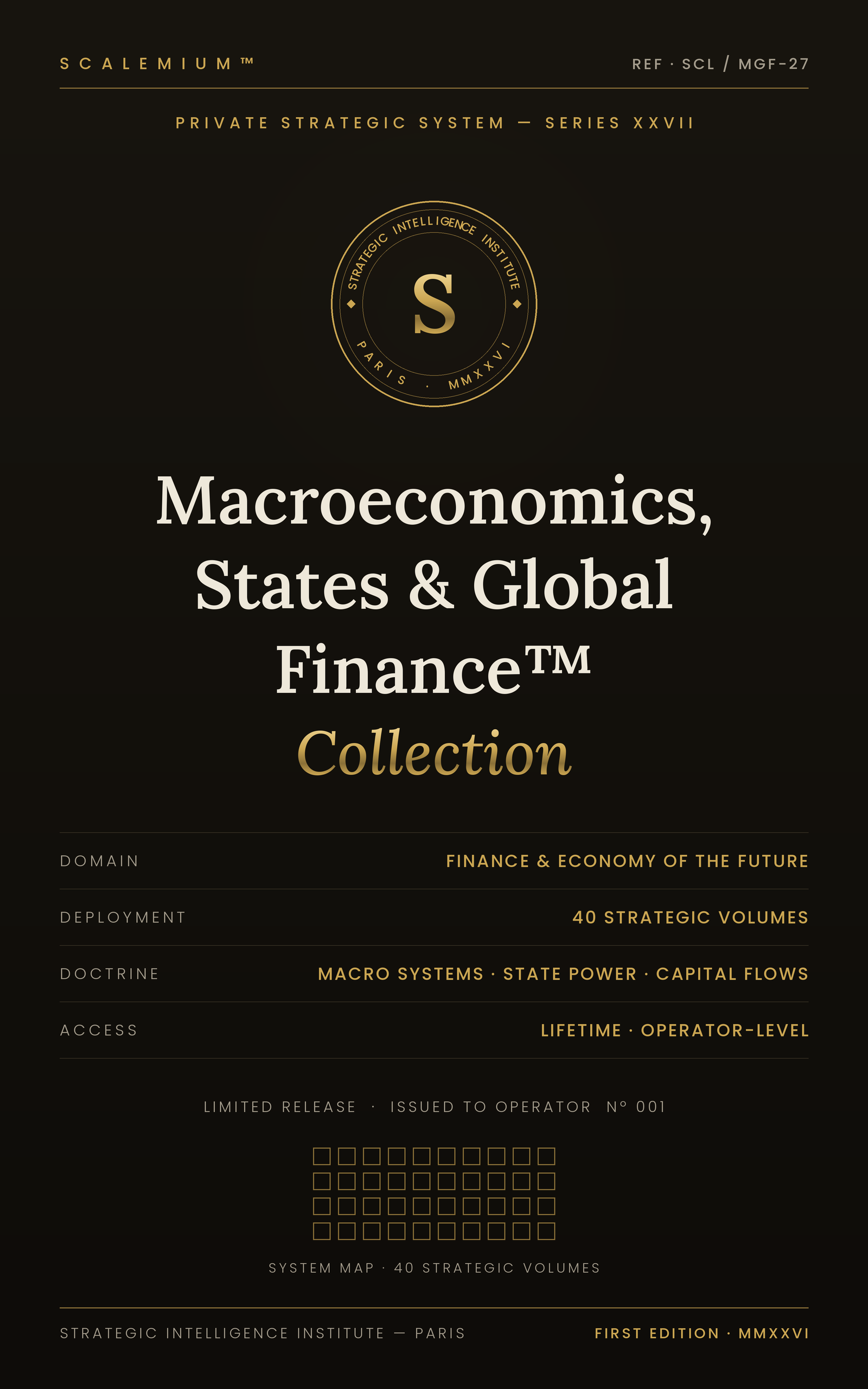
€ 6997
The international monetary system is destabilizing.
For approximately eight decades following the construction of the Bretton Woods framework in 1944, the international monetary system operated through architecture that, while undergoing substantial revisions across the period, maintained foundational structural continuity. The United States dollar functioned as primary reserve currency. American institutional infrastructure underpinned the global financial order. Central banking operated through frameworks developed and refined across the post-war decades. Sovereign debt operated within structural assumptions that, while regularly tested by specific crises, maintained foundational continuity. Capital flows operated across an increasingly integrated global financial system whose institutional architecture, while contested, persisted across decades.
This eight-decade structural arrangement is now entering substantial restructuring.
Not gradually. Not theoretically. Structurally — through the simultaneous operation of foundational developments whose interactions produce the most consequential monetary and sovereign-financial restructuring since the construction of the post-war order. Sovereign debt across major economies has reached levels whose sustainability under traditional monetary frameworks operates as substantial open question. Central banking has expanded its operational scope through unconventional monetary policy whose long-term consequences remain inadequately understood. The dollar’s reserve currency status, while persisting, faces structural challenges that the post-war architecture was not designed to address. Sanctions deployment as economic warfare has accelerated the search for alternative monetary infrastructure across multiple major economies. Digital currency architecture — central bank digital currencies, private digital currencies, the broader digital monetary infrastructure — is restructuring foundational assumptions about monetary operation. Capital flows are restructuring under geopolitical pressures unprecedented in the post-Cold War period.
The strategic implications extend across every dimension of substantial financial operation.
Investment principals operating across jurisdictions navigate monetary environments whose structural conditions differ substantially from those operating during recent decades. The assumptions underlying multi-jurisdictional capital deployment — dollar dominance, central bank cooperation, sovereign debt sustainability, free capital movement — require systematic re-examination under emerging conditions. The strategic positioning of capital across jurisdictions has consequences operating across timescales no individual cycle can fully reveal.
Family office principals navigating multi-jurisdictional positioning operate within international monetary environments whose dynamics affect every dimension of multi-generational planning. Currency exposure, sovereign jurisdiction risk, inflation dynamics across jurisdictions, and the broader monetary infrastructure within which family architecture operates all require systematic engagement under restructured conditions.
Corporate leadership of multinational operations navigates monetary environments substantially more complex than those operating during the period of relative monetary stability. The financial operation of multinational corporations involves substantial exposure to monetary dynamics whose strategic implications affect every dimension of corporate positioning.
Sovereign operators engaging directly with monetary and financial policy operate within international frameworks whose architecture is itself under reconstruction through the very decisions sovereign operators are making. The monetary frameworks emerging from the coming decades will determine substantially how international finance operates across periods substantially longer than any current operator will personally engage.
Most operators encounter macroeconomic and sovereign-financial dynamics through inadequate registers.
They engage these dynamics through popular financial commentary that addresses surface manifestations rather than structural mechanics. They consume central bank communications whose substantive content requires interpretive infrastructure most operators do not possess. They engage sovereign debt and currency dynamics through frameworks calibrated to the relatively stable post-war period that no longer fully applies. They navigate sanctions environments through reactive engagement with specific developments rather than through systematic intelligence on the structural dynamics affecting sanctions operation across jurisdictions. The result is fragmentary engagement with macroeconomic and sovereign-financial dynamics that operate as integrated phenomena requiring integrated strategic intelligence.
The strategic operators of significance who engage macroeconomic and sovereign-financial dynamics systematically operate with substantial advantages.
They understand the structural mechanics of the monetary restructuring underway rather than engaging discrete monetary events. They recognize sovereign debt dynamics as patterns observable across centuries of financial history rather than as novel developments requiring novel frameworks. They engage central bank operation through analytical infrastructure adequate to actual central bank mechanics rather than through reactive consumption of central bank communications. They navigate capital flow restructuring through frameworks calibrated to emerging conditions rather than through assumptions about continuity that contemporary developments do not support.
The questions emerging are foundational.
How will the international monetary system actually restructure across the coming decades? What is the substantive significance of the dollar’s evolving reserve currency status, and what implications follow for operators with substantial dollar exposure or with positioning affected by dollar dynamics? How should operators engage sovereign debt dynamics across major economies whose debt levels operate at unprecedented post-war scales? What is the strategic significance of digital currency infrastructure — central bank digital currencies, the broader digital monetary architecture — for multi-jurisdictional financial operation? How will inflation dynamics actually operate across the coming decades under conditions substantially different from the post-WWII period of relative price stability? How should strategic operators position themselves within monetary environments characterized by accelerating change, structural restructuring, and the broader sovereign-financial dynamics that require frameworks calibrated to actual emerging conditions?
These questions are not adequately engaged through popular financial commentary, ideologically-positioned analysis, or fragmentary engagement with specific developments. They require integrated structural intelligence on macroeconomics, sovereign finance, and global financial dynamics as integrated phenomena.
This collection addresses that intelligence.
Macroeconomics, States & Global Finance operates as comprehensive institutional intelligence on the macroeconomic and sovereign-financial dimensions of the international order. The collection extends across 40 volumes covering the architectural dimensions of contemporary macroeconomics — from the global financial system through monetary power dynamics, from sovereign debt and currency war dynamics through the structural fragility of the global economy, from inflation and sanctions through the foundational restructuring of the international monetary order across the coming decades.
The collection addresses the foundational dimensions of macroeconomics, sovereign finance, and global financial dynamics across institutional, monetary, and geopolitical horizons.
The collection articulates the global financial system as integrated structural phenomenon — how money actually moves between nations, what institutional infrastructure supports international financial operation, why specific arrangements persist while others restructure. Strategic operators receive structural recognition of global finance distinguished from popular commentary addressing surface manifestations.
The collection addresses central banking as integrated power phenomenon. Central banks operate as substantial power infrastructure whose mechanics traditional analyses inadequately address. The structural reality of central bank operation — what central banks actually do, how their decisions affect strategic positioning across multiple dimensions, what their evolving role across the coming decades implies — operates as foundational consideration for operators navigating economic environments shaped by monetary policy.
The collection articulates the structural reality of contemporary debt-based economic operation. Major economies operate through debt levels substantially exceeding traditional sustainability frameworks. The strategic implications of debt accumulation at scale affect monetary policy, sovereign positioning, capital flow dynamics, and broader economic operation across timescales operators must engage strategically.
The collection addresses currency dynamics as integrated geopolitical phenomenon. Currency operates as both economic instrument and geopolitical weapon. The strategic implications of currency competition, currency manipulation, and the broader integration of monetary and geopolitical dynamics affect operations across multi-jurisdictional contexts.
The collection articulates the structural dynamics affecting reserve currency arrangements. The dollar’s reserve currency status, while persisting, operates under structural pressures unprecedented in the post-WWII period. The strategic implications of reserve currency restructuring affect capital allocation, sovereign positioning, and broader strategic operation across substantial timescales.
The collection addresses global capital flows as integrated structural phenomenon. Capital flows produce winners and losers through structural mechanics that traditional analyses inadequately address. The strategic implications of capital flow dynamics affect investment positioning, sovereign strategy, and broader institutional operation.
The collection articulates the sovereign balance sheet as analytical frame. Nations operate as financial entities whose balance sheet dynamics — assets, liabilities, contingent obligations, off-balance-sheet considerations — produce strategic implications affecting every dimension of sovereign-adjacent operation.
The collection addresses inflation as integrated economic and political phenomenon. Inflation operates as both monetary tool and hidden taxation mechanism. The structural mechanics of contemporary inflation, the political economy of inflation policy, and the strategic implications of inflation dynamics across jurisdictions affect operations across multiple dimensions.
The collection articulates the structural reality of sanctions as geopolitical economic weapon. Sanctions deployment has accelerated substantially across recent years and produces strategic implications affecting multi-jurisdictional operations across investment, corporate, and family office contexts.
The collection addresses systemic risk as integrated structural phenomenon. The global economy operates with structural fragility whose mechanics traditional risk analyses inadequately address. The strategic implications of systemic fragility affect risk management, portfolio construction, and broader strategic positioning.
The collection articulates the structural dynamics of monetary reset. Monetary systems do not persist indefinitely — they undergo periodic reset through structural mechanics observable across centuries of financial history. The strategic implications of potential monetary reset across the coming decades operate as foundational consideration.
The collection addresses global liquidity cycles as integrated structural phenomenon. Liquidity operates cyclically, producing boom and bust dynamics whose mechanics affect operations across multiple dimensions. The strategic operators of significance engage liquidity cycles as integrated phenomena rather than as discrete events.
The collection articulates the structural transformation through which finance has come to dominate production across major economies. The implications of financialization affect strategic positioning across investment, corporate, and broader institutional contexts.
The collection addresses the structural restructuring of global commerce through trade conflicts, financial nationalism, and the broader political restructuring of cross-border economic operation. The strategic implications affect multinational positioning across every dimension.
The collection articulates the structural emergence of digital currency infrastructure. Central bank digital currencies, the broader digital monetary architecture, and the implications for state monetary control produce strategic implications affecting operations across multi-jurisdictional contexts.
The collection addresses sovereign default as integrated structural phenomenon. The conditions producing sovereign default, the patterns observable across historical defaults, and the strategic implications for operators with sovereign-adjacent positioning operate as foundational considerations.
The collection articulates the structural mechanics of financial contagion. Crises spread through identifiable channels whose dynamics affect risk management and strategic positioning. The collection addresses these mechanics as institutional intelligence supporting actual operation rather than as historical observation.
The collection addresses demographic transition as foundational macroeconomic dynamic. Aging populations, demographic decline across major economies, and the broader demographic restructuring affect monetary policy, sovereign positioning, capital flow dynamics, and strategic operation across multiple dimensions.
The collection articulates climate finance as integrated strategic dimension. Capital allocation for energy transition, climate adaptation infrastructure, and the broader climate-financial dynamics affect operations across multi-jurisdictional contexts.
The collection addresses the political dimensions of monetary policy. Monetary policy decisions produce political winners and losers through structural mechanics that traditional monetary analysis inadequately addresses. The political economy of monetary policy operates as foundational consideration for strategic positioning.
The collection articulates financial stability engineering as integrated discipline. Operators with substantial exposure to financial stability concerns — virtually all strategic operators — benefit from systematic intelligence on the mechanics through which financial stability is constructed and maintained.
The collection addresses the emerging monetary order that will operate beyond the current restructuring. The frameworks calibrated to the post-WWII order may operate differently under emerging conditions. The strategic operators of significance require intelligence on the order that emerges from the current transition.
The collection articulates the structural implications of AI for macroeconomic policy. AI systems are restructuring the operational tempo of financial markets, the analytical capabilities of central banks, and the broader macroeconomic infrastructure within which policy operates.
The collection operates across 40 volumes structured through four monetary domains — each addressing a foundational dimension of macroeconomics, sovereign finance, and global financial operation.
The opening domain establishes the foundational architecture of global finance — the system through which money moves between nations, monetary power dynamics, the debt economy, currency competition, and the structural fragility of the global financial order.
Volume 1 — The Global Financial System: How Money Moves Between Nations
Volume 2 — Monetary Power: Central Banks and Control
Volume 3 — The Debt Economy: Growth Fueled by Borrowing
Volume 4 — The Currency Wars: Money as a Geopolitical Weapon
Volume 5 — The End of Dollar Dominance? Reserve Currencies in Transition
Volume 6 — Global Capital Flows: Winners and Losers
Volume 7 — The Sovereign Balance Sheet: Nations as Financial Entities
Volume 8 — Inflation Explained: Hidden Tax or Necessary Tool?
Volume 9 — The Economics of Sanctions: Financial Pressure as Power
Volume 10 — The Fragile Global Economy: Systemic Risk at Scale
The second domain addresses the structural mechanics of monetary reset, central bank strategic operation, global liquidity cycles, financialization dynamics, and the structural framework for engaging contemporary financial crises.
Volume 11 — The Monetary Reset: When Systems Reboot
Volume 12 — Central Bank Strategy: Stability vs Growth
Volume 13 — Global Liquidity Cycles: Booms and Busts Explained
Volume 14 — The Financialization of Economies: When Finance Dominates Production
Volume 15 — The Global Debt Trap: Risks of Leverage at Scale
Volume 16 — The Economics of Trade Wars: Tariffs, Power, Consequences
Volume 17 — The Rise of Financial Nationalism: Capital Under Borders
Volume 18 — The Future of Money: Digital Currencies and State Control
Volume 19 — Macroeconomic Fragility: Why Crises Are Inevitable
Volume 20 — The New Bretton Woods: Rebuilding Global Finance
The third domain addresses economic shock management, the political economy of growth, global inequality dynamics, the end of cheap money, sovereign default mechanics, and the structural conditions producing financial contagion.
Volume 21 — Economic Shock Management: Policy Under Crisis
Volume 22 — The Political Economy of Growth: Power Shapes Markets
Volume 23 — Global Inequality Dynamics: Wealth Between Nations
Volume 24 — The End of Cheap Money: Adjusting to New Realities
Volume 25 — The Sovereign Default Playbook: When Nations Can’t Pay
Volume 26 — Financial Contagion: How Crises Spread
Volume 27 — The Economics of Demographics: Aging, Growth, Decline
Volume 28 — Global Financial Governance: Who Sets the Rules
Volume 29 — The Shadow Banking System: Finance Outside Regulation
Volume 30 — The Monetary Future: Trust After Fiat
The closing domain addresses climate finance, the global risk economy, the politics of inflation, financial stability engineering, and the structural dimensions of the new monetary order emerging from current restructuring.
Volume 31 — The Economics of Climate Finance: Capital for Transition
Volume 32 — The Global Risk Economy: Pricing Uncertainty
Volume 33 — The Politics of Inflation: Winners and Losers
Volume 34 — Financial Stability Engineering: Preventing Collapse
Volume 35 — The New Monetary Order: Power After the Reset
Volume 36 — The Global Capital Hierarchy: Who Gets Funded First
Volume 37 — The Fragility of Growth Models: When Assumptions Break
Volume 38 — Macroeconomics in the AI Era: Policy at Machine Speed
Volume 39 — The End of Monetary Illusions: Facing Reality
Volume 40 — Global Economic Strategy: Competing for Capital
The collection delivers institutional intelligence value across the structural dimensions of macroeconomics, sovereign finance, and global financial operation.
Operators receive structural intelligence on the monetary restructuring underway. The intelligence enables strategic operation calibrated to actual emerging monetary conditions rather than to assumptions about continuity that contemporary developments do not support.
The collection provides frameworks for engaging central banking as integrated power phenomenon. Operators with positioning substantially affected by central bank operation — investment principals, multinational corporate leadership, family office principals — receive analytical infrastructure calibrated to actual central bank mechanics.
The collection provides intelligence on sovereign debt and currency dynamics. Operators with multi-jurisdictional positioning, sovereign-adjacent investment, or substantial exposure to sovereign-financial dynamics receive frameworks calibrated to actual emerging conditions.
The collection provides analytical capacity for engaging global capital flows. Operators positioning capital across jurisdictions receive intelligence on the structural mechanics affecting capital flow dynamics across the coming decades.
The collection provides intelligence on contemporary sanctions deployment and the broader weaponization of financial infrastructure. Operators with multi-jurisdictional exposure receive frameworks for engaging this strategic dimension systematically.
The collection provides analytical frameworks for engaging inflation as integrated economic and political phenomenon. Operators with substantial exposure to inflation dynamics — virtually all strategic operators — receive frameworks calibrated to actual inflation mechanics.
The collection provides analytical capacity for engaging financial crises and contagion dynamics. The structural patterns governing crisis development and transmission affect risk management and strategic positioning across institutional contexts.
The collection provides intelligence on the emerging digital monetary infrastructure. Operators with positioning affected by central bank digital currencies, the broader digital monetary architecture, and the implications for state monetary control receive frameworks calibrated to these emerging dynamics.
The collection provides intelligence on climate finance and energy transition capital allocation. Operators with substantial exposure to climate-financial dynamics — increasingly all major institutional operators — receive frameworks for engaging this strategic dimension.
The collection provides frameworks for the new monetary order emerging from current restructuring. Operators positioning strategically for the order that emerges from the current transition receive intelligence supporting strategic positioning calibrated to actual emerging conditions.
The collection operates as reserved infrastructure for operators whose strategic positioning involves substantial macroeconomic and sovereign-financial dimensions.
Investment principals whose strategic positioning involves substantial exposure to macroeconomic, monetary, and sovereign-financial dynamics — particularly principals with multi-jurisdictional capital deployment, exposure to sovereign-adjacent investments, and positioning in geopolitically-sensitive financial sectors.
Family office principals navigating multi-jurisdictional, multi-generational positioning under conditions where the macroeconomic and sovereign-financial environments substantially affect dynastic architecture across timescales no individual position can fully oversee.
Senior corporate leadership of multinational operations whose strategic positioning involves substantial macroeconomic and monetary considerations. The financial operation of multinational corporations involves substantial exposure to monetary dynamics whose strategic implications affect every dimension of corporate operation.
Senior governmental operators, sovereign principals, central bank operators, and senior monetary policy architects engaged directly with monetary and financial policy at sovereign scales.
Senior leadership of major financial institutions — global banks, asset managers, insurance companies — whose strategic operation involves substantial exposure to macroeconomic and sovereign-financial dynamics.
Senior operators in strategic intelligence functions, macroeconomic analysis, and institutional risk management whose work requires institutional-grade synthesis of macroeconomic dynamics as foundational professional infrastructure.
Senior operators in energy sectors, climate finance, critical materials, and energy transition domains whose strategic positioning involves substantial macroeconomic considerations operating as foundational dimensions of contemporary operation.
Academic researchers in macroeconomics, international finance, monetary economics, and adjacent fields whose work requires institutional-grade synthesis of contemporary macroeconomic dynamics as foundational research infrastructure.
The collection does not operate as popular macroeconomic commentary, ideologically-positioned analysis of monetary policy, or general-audience content on global finance. The reserved positioning operates through strategic standards rather than through commercial accessibility.
Access: €6,997
Access operates through institutional channels. The collection delivers across the 40 volumes with continuing institutional support for operators integrating the intelligence into their strategic and institutional infrastructure.
Reserved for operators recognizing that contemporary macroeconomics and sovereign finance operate as foundational strategic dimensions across investment, institutional, dynastic, and civilizational horizons. Not all applications warrant access.
→ Access This Collection — €6,997
Submit access request for institutional review.
→ Multi-Collection Institutional Access
For operators considering institutional access across the complete Finance & Economy of the Future edition or across the broader Strategic Intelligence library.
→ Private Advisory
For operators whose strategic situations warrant direct engagement at substantial depth.
Full access, delivered instantly upon acquisition.
For operators acquiring several collections within the Strategic Intelligence library. Submit your selection — we structure a single institutional access, priced accordingly.
For operators whose strategic situation warrants direct counsel at substantial depth.
SCALEMIUM™
Collections → Finance & Economy of the Future → Volume 4
people focused only on local thinking
people relying only on news
people avoiding complexity
This is not economics education.
This is:
 understanding the system behind the system
If you understand macroeconomics:
you see trends early
you avoid major risks
you position strategically
That’s global awareness.
Most people react to markets.
Very few understand what moves them.
This collection gives you:
a clear view of the global economic system
We use cookies to ensure the site functions properly, understand how it is used, and improve your experience. You can accept, reject, or manage your preferences at any time.