
|
SCALEMIUM™ — Strategic systems for modern operators. |
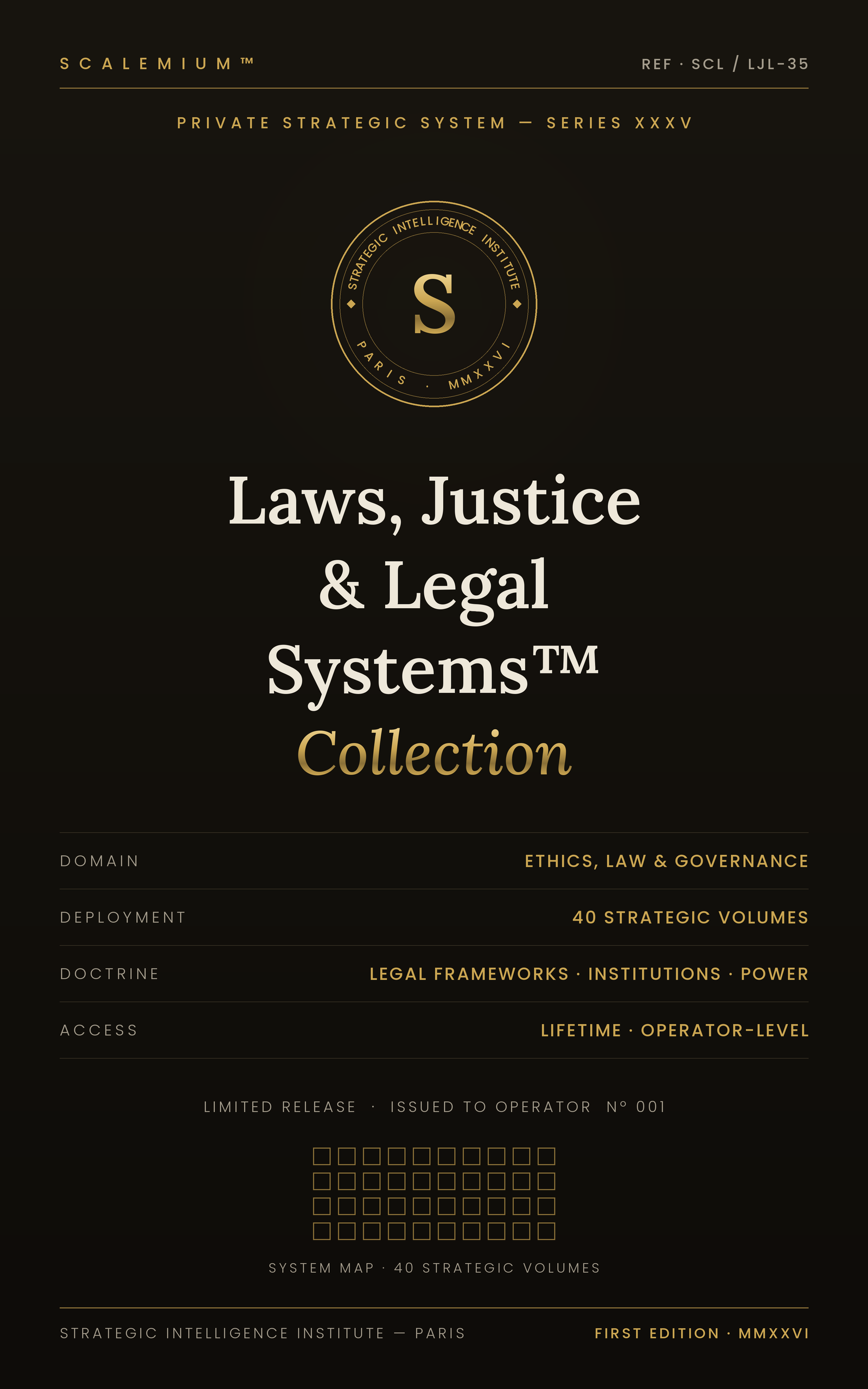
€ 6997
Law is the most underestimated form of power.
For the strategic operators of significance, this underestimation produces some of the most consequential strategic errors observable across institutional contexts. The operators who would never underestimate the power of capital, who attend carefully to political dynamics, who track technological developments with substantial sophistication, frequently engage law as background infrastructure rather than as foundational strategic terrain. They treat legal frameworks as constraints to be navigated rather than as the actual operational substrate within which their entire strategic operation occurs. They retain sophisticated legal counsel for specific transactions while remaining strategically illiterate about the legal systems whose operational reality shapes every dimension of their institutional positioning.
This is a structural error.
Law is not background. Law is the operational infrastructure through which all sustained institutional activity occurs. Capital allocation operates within legal frameworks that determine what investment structures are possible, how returns can be captured, what regulatory environments apply, and how cross-border positioning operates. Family architecture operates within legal frameworks that determine generational transfer mechanisms, family governance structures, and dynastic positioning across jurisdictions. Corporate operation operates within legal frameworks determining everything from organizational structure to liability allocation, from intellectual property to regulatory compliance. International strategy operates within legal frameworks whose complexity has expanded substantially across recent decades and whose continued expansion shapes strategic possibility across every domain.
The operators who understand this operate with substantial strategic advantage.
The operators who do not understand it operate within legal systems whose actual dynamics they engage primarily through reactive consultation with legal practitioners whose expertise is calibrated to specific transactional needs rather than to the structural intelligence required for strategic positioning. They make decisions whose legal implications they understand only partially. They construct institutional architectures whose legal vulnerabilities they recognize only after these vulnerabilities materialize as actual problems. They position themselves within regulatory environments whose trajectory they fail to anticipate. They engage legal systems as separate domain from strategic operation rather than as the structural foundation upon which all strategic operation rests.
The gap is becoming consequential.
The legal systems of the coming decades are entering periods of substantial transformation. Technological developments are producing categories of legal questions that traditional legal frameworks were not designed to address. The globalization of operational reality continues to outpace the development of international legal coordination, producing increasing complexity for operators with multi-jurisdictional positioning. The emergence of AI systems, autonomous entities, and hybrid technological-legal questions is destabilizing traditional categories of legal personhood, liability, and accountability. The acceleration of operational tempo is creating mismatches between the speed of strategic operation and the speed of legal development that produce strategic opportunities and risks of substantial consequence.
The strategic operators of significance recognize this transformation as one of the most consequential institutional developments of the era. The legal frameworks emerging across the coming decades will determine substantially how strategic operation occurs across investment, capital allocation, institutional positioning, dynastic planning, and every other domain whose operation depends on legal infrastructure.
Most operators encounter law fragmentarily — through specific transactions, particular regulatory questions, occasional litigation, the legal documents that accompany institutional operation. The strategic operators of significance recognize law as structural intelligence domain — operating with sophistication on legal mechanics produces strategic advantages that fragmentary legal engagement cannot match.
The questions emerging are foundational.
How do legal systems actually function — distinguished from how they formally describe themselves? What is the operational reality of justice as practiced rather than as theorized? How do the relationships between law, morality, and political power actually operate? What determines whether legal systems retain legitimacy or enter crisis? How do legal systems navigate the technological developments destabilizing traditional legal categories? What is the future of courts, adjudication, and traditional legal authority under conditions of AI integration, automated decision-making, and operational speeds that traditional legal frameworks cannot match? How should strategic operators position themselves within legal systems undergoing substantial transformation while remaining the operational substrate upon which their strategic positioning depends?
These questions are not adequately engaged through transactional legal consultation or through political-science analysis of regulatory systems. They require integrated structural intelligence on law as institutional reality.
This collection addresses that intelligence.
Law, Justice & Legal Systems operates as comprehensive institutional intelligence on the structural foundations of law. The collection extends across 40 volumes covering the architectural dimensions of legal systems — from the first principles of law through the operational reality of justice, from the architecture of legal authority through the transformation of law under technological and civilizational pressures, from comparative legal systems through the future of legal infrastructure across the coming decades.
The collection addresses the structural foundations of law and legal systems across multiple foundational dimensions.
The collection articulates the actual purpose of law as institutional phenomenon — distinguished from the various theoretical accounts that describe law in idealized terms. Law operates simultaneously as order-maintenance infrastructure, justice mechanism, and instrument of political power. The collection addresses these operational realities with the analytical depth their institutional consequences require.
The collection articulates the first principles operating across legal systems despite their substantial variation in form and content. These principles — the existence of rules, the establishment of authority to interpret rules, the construction of enforcement mechanisms, the legitimation of legal authority — operate with remarkable consistency across legal traditions and provide foundational analytical infrastructure for strategic engagement with legal systems generally.
The collection addresses law as system rather than as collection of rules. Legal systems operate through interconnected infrastructure — courts, codes, enforcement institutions, professional communities, legal cultures — whose interactions produce dynamics no individual component analysis can adequately address. The collection articulates these systemic dynamics.
The collection articulates justice as institutional reality — what justice actually means in operational practice within functioning legal systems, distinguished from justice as theoretical category in moral philosophy. The distinction has substantial strategic implications for operators whose positioning depends on legal outcomes.
The collection addresses the rule of law as foundational institutional commitment — the structural commitment to legal systems operating through general rules applied consistently rather than through arbitrary exercise of power by specific individuals. The strategic implications of operating within rule-of-law systems versus systems where formal legal frameworks mask arbitrary exercise of power are substantial.
The collection articulates the strategic significance of legal power — the power to write rules. The operators with substantial influence over rule-writing operate with strategic advantages that traditional analyses of power dynamics frequently underestimate. The collection addresses this dimension of power with the analytical depth its consequences warrant.
The collection addresses the architectural dimensions of justice — courts, codes, enforcement mechanisms, professional communities, dispute-resolution infrastructure. These architectures operate differently across legal traditions and produce substantially different operational characteristics that operators with multi-jurisdictional positioning must navigate strategically.
The collection articulates the structural relationship between law and morality. Legal systems and moral systems overlap substantially but are not identical. The conflicts between legal and moral considerations produce strategic situations of substantial complexity that the collection addresses analytically.
The collection addresses legal interpretation as foundational legal process. The meaning of legal rules emerges through interpretive processes whose dynamics determine substantially what those rules actually require in practice. The strategic implications of interpretive variability are significant for operators whose positioning depends on legal outcomes.
The collection articulates the structural challenge of legal enforcement — the gap between formal legal authority and actual operational power to enforce legal requirements. The gap operates differently across legal systems and produces strategic considerations operators with substantial international exposure must engage.
The collection addresses the structural challenges legal systems face under technological transformation — AI development, autonomous systems, algorithmic decision-making, digital infrastructure. Traditional legal categories destabilize under these developments. The collection articulates the structural dynamics and the strategic implications they produce.
The collection addresses comparative legal analysis as strategic intelligence. Operators with multi-jurisdictional positioning navigate substantially different legal systems whose comparative analysis provides strategic intelligence that single-system focus cannot deliver.
The collection addresses the structural future of courts and traditional adjudication. The pressures on traditional legal authority — from technological acceleration, from operational complexity, from emerging governance forms — produce structural questions about the future of legal infrastructure that operators positioning strategically for the coming decades must engage.
The collection articulates the structural destabilization of traditional legal categories under contemporary pressures — particularly the legal personhood category as it confronts AI systems, autonomous entities, and the broader transformation of the entities legal systems are asked to address.
The collection operates across 40 volumes structured through four legal foundations — each addressing a structural dimension of law, justice, and legal systems.
The opening foundation establishes the structural foundations of law — the purpose of law, the first principles operating across legal systems, the architecture of justice, and the relationship between law and the broader institutional infrastructure within which it operates.
Volume 1 — The Purpose of Law: Order, Justice, or Control?
Volume 2 — First Principles of Law: Why Rules Exist
Volume 3 — Law as a System: From Norms to Enforcement
Volume 4 — Justice Explained: Fairness Beyond Emotion
Volume 5 — The Rule of Law: Why Systems Matter More Than People
Volume 6 — Legal Power: Who Writes the Rules Wins
Volume 7 — The Architecture of Justice: Courts, Codes, and Authority
Volume 8 — Law and Legitimacy: When Rules Are Accepted
Volume 9 — The Limits of Legal Systems: When Law Breaks Down
Volume 10 — Law vs Morality: When Rules Conflict With Values
The second foundation addresses the operational dimensions of legal systems — interpretation, evidentiary standards, the legal response to crisis, the structural challenges of legal access and complexity.
Volume 11 — The Evolution of Justice: From Retribution to Rights
Volume 12 — Legal Interpretation: Meaning, Context, Power
Volume 13 — The Burden of Proof: Truth in Legal Systems
Volume 14 — Law in Times of Crisis: Emergency Powers and Abuse
Volume 15 — The Justice Gap: Access, Inequality, Outcomes
Volume 16 — The Legal Fiction: How Law Simplifies Reality
Volume 17 — The Enforcement Problem: Rules Without Power
Volume 18 — The Legitimacy Crisis: When People Stop Believing in Law
Volume 19 — Law and Technology: Speed vs Stability
Volume 20 — The Globalization of Law: Rules Across Borders
The third foundation addresses the structural pressures on legal systems — complexity, the relationship between law and power, the future of legal infrastructure, and the legal stack from constitution through enforcement.
Volume 21 — Legal Complexity: When Too Many Rules Fail
Volume 22 — The Law of Power: Why the Strong Shape Justice
Volume 23 — The Future of Courts: Automation, AI, and Adjudication
Volume 24 — The End of Legal Certainty: Law in a Fast-Changing World
Volume 25 — Rights and Responsibilities: Two Sides of Justice
Volume 26 — The Legal Stack: Constitution, Statutes, Enforcement
Volume 27 — Law as Governance: Control Through Rules
Volume 28 — The Justice Paradox: Fair Systems, Unfair Outcomes
Volume 29 — Legal Systems Under Stress: Collapse and Reform
Volume 30 — The Law of the Future: Rules for New Realities
The closing foundation addresses comparative legal analysis, the structural destabilization of traditional legal categories, and the future of legal order across the coming decades — including the emerging questions of legal personhood, AI rights, and global legal coordination.
Volume 31 — Comparative Legal Systems: Different Paths to Order
Volume 32 — The Rights Framework: Defining Human Protection
Volume 33 — Law and Social Change: Who Leads Whom?
Volume 34 — The Legal Responsibility Problem: Blame in Complex Systems
Volume 35 — Law Beyond Humans: Rights for AI and Nature?
Volume 36 — The Legal Status of Intelligence: Personhood Reconsidered
Volume 37 — The End of Traditional Liability: Responsibility in Automated Worlds
Volume 38 — Justice at Scale: Law for Billions
Volume 39 — The Global Legal Order: Fragmentation or Unity?
Volume 40 — The Rulebook of Civilization: Law as Collective Agreement
The collection delivers institutional intelligence value across the structural dimensions of law and legal systems.
Operators receive structural understanding of legal systems — the operational reality of how legal infrastructure functions, distinguished from the theoretical and idealized accounts that dominate popular legal discourse. The understanding enables strategic operation calibrated to actual legal conditions.
The collection provides legal-system literacy as foundational strategic capacity. Operators whose positioning depends on legal infrastructure benefit from systematic understanding of that infrastructure rather than from reliance solely on transactional legal counsel whose expertise is calibrated to specific needs rather than to strategic intelligence.
The collection provides comparative legal intelligence for operators with multi-jurisdictional positioning. The differences between legal systems produce substantial strategic implications that single-system focus cannot adequately address.
The collection provides frameworks for engaging the substantial legal transformation underway. Operators positioning strategically for the coming decades benefit from intelligence on the transformation trajectory rather than from reactive engagement with legal developments as they emerge.
The collection provides intelligence on the strategic dimensions of legal power. Operators with substantial influence on rule-writing — through regulatory engagement, institutional positioning, political relationships, or strategic philanthropy — receive frameworks for engaging this dimension of power systematically.
The collection provides frameworks for navigating legal complexity and uncertainty. The contemporary legal landscape involves substantial complexity and uncertainty that traditional legal analysis often understates. Operators receive analytical infrastructure calibrated to actual legal conditions.
The collection provides intelligence on the future of law and legal infrastructure. The structural transformations underway will produce legal environments substantially different from current conditions. Operators positioning for these environments benefit from intelligence on the transformation trajectory.
The collection supports strategic positioning within the emerging legal categories produced by technological and civilizational developments. Operators engaged with AI systems, autonomous entities, hybrid technological-legal questions, or other emerging legal terrain receive intelligence calibrated to these emerging dimensions.
The collection operates as reserved infrastructure for operators whose strategic positioning depends on legal infrastructure.
Investment principals whose strategic operation occurs within legal frameworks shaping every dimension of capital allocation, investment structure, return capture, and cross-border positioning. The depth of legal-system understanding shapes strategic positioning across investment domains.
Family office principals navigating multi-generational positioning across legal jurisdictions whose differences and trajectories shape the dynastic architecture their planning must accommodate. The legal infrastructure of multi-generational planning involves substantial complexity that benefits from systematic engagement.
Senior legal practitioners — partners at major law firms, in-house general counsel, sophisticated legal professionals — whose strategic engagement with law benefits from institutional-grade intelligence on legal systems beyond what specialized legal expertise alone provides.
Senior corporate leadership of organizations operating across multiple legal systems. The strategic positioning of multinational corporations involves substantial legal complexity that benefits from systematic intelligence on the legal landscapes within which operation occurs.
Senior governmental operators, regulatory architects, and political principals engaged with legal-system construction. The collection provides institutional-grade intelligence on the structural dimensions of legal infrastructure these positions involve.
Senior institutional principals — financial services leadership, technology institution leaders, healthcare principals, regulated industry executives — whose strategic operation occurs within substantial regulatory environments shaped by legal infrastructure.
Academic legal scholars, jurisprudence researchers, and intellectual operators whose work requires institutional-grade synthesis of legal systems as foundational research infrastructure.
Senior leadership of AI organizations, technology platforms, and digital infrastructure institutions whose operations increasingly involve emerging legal questions of substantial consequence. The intersection of these institutions with legal infrastructure produces strategic considerations of substantial depth.
The collection does not operate as introductory legal commentary, popular jurisprudence, or general-audience analysis of legal systems. The reserved positioning operates through strategic standards rather than through commercial accessibility.
This collection completes the Ethics, Law & Governance edition. The edition extends across five collections:
— Ethics, Law & AI Governance — the governance of artificial intelligence
— Foundations of Ethics & Moral Systems — the canonical foundation of moral philosophy
— Future Ethics & Civilization-Scale Governance — ethics and governance at civilizational scale
— Governance, Institutions & Power — the mechanics of governance and institutional power
— Law, Justice & Legal Systems — the structural foundations of law (this collection)
Each collection operates independently as comprehensive intelligence on its specific domain. The five collections together provide integrated intelligence on the institutional infrastructure within which strategic operation occurs across ethical, governance, political, and legal dimensions.
Operators considering systematic engagement with the Ethics, Law & Governance library benefit from access across multiple collections. Multi-collection institutional access addresses operators planning systematic engagement across the full edition or across the broader Strategic Intelligence library.
Access: €6,997
Access operates through institutional channels. The collection delivers across the 40 volumes with continuing institutional support for operators integrating the intelligence into their strategic and institutional infrastructure.
Reserved for operators recognizing that legal systems operate as foundational strategic dimension across institutional, jurisdictional, and civilizational horizons. Not all applications warrant access.
→ Access This Collection — €6,997
Submit access request for institutional review.
→ Multi-Collection Institutional Access
For operators considering institutional access across the complete Ethics, Law & Governance edition (five collections) or across the broader Strategic Intelligence library.
→ Private Advisory
For operators whose strategic situations warrant direct engagement at substantial depth.
Full access, delivered instantly upon acquisition.
For operators acquiring several collections within the Strategic Intelligence library. Submit your selection — we structure a single institutional access, priced accordingly.
For operators whose strategic situation warrants direct counsel at substantial depth.
SCALEMIUM™
Collections → Ethics, Law & Governance → Volume 5
This is not legal advice.
This is:
 understanding how law structures reality
If you understand law:
you understand systems
you understand constraints
you understand power
That’s structural awareness.
Most people follow rules without understanding them.
Very few understand how rules are created and used.
This collection gives you:
clarity on how legal systems shape power and decisions
We use cookies to ensure the site functions properly, understand how it is used, and improve your experience. You can accept, reject, or manage your preferences at any time.