
|
SCALEMIUM™ — Strategic systems for modern operators. |
€ 6997
The most consequential battles of the 21st century are not being fought on physical terrain.
They are being fought across the cognitive infrastructure of contemporary civilization — across the attention economies of platform companies, across the narrative architectures of media institutions, across the algorithmic systems that determine what billions of people see, read, believe, and decide. The strategic operators who understand this — institutional principals shaping public perception, political operators contesting elections, corporations defending reputation, geopolitical actors competing for legitimacy, and the increasingly sophisticated apparatus dedicated specifically to influence operations — operate within environments whose structural mechanics most strategic operators engage primarily through intuition and inherited assumptions calibrated to substantially earlier informational conditions.
The cognitive battlefield is operational.
This is not metaphor. The same techniques traditionally associated with military psychological operations now operate continuously across commercial, political, institutional, and geopolitical contexts. The same algorithmic infrastructure that delivers consumer advertising delivers political influence campaigns. The same narrative engineering that produces successful marketing produces successful political movements. The same attention-capture mechanics that drive platform engagement drive radicalization, polarization, and the broader restructuring of public discourse. The boundaries that previously separated commercial persuasion from political influence, advertising from propaganda, journalism from advocacy, and information from informational warfare have largely dissolved into integrated infrastructure operating across formerly distinct domains.
The strategic implications are foundational and uneven.
The operators who understand the structural mechanics of contemporary influence operate with substantial advantages. They shape public perception of their institutions, their decisions, their sectors, and increasingly the political and regulatory environments within which their operation occurs. They construct narrative architectures that protect their strategic positioning from challenges that operators without comparable narrative infrastructure cannot resist. They engage the informational dimensions of their strategic environment as active terrain rather than as background condition. The operators who lack this understanding operate primarily as objects of influence rather than as influence operators — subject to narratives shaped by others, exposed to perception management whose mechanics they cannot identify, vulnerable to influence operations whose existence they may not recognize.
Most strategic operators encounter influence fragmentarily.
They retain communications consultants for specific situations. They engage public relations firms for particular campaigns. They consume media commentary about influence developments without recognizing that the commentary itself operates as influence within the systems it describes. They participate in the contemporary informational environment as users rather than as sophisticated operators with structural understanding of how that environment actually functions. The gap between the influence sophistication of dedicated influence operators and the influence sophistication of most strategic operators continues to widen, with substantial consequences for relative strategic positioning.
The strategic operators of significance recognize this gap as one of the most consequential strategic considerations of the era. The operators who close it — by developing canonical understanding of contemporary influence infrastructure, by engaging influence as integrated strategic dimension rather than as occasional tactical concern, by constructing narrative infrastructure aligned with their strategic positioning — operate with advantages that fragmentary engagement with influence cannot match.
The questions emerging are foundational.
How does contemporary influence actually operate — distinguished from how it is theoretically described in communication theory or popularly described in media commentary? What is the structural relationship between attention, narrative, perception, and behavior? How do contemporary platforms function as influence infrastructure, and how does this function shape the operational environment within which strategic positioning occurs? What is the actual significance of narrative as strategic asset — and what determines whether narrative infrastructure protects or fails to protect strategic positioning? How does soft power actually operate at institutional and geopolitical scales? What is the strategic significance of the cognitive dimensions of contemporary competition, and how should operators position themselves within cognitive battlefields whose existence traditional strategic frameworks do not adequately acknowledge?
Beyond these structural questions lies a deeper strategic recognition: in environments where attention is contested, narratives compete, perceptions are constructed, and trust is engineered, the operators who engage these dimensions sophisticatedly position themselves with substantial advantages. The operators who do not — regardless of the substance underlying their positioning — operate at substantial disadvantage relative to operators with comparable substance and superior influence infrastructure.
This collection addresses that recognition.
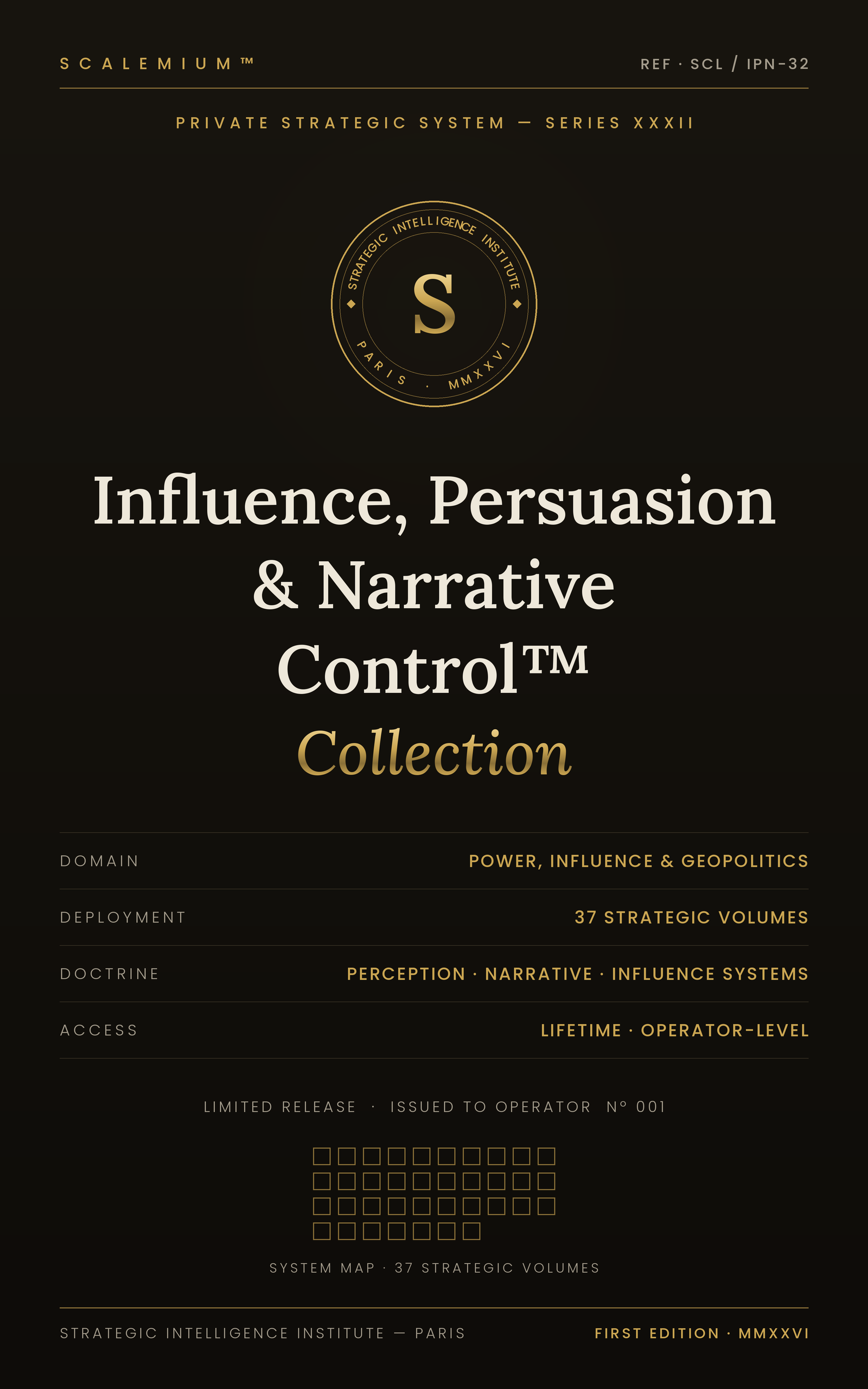
Influence, Persuasion & Narrative Control operates as comprehensive institutional intelligence on the architecture of contemporary influence. The collection extends across 40 volumes covering the architectural dimensions of influence operation — from the structural mechanics of persuasion through the operation of narrative power at civilization scale, from the architecture of attention infrastructure through the algorithmic mechanics of platform-based influence, from the psychology of mass influence through the strategic implications of operating in post-truth informational environments.
The collection addresses the foundational dimensions of influence and persuasion across institutional, commercial, political, and geopolitical horizons.
The collection articulates how contemporary influence actually operates — distinguished from theoretical communication models and from popular media commentary. The actual mechanics involve integrated infrastructure operating across cognitive, technological, narrative, and institutional dimensions whose interaction produces the influence dynamics strategic operators navigate.
The collection addresses the structural significance of narrative as strategic asset. Narratives shape what is considered possible, legitimate, desirable, threatening, normal, exceptional. The operators who construct narrative infrastructure aligned with their strategic positioning operate with substantial advantages relative to operators whose strategic positioning remains narratively unprotected.
The collection articulates the structural reality that what people perceive — what they consider true, important, threatening, normal — operates as substantially constructed phenomenon rather than as transparent reflection of external reality. The construction occurs through identifiable infrastructure that the collection addresses with appropriate analytical depth.
The collection addresses attention as foundational strategic resource. Contemporary informational environments operate as attention economies in which attention itself functions as scarcest resource whose distribution determines substantially what gets considered, what gets ignored, what becomes consequential, and what disappears from strategic relevance. The collection articulates the structural significance of attention with the depth its strategic implications require.
The collection addresses the structural infrastructure through which influence operates at mass scale — platform algorithms, media institutions, communication networks, narrative communities, and the broader architecture through which contemporary influence reaches populations exceeding any previous communication infrastructure’s capacity.
The collection articulates soft power as integrated strategic capability operating across institutional and geopolitical contexts. Soft power produces effects that coercive power cannot produce. The operators who develop sophisticated soft power infrastructure operate with strategic capabilities that hard power alone cannot replicate.
The collection addresses the structural mechanics through which consent is manufactured and agreement is engineered across populations larger than direct relationships can encompass. These mechanics operate across commercial, political, institutional, and geopolitical contexts with substantial consistency.
The collection articulates the structural continuity between historical propaganda systems and contemporary influence infrastructure. Many techniques associated specifically with twentieth-century propaganda now operate through commercial platforms whose ostensible purposes differ substantially from explicit propaganda. The structural continuity has substantial strategic implications.
The collection addresses the structural emergence of opinion as economic asset. Belief production, conviction maintenance, narrative reinforcement, and the broader monetization of belief operate as substantial industries whose strategic implications affect institutional, political, and geopolitical environments.
The collection articulates information dominance as integrated strategic capability — the capacity to shape what information reaches which populations, when, in what framing, and with what comparative emphasis. Information dominance operates as foundational dimension of contemporary competition.
The collection addresses the psychological dynamics of mass influence — the cognitive, emotional, and social mechanics through which populations respond to influence operations. These dynamics operate with substantial consistency across institutional and historical contexts.
The collection articulates the structural significance of memetic dynamics — how ideas propagate, mutate, and consolidate across populations through mechanisms that traditional influence theory inadequately addresses. The memetic dimensions of contemporary influence have substantial strategic implications.
The collection addresses the structural significance of algorithmic infrastructure as influence mechanism. Platform algorithms operating across major communication infrastructure exercise substantial influence over what billions of users see, engage with, and form beliefs about. The strategic implications affect every domain whose operation depends on public perception.
The collection articulates the structural emergence of competing reality systems across contemporary informational environments. The post-truth dynamics affecting contemporary discourse operate through identifiable mechanisms whose strategic implications affect institutional positioning across domains.
The collection addresses emotional control as integrated influence capability. Fear, hope, anger, indignation, pride — these and other affective states operate as strategic terrain across contemporary influence operations.
The collection articulates narrative sovereignty as foundational strategic concept. Operators whose strategic positioning depends on narratives shaped by others operate as objects of influence rather than as sovereign strategic actors. The construction of narrative sovereignty — owning the story that defines strategic positioning — operates as foundational strategic project.
The collection operates across 40 volumes structured through four influence registers — each addressing a foundational dimension of influence, persuasion, and narrative control.
The opening register establishes the structural architecture of contemporary influence — the mechanics of narrative power, the battle for perception, the strategic significance of attention, and the foundational infrastructure through which influence operates at scale.
Volume 1 — The Influence Machine: How Minds Are Shaped at Scale
Volume 2 — Narrative Power: Controlling Reality Through Story
Volume 3 — The Battle for Perception: Why Truth Is Not Enough
Volume 4 — Psychological Warfare: Influence Without Weapons
Volume 5 — The Attention Weapon: Controlling What People See and Ignore
Volume 6 — Manufacturing Consent: How Agreement Is Engineered
Volume 7 — Soft Power Mastery: Winning Without Coercion
Volume 8 — The Propaganda System: Old Tools, New Platforms
Volume 9 — Influence Architecture: Designing Persuasion Environments
Volume 10 — The Opinion Economy: Monetizing Belief
The second register addresses the operation of narrative across institutional and civilizational scales, the strategic significance of trust, and the integrated persuasion infrastructure through which contemporary influence operates.
Volume 11 — Narratives That Rule Nations: Stories That Shape History
Volume 12 — The Trust Battlefield: Credibility as Strategic Asset
Volume 13 — Information Dominance: Winning by Controlling Flows
Volume 14 — The Persuasion Stack: From Emotion to Action
Volume 15 — Influence Without Awareness: How Control Operates Invisibly
Volume 16 — Memetic Power: How Ideas Spread Like Viruses
Volume 17 — The Psychology of Mass Influence: Crowd-Level Persuasion
Volume 18 — Media Power Structures: Who Shapes the Narrative
Volume 19 — The Algorithmic Megaphone: Platforms as Power Multipliers
Volume 20 — The Reality Designers: Who Decides What Feels True
The third register addresses contemporary digital influence dynamics, the structural emergence of post-truth conditions, and the strategic infrastructure operating across emotional, cognitive, and informational dimensions.
Volume 21 — Influence in the Digital Age: Scale Without Presence
Volume 22 — Narrative Collapse: When Belief Systems Break
Volume 23 — The Post-Truth Mechanism: Competing Realities
Volume 24 — Emotional Control Systems: Fear, Hope, Anger as Tools
Volume 25 — The Influence Feedback Loop: Reinforcing Belief at Scale
Volume 26 — Strategic Messaging: Precision Persuasion for Power
Volume 27 — Psychological Operations Explained: Influence as Infrastructure
Volume 28 — The Cognitive Battlefield: Minds as Strategic Terrain
Volume 29 — The Trust Manipulation Problem: Engineering Credibility
Volume 30 — The Narrative Arms Race: Competing Stories for Control
The closing register addresses identity-based influence dynamics, the strategic significance of symbolic warfare, the structural power of platforms, and the foundational strategic project of narrative sovereignty.
Volume 31 — Influence and Identity: Persuasion Through Belonging
Volume 32 — Symbolic Warfare: Meaning as Weapon
Volume 33 — The Platform Power Effect: Who Benefits from Visibility
Volume 34 — Perception Management: Designing Public Reality
Volume 35 — Influence Without Truth: Power Beyond Facts
Volume 36 — The Story Advantage: Why Narratives Beat Data
Volume 37 — The Meme State: Governance Through Culture
Volume 38 — The Power of Repetition: Belief Through Exposure
Volume 39 — The End of Objective Reality: Competing Truth Systems
Volume 40 — Narrative Sovereignty: Owning the Story That Rules You
The collection delivers institutional intelligence value across the structural dimensions of influence and persuasion.
Operators receive structural understanding of how contemporary influence actually operates — intelligence calibrated to actual operational reality rather than to theoretical models or popular commentary. The understanding enables strategic operation calibrated to actual informational conditions.
The collection provides frameworks for constructing narrative infrastructure aligned with strategic positioning. Operators whose strategic effectiveness depends on public perception, institutional reputation, or political environment receive intelligence for systematic narrative construction rather than reactive narrative defense.
The collection provides intelligence on the structural operation of attention economies. Operators whose strategic positioning depends on capturing, sustaining, or directing attention — virtually all operators with public-facing strategic dimensions — receive analytical infrastructure calibrated to the actual dynamics of contemporary attention.
The collection provides perception management capability as integrated strategic skill rather than as occasional tactical concern. The operators who develop systematic perception management infrastructure operate with advantages that ad-hoc perception management cannot match.
The collection provides soft power frameworks calibrated to institutional and geopolitical operation. Soft power operates differently from hard power and produces strategic effects that hard power alone cannot produce. The collection articulates these dynamics with the depth their strategic implications require.
The collection provides intelligence on the operation of contemporary platform infrastructure as influence mechanism. Operators with substantial exposure to platform dynamics — through their own operation, through reputation considerations, through strategic positioning affected by platform algorithms — receive analytical infrastructure calibrated to these dynamics.
The collection provides intelligence on contemporary information warfare and influence operations. Operators whose strategic environment is shaped by influence operations conducted by other actors — increasingly all strategic operators — receive frameworks for recognition, analysis, and strategic response.
The collection provides frameworks for the foundational strategic project of narrative sovereignty. Operators whose long-term strategic positioning depends on owning the narratives defining their operation receive intelligence on the structural requirements of narrative sovereignty as integrated strategic capability.
The collection provides defensive intelligence for operators subject to influence operations conducted by other actors. The capacity to recognize, analyze, and counteract influence operations operates as increasingly essential strategic skill that fragmentary engagement with influence cannot develop.
The collection operates as reserved infrastructure for operators whose strategic positioning involves substantial influence dimensions.
Senior institutional principals — corporate leadership, foundation principals, organizational executives — whose strategic effectiveness depends substantially on public perception, institutional reputation, and the broader narrative environment within which their operation occurs.
Investment principals whose strategic operation involves substantial reputation considerations — public market positioning, institutional investing, family office positioning whose effectiveness depends on the perception environment surrounding the family or its operation.
Senior political operators, governmental principals, campaign architects, and operators engaged with electoral, regulatory, and political environments whose dynamics are substantially shaped by contemporary influence infrastructure.
Senior communications professionals, strategic communications principals, public relations leadership, and operators dedicated specifically to influence operations whose work benefits from institutional-grade intelligence on the structural dimensions of their professional terrain.
Senior leadership of media institutions, platform companies, and digital infrastructure entities whose operations involve substantial influence dimensions affecting their strategic positioning and the broader informational environment.
Senior sovereign operators, foreign policy architects, and operators engaged with international institutional dynamics whose effectiveness depends substantially on soft power, narrative positioning, and the broader cognitive dimensions of contemporary international competition.
Family office principals navigating multi-generational positioning whose effectiveness involves substantial reputation considerations — particularly principals whose family names operate as institutional assets requiring narrative infrastructure protection across timescales no individual operator can fully oversee.
Academic researchers in communications, political science, strategic studies, media studies, and adjacent fields whose work requires institutional-grade synthesis of contemporary influence dynamics as foundational research infrastructure.
The collection does not operate as popular commentary on media and influence, ideologically-positioned analysis of contemporary discourse, or general-audience content on persuasion and propaganda. The reserved positioning operates through strategic standards rather than through commercial accessibility.
Access: €6,997
Access operates through institutional channels. The collection delivers across the 40 volumes with continuing institutional support for operators integrating the intelligence into their strategic and institutional infrastructure.
Reserved for operators recognizing that contemporary influence operates as foundational strategic dimension across institutional, political, geopolitical, and dynastic horizons. Not all applications warrant access.
→ Access This Collection — €6,997
Submit access request for institutional review.
→ Multi-Collection Institutional Access
For operators considering institutional access across the complete Power, Influence & Geopolitics edition or across the broader Strategic Intelligence library.
→ Private Advisory
For operators whose strategic situations warrant direct engagement at substantial depth.
Full access, delivered instantly upon acquisition.
For operators acquiring several collections within the Strategic Intelligence library. Submit your selection — we structure a single institutional access, priced accordingly.
For operators whose strategic situation warrants direct counsel at substantial depth.
SCALEMIUM™
Collections → Power, Influence & Geopolitics → Volume 3
people believing information is neutral
people avoiding complexity
people seeking simple explanations
This is not communication.
This is:
 understanding how reality is shaped
If you understand influence:
you decode narratives
you anticipate behavior
you see what others miss
That’s invisible power.
Most people consume information.
Very few understand how it shapes them.
This collection gives you:
clarity on how influence actually works
We use cookies to ensure the site functions properly, understand how it is used, and improve your experience. You can accept, reject, or manage your preferences at any time.