
|
SCALEMIUM™ — Strategic systems for modern operators. |
€ 6997
Most operators do not understand how power actually operates.
They understand authority in its formal expression — the constitutional structures, the legal hierarchies, the organizational charts that describe who has the legitimate power to make which decisions. They understand power in its visible manifestations — elections, regulatory announcements, corporate decisions, judicial rulings. What they typically do not understand is the structural mechanics underneath these visible expressions — the actual operational reality of how governance functions, why some institutions endure across centuries while others collapse within decades, what determines whether decisions made within institutional frameworks are actually implemented or merely formally announced, and how the relationships between formal authority, operational power, and institutional legitimacy create the conditions within which all strategic operation occurs.
This gap between understood power and actual power has substantial strategic consequences.
The strategic operators of significance — investment principals making capital allocation decisions affected by regulatory environments, family office principals navigating multi-jurisdictional positioning, institutional leaders constructing organizational architecture, sovereign operators engaged with national or international governance — operate within institutional environments whose actual mechanics they engage primarily through intuition, professional experience, and accumulated pattern recognition. The structural intelligence that would allow systematic engagement with governance mechanics remains largely outside their analytical infrastructure.
The gap is widening.
The governance environments of the coming decades are becoming structurally more complex while remaining institutionally analyzed through frameworks developed for substantially simpler conditions. Traditional nation-state governance now operates alongside platform governance whose scope exceeds most national jurisdictions, corporate governance whose operational reach extends across multiple sovereign territories, supranational governance through institutions whose legitimacy remains contested, and emerging algorithmic governance whose decision-making operates at speeds and scales that exceed traditional institutional oversight. The strategic operator who understands governance through nation-state-centric frameworks alone operates with substantially inadequate intelligence for the actual governance landscape.
The complexity is not merely additive but structural.
The interactions between governance forms produce dynamics that no single governance theory adequately addresses. National regulators attempt to govern platform companies whose actual operational power exceeds national institutional capacity. International institutions construct frameworks that depend on enforcement by national authorities whose interests may diverge from international consensus. Corporate governance increasingly addresses considerations — environmental, social, geopolitical — that exceed traditional corporate purpose categories. Platform governance operates through terms of service whose practical authority over user behavior exceeds most national legal frameworks. Algorithmic governance produces decisions whose institutional oversight remains structurally inadequate.
The strategic operators of significance recognize this complexity as one of the most consequential institutional realities of the era. The governance frameworks emerging across the coming decades will determine substantially how strategic operation occurs across every domain — investment, institutional design, capital allocation, dynastic positioning, sovereign strategy, corporate architecture.
Most operators encounter governance as background condition — the institutional environment within which their strategic operation occurs. The strategic operators of significance recognize governance as strategic terrain — terrain that can be navigated with substantial sophistication by operators with adequate intelligence on its actual mechanics, or that operates as opaque environment producing strategic surprise for operators without such intelligence.
The questions emerging are operational rather than theoretical.
How does institutional legitimacy actually operate? What determines whether formal authority translates into actual operational power? Under what conditions do institutions endure across centuries? What patterns of institutional failure recur across institutional types and historical periods? How do multi-level governance systems actually function — when do they coordinate, when do they conflict, when do they produce governance gaps that no institution adequately addresses? What is the strategic significance of the emerging governance forms — platform, corporate, algorithmic — that operate alongside traditional governance? How should strategic operators position themselves within governance environments characterized by accelerating complexity, structural inadequacy of traditional frameworks, and emerging governance forms whose institutional architecture remains under construction?
These questions are not adequately engaged through traditional political science, regulatory analysis, or institutional theory taken individually. They require integrated intelligence on the actual mechanics of governance across all its operational forms.
This collection addresses that intelligence.
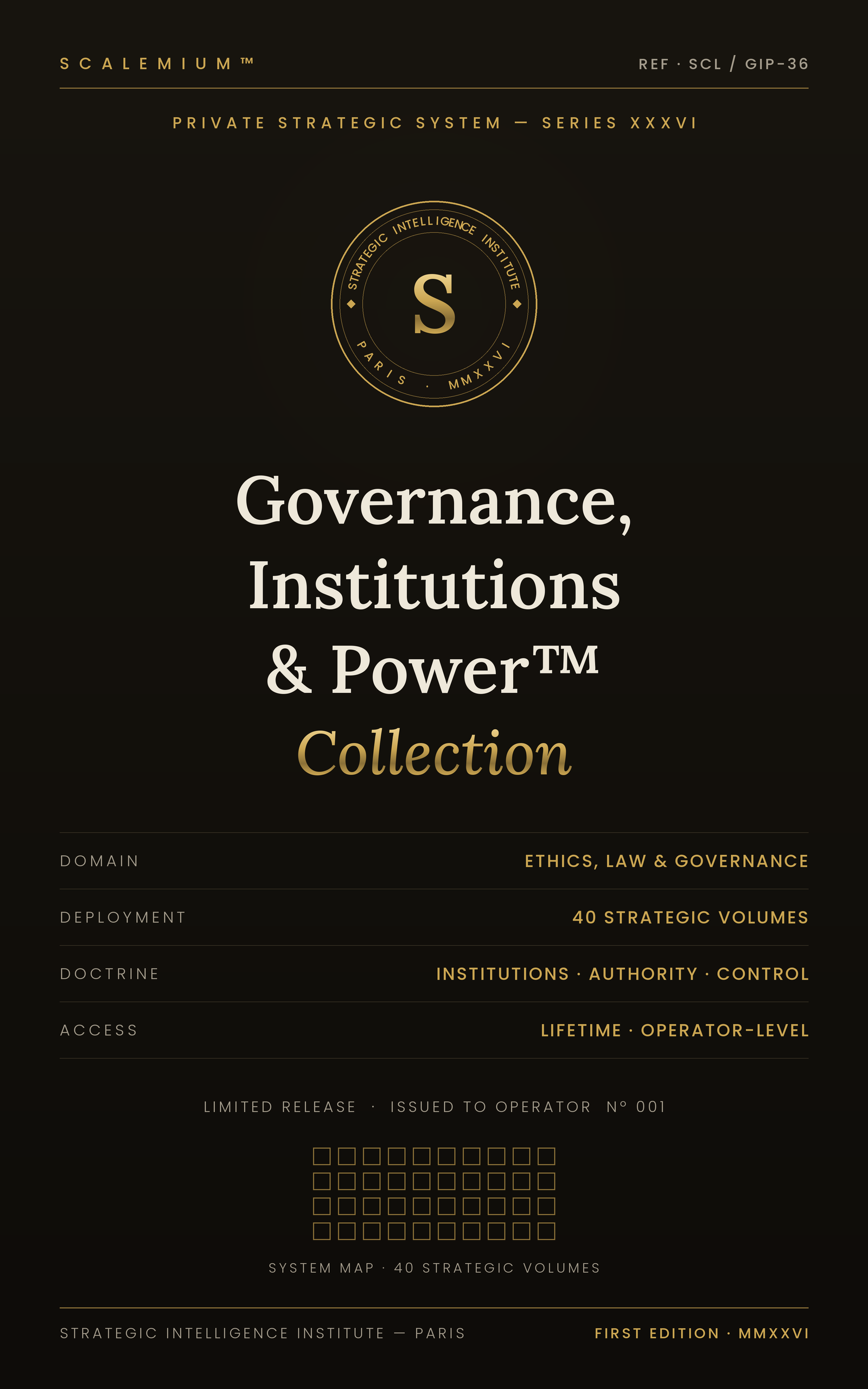
Governance, Institutions & Power operates as comprehensive institutional intelligence on the structural mechanics of governance. The collection extends across 40 volumes covering the architectural dimensions of governance and power — from the foundational principles of how societies are actually run through the patterns of institutional success and failure, from the architecture of legitimacy through the emergence of new governance forms, from the global governance landscape through the algorithmic and platform-based governance reshaping institutional reality.
The collection addresses the structural mechanics of governance across institutional, national, and emerging dimensions.
The collection articulates how governance actually functions — distinguished from how governance is formally described in constitutional documents, organizational charts, and institutional self-descriptions. The distinction operates as one of the most consequential analytical capacities for strategic operators in institutional environments.
The collection addresses the first principles of governance — authority, consent, enforcement, legitimacy — and how these principles operate across the diverse institutional forms governance takes. The first principles transcend specific institutional implementations and provide analytical infrastructure applicable across governance contexts.
The collection articulates the structural patterns determining institutional endurance and failure. Why do some institutions persist across centuries while others collapse within decades? What structural conditions produce institutional resilience? What patterns of institutional failure recur across institutional types and historical periods? The collection addresses these questions as institutional realities operators navigate rather than as merely theoretical concerns.
The collection addresses legitimacy as institutional infrastructure rather than as merely rhetorical category. Legitimacy is the operational substrate that converts formal authority into actual compliance. The collection articulates how legitimacy is constructed, sustained, and eroded — and the strategic implications of these dynamics for operators dependent on institutional environments.
The collection addresses multi-level governance — the actual operational reality of governance occurring simultaneously at local, national, regional, and international levels. The interactions between these levels produce dynamics substantially more complex than single-level analysis can engage. The collection articulates these dynamics with the analytical depth required for strategic operation.
The collection addresses the emergence of governance forms beyond traditional state-based governance. Platform governance exercises substantial regulatory authority over populations exceeding most national jurisdictions. Corporate governance increasingly addresses considerations of substantial public consequence. Algorithmic governance operates at scales and speeds traditional institutional oversight cannot adequately match. The collection articulates these emerging forms as immediate strategic reality.
The collection addresses global governance as ongoing institutional construction project. The traditional architecture of international relations — sovereign states cooperating through voluntary agreements — proves inadequate for governance challenges operating at genuinely global scale. The collection articulates the structural developments in global governance and the strategic implications they produce.
The collection addresses institutional design as strategic discipline. Operators constructing institutions — corporations, foundations, family architectures, governance bodies — receive frameworks calibrated to the actual structural requirements of institutional endurance.
The collection articulates the structural challenge of governance accountability — the persistent question of who watches the watchers. The challenge operates across every governance form and represents one of the foundational unresolved problems of institutional architecture.
The collection addresses the structural challenge of adaptive governance — the construction of institutional frameworks capable of evolving in response to rapidly changing conditions while maintaining the stability that institutional legitimacy requires. The challenge operates at the leading edge of contemporary governance theory and practice.
The collection articulates governance as fundamentally incentive design — the construction of institutional environments whose incentive structures produce desired behavior across populations too large for direct supervision. The political economy lens provides analytical infrastructure substantially more powerful than formal-authority analysis alone.
The collection addresses the transition toward governance operating at machine speed. Traditional institutional governance was calibrated to timescales — legislative cycles, judicial deliberation, regulatory development — that the operational environments being governed increasingly exceed. The structural implications of this temporal mismatch operate as foundational governance challenge.
The collection operates across 40 volumes structured through four institutional terrains — each addressing a foundational dimension of governance and power.
The opening terrain establishes the structural foundations of governance — how societies are actually run, the first principles operating across institutional forms, and the architectural requirements of institutional endurance.
Volume 1 — The Science of Governance: How Societies Are Actually Run
Volume 2 — First Principles of Governance: Authority, Consent, Enforcement
Volume 3 — Institutions Explained: Why They Outlast Leaders
Volume 4 — Governance as Infrastructure: Systems That Enable Stability
Volume 5 — The Governance Stack: Policy, Enforcement, Compliance
Volume 6 — Power and Governance: Who Decides for Whom
Volume 7 — The Crisis of Governance: When Institutions Fail
Volume 8 — Governing Complexity: Managing Systems Too Big to Control
Volume 9 — The Legitimacy Engine: Trust, Consent, Compliance
Volume 10 — Institutional Design: Building Systems That Endure
The second terrain addresses the architecture of governance operating across multiple levels — the emerging global governance landscape, the accountability challenges across governance forms, and the patterns of institutional failure that recur across types.
Volume 11 — The Governance Gap: Power Without Oversight
Volume 12 — Global Governance Explained: Rules Without a World Government
Volume 13 — The End of Nation-State Monopoly: Power Beyond Borders
Volume 14 — Multi-Level Governance: Local, National, Global
Volume 15 — Governance and Accountability: Who Watches the Watchers?
Volume 16 — The Institutional Failure Pattern: Why Systems Collapse
Volume 17 — The Reform Trap: Why Change Is Hard
Volume 18 — Adaptive Governance: Evolving Rules in Real Time
Volume 19 — The Bureaucracy Problem: Efficiency vs Control
Volume 20 — Governance and Speed: Decision-Making Under Pressure
The third terrain addresses the operational dynamics of governance — the construction and erosion of institutional trust, the governance of crisis and rapid change, and the reconstruction of authority across institutional contexts.
Volume 21 — Institutional Trust: Why People Obey Rules
Volume 22 — The Governance of Technology: Rules for Fast Systems
Volume 23 — The Institutional Mindset: Thinking Beyond Individuals
Volume 24 — Governance Without Borders: Managing Global Risks
Volume 25 — The Power of Standards: Rules That Shape Markets
Volume 26 — The Invisible Institutions: Norms That Govern Behavior
Volume 27 — Governance in Crisis: Authority Under Stress
Volume 28 — The Institutional Reset: Rebuilding Trust
Volume 29 — Governance as Coordination: Aligning Interests
Volume 30 — The Future of Institutions: Reinvention or Irrelevance
The closing terrain addresses the emerging governance forms transforming institutional reality — platform governance, corporate governance, algorithmic governance — and the structural recognition that governance will define the coming century.
Volume 31 — Public vs Private Governance: Who Really Rules?
Volume 32 — The Corporate Governance State: Companies as Governments
Volume 33 — Platform Governance: Rules Set by Technology Firms
Volume 34 — The Algorithmic Governor: Automated Decision Systems
Volume 35 — The End of Slow Governance: Institutions at Machine Speed
Volume 36 — Governance and Incentives: Designing Compliance
Volume 37 — The Global Risk Council: Coordinating Humanity
Volume 38 — The Governance of AI: Rules for Intelligence
Volume 39 — Institutional Power Mapping: Who Controls What
Volume 40 — The Governance Century: Why Rules Will Define Power
The collection delivers institutional intelligence value across the structural dimensions of governance and power.
Operators receive structural understanding of governance mechanics — the operational reality underneath formal institutional descriptions. The understanding enables strategic operation calibrated to actual governance conditions rather than to formal-authority assumptions that often diverge from operational reality.
The collection provides institutional design intelligence calibrated to actual structural requirements of institutional endurance. Operators constructing institutions — corporations, foundations, family architectures, organizational structures — receive frameworks for design choices whose long-term consequences institutional theory alone cannot adequately address.
The collection provides frameworks for navigating multi-level governance environments. Operators with multi-jurisdictional, multi-level operational contexts — multinational corporations, international family offices, sovereign-adjacent investors, transnational institutions — receive analytical infrastructure for strategic operation across these complex environments.
The collection provides intelligence on the construction, maintenance, and erosion of institutional legitimacy. Operators in positions whose effectiveness depends on legitimacy — institutional principals, organizational leaders, public-facing operators — receive structural intelligence on how legitimacy actually operates.
The collection provides intelligence on the emerging governance forms reshaping institutional reality — platform governance, corporate governance expansion, algorithmic governance. Operators with substantial exposure to these emerging forms receive frameworks calibrated to their actual operational characteristics.
The collection provides pattern recognition frameworks for institutional failure. Operators whose strategic positioning depends on institutional stability — long-term investment, multi-generational planning, dynastic positioning — receive intelligence on the structural conditions producing institutional failure and the operational signals indicating institutional vulnerability.
The collection provides intelligence for navigating governance complexity — the actual operational reality of governance environments substantially more complex than traditional single-level analysis addresses. Operators of significance routinely operate within such complexity and benefit from analytical infrastructure calibrated to it.
The collection supports strategic positioning within what is increasingly recognizable as the governance century — the coming decades during which governance frameworks will be constructed for civilization-scale challenges, emerging technologies, and post-traditional institutional realities. Operators positioning strategically for these decades benefit from intelligence on the governance trajectory.
The collection operates as reserved infrastructure for operators whose strategic positioning depends on understanding governance and power.
Investment principals whose strategic operation occurs within institutional environments shaped by governance — every substantial capital allocator operates within such environments. The depth of governance understanding shapes the quality of strategic positioning across investment domains.
Senior corporate leadership of organizations operating across multiple jurisdictions, governance environments, and emerging governance forms. The institutional complexity these operators navigate requires structural intelligence on governance that traditional corporate strategic frameworks do not adequately address.
Senior governmental operators, political principals, sovereign wealth managers, and institutional architects engaged with national and international governance construction. The collection provides institutional-grade intelligence on the structural dimensions of governance these positions involve.
Family office principals navigating multi-generational, multi-jurisdictional strategic positioning whose effectiveness depends on understanding the governance environments their architecture must accommodate across timescales no individual position can fully anticipate.
Operators constructing institutions, organizations, foundations, or governance bodies. The collection provides structural intelligence on institutional design substantially more rigorous than what traditional organizational theory addresses.
Senior leadership of platform companies, technology institutions, and AI organizations whose operational reach increasingly involves governance considerations of substantial public consequence. The structural intelligence on emerging governance forms applies most directly to operators positioned within them.
Senior regulatory operators, compliance principals, and institutional leaders responsible for navigating governance environments across complex jurisdictional and institutional landscapes.
Academic researchers in political science, institutional economics, governance studies, and adjacent fields whose work requires institutional-grade synthesis of governance mechanics as foundational research infrastructure.
The collection does not operate as introductory political science, popular commentary on governance, or general-audience analysis of institutional politics. The reserved positioning operates through strategic standards rather than through commercial accessibility.
Access: €6,997
Access operates through institutional channels. The collection delivers across the 40 volumes with continuing institutional support for operators integrating the intelligence into their strategic and institutional infrastructure.
Reserved for operators recognizing that governance mechanics operate as foundational strategic dimension across institutional, jurisdictional, and civilizational horizons. Not all applications warrant access.
→ Access This Collection — €6,997
Submit access request for institutional review.
→ Multi-Collection Institutional Access
For operators considering institutional access across the complete Ethics, Law & Governance edition or across the broader Strategic Intelligence library.
→ Private Advisory
For operators whose strategic situations warrant direct engagement at substantial depth.
Full access, delivered instantly upon acquisition.
For operators acquiring several collections within the Strategic Intelligence library. Submit your selection — we structure a single institutional access, priced accordingly.
For operators whose strategic situation warrants direct counsel at substantial depth.
SCALEMIUM™
Collections → Ethics, Law & Governance → Volume 4
people ignoring systems
people focused only on individuals
people avoiding complexity
This is not politics.
This is:
 understanding how power is structured and maintained
If you understand governance:
you understand decision systems
you understand authority
you understand structure
That’s institutional intelligence.
Most people see decisions.
Very few understand who structures them.
This collection gives you:
clarity on how institutions shape power and outcomes
We use cookies to ensure the site functions properly, understand how it is used, and improve your experience. You can accept, reject, or manage your preferences at any time.