
|
SCALEMIUM™ — Strategic systems for modern operators. |
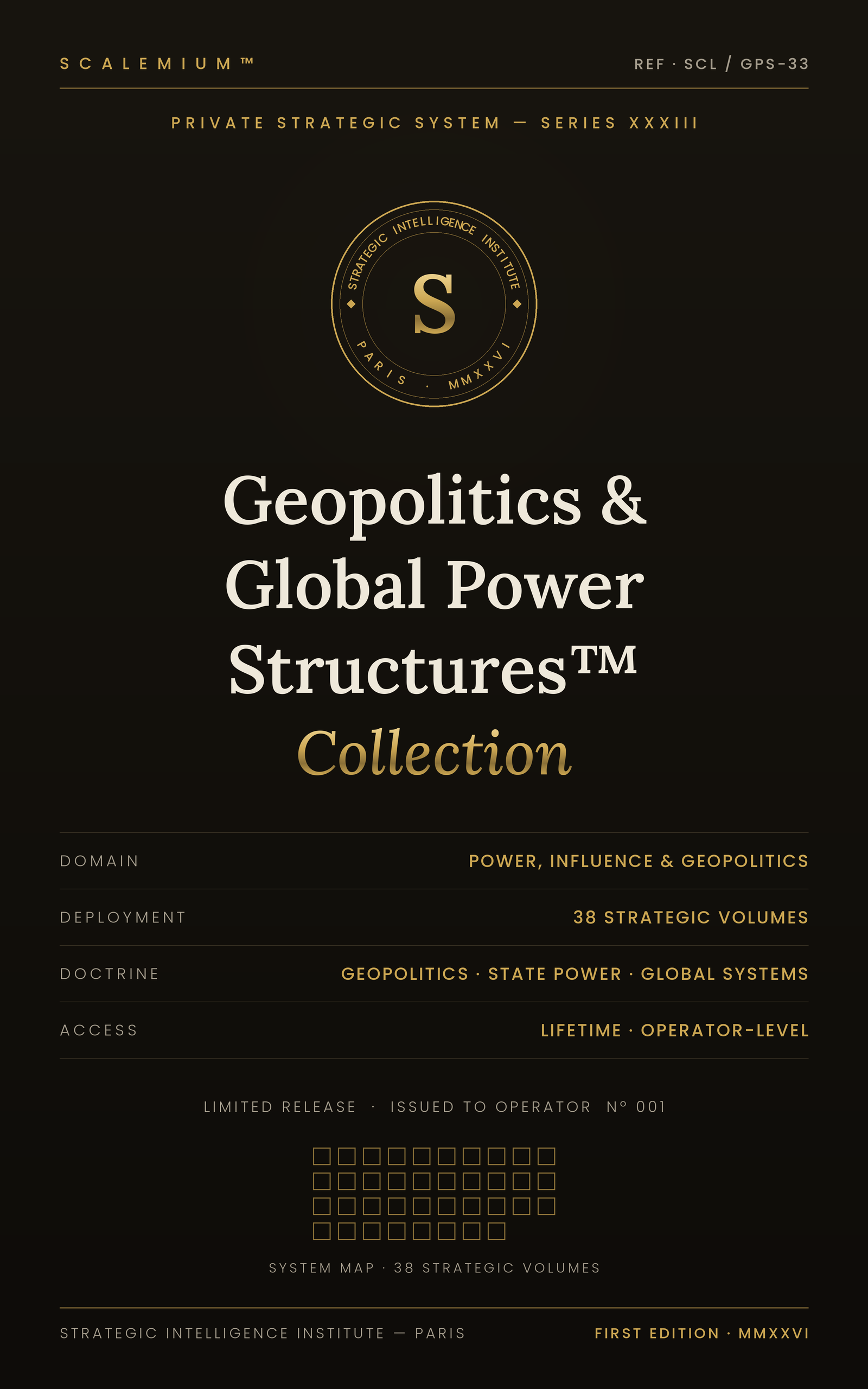
€ 6997
The international order is restructuring.
For approximately three decades following the end of the Cold War, the international system operated within a framework of relative stability that strategic operators across investment, institutional, and dynastic domains could engage as background condition. The framework — United States primacy, expanding globalization, integration of major economies into common institutional architecture, predominance of liberal-democratic political models, dollar-denominated financial infrastructure — provided the operational substrate within which strategic decisions could be made with reasonable confidence about the institutional environment within which their consequences would unfold.
This framework is now disintegrating.
Not gradually. Not theoretically. Structurally — through the simultaneous operation of multiple foundational developments whose interactions produce the most consequential geopolitical restructuring since the construction of the post-1945 order. The rise of China to genuine peer-competitor status. The relative decline of United States hegemonic capacity. The fragmentation of the global trading system. The weaponization of economic interdependence. The emergence of artificial intelligence as strategic capability whose distribution will substantially determine the next generation of geopolitical hierarchy. The transformation of warfare through cyber capability, autonomous systems, and informational operations. The emergence of corporate entities — particularly technology platforms — whose operational power exceeds most nation-states. The contestation of standards, norms, and institutional architecture across multiple domains where international consensus previously operated.
The strategic implications extend across every dimension of institutional operation.
Investment principals navigating geopolitically-exposed positioning — across emerging markets, regulated industries, technology sectors, energy infrastructure, critical materials, and increasingly across domains previously considered geopolitically neutral — operate within environments shaped substantially by the restructuring. The strategic decisions of substantial capital allocation, multi-generational positioning, sovereign-adjacent investment, and institutional architecture cannot be made effectively without sophisticated engagement with the geopolitical landscape.
Family office principals navigating multi-jurisdictional positioning across the coming decades operate within environments where the strategic stability assumptions of the immediate post-Cold-War period no longer apply. The relationship between major jurisdictions, the architecture of international institutions, the regulatory and political environments across major economies — each of these is undergoing substantial transformation whose strategic implications affect dynastic planning, multi-generational capital deployment, and the institutional architecture of family operation across jurisdictions.
Corporate leadership of multinational operations engages geopolitical environments substantially more complex and contested than those operating during the period of relative globalization stability. The strategic positioning of multinational operations now requires intelligence on geopolitical dynamics that traditional corporate strategic frameworks did not adequately address.
The strategic operators of significance recognize this restructuring as one of the most consequential developments of the era. The operators who engage it sophisticatedly position themselves with substantial strategic advantage. The operators who engage it through inadequate frameworks — through fragmentary news consumption, through ideologically-positioned commentary, through institutional analyses calibrated to outdated assumptions — operate at substantial strategic disadvantage relative to operators with adequate intelligence.
Most operators encounter geopolitics as topic of news commentary, occasional institutional briefings, or background concern. The strategic operators of significance recognize it as operational reality affecting every domain of substantial strategic operation across the coming decades.
The questions emerging are foundational.
What is the structural shape of the multipolar order replacing the unipolar period? How will the great power competition between the United States and China actually develop, and what implications follow for operators across jurisdictions whose positioning depends on this competition? What is the strategic significance of the technological competition — particularly AI, semiconductors, computing infrastructure — and how does this competition reshape traditional geopolitical analysis? How will the weaponization of economic interdependence continue to develop, and what strategic implications follow for capital allocation across jurisdictions? What is the actual significance of emerging technology corporations as geopolitical actors whose operational power exceeds most nation-states? How will the contestation of standards, norms, and institutional architecture across multiple domains actually unfold? What collapse scenarios warrant serious strategic consideration, and what risk frameworks adequately address them? How should strategic operators position themselves within geopolitical environments characterized by accelerating complexity, structural restructuring, and emerging power forms whose operational characteristics traditional analyses do not adequately address?
These questions are not adequately engaged through fragmentary news consumption or through commentary calibrated to particular political positions. They require integrated structural intelligence on geopolitics as institutional reality.
This collection addresses that intelligence.
Geopolitics & Global Power Structures operates as comprehensive institutional intelligence on the structural reality of global power. The collection extends across 40 volumes covering the architectural dimensions of contemporary geopolitics — from the emergence of the multipolar order through the technological dimensions of great power competition, from the weaponization of economic interdependence through the rise of non-state actors with geopolitical significance, from the contestation of global standards through the civilization-level competition shaping the next generation of international order.
The collection addresses the foundational dimensions of contemporary geopolitics across institutional, technological, economic, and strategic horizons.
The collection articulates the structural restructuring underway — distinguished from the surface-level commentary that dominates popular geopolitical discourse. The restructuring involves multiple foundational developments whose interactions produce the actual geopolitical landscape strategic operators navigate.
The collection addresses the architectural dimensions of multipolar competition — the structural differences between unipolar, bipolar, and multipolar international systems, the operational characteristics of multipolar competition, and the strategic implications for operators navigating environments shaped by multi-centric power dynamics.
The collection articulates the structural patterns of imperial decline and hegemonic transition. These patterns recur across recorded political history. Contemporary developments frequently recapitulate patterns observable across previous hegemonic transitions, providing comparative intelligence that operators without historical perspective cannot access.
The collection addresses the structural significance of strategic geography in contemporary power dynamics. Despite frequent claims that geography has lost relevance under conditions of globalization and digital connectivity, geographic positioning continues to operate as foundational dimension of strategic reality. The collection articulates this dimension with appropriate institutional rigor.
The collection addresses the structural dimensions of contemporary great power competition — particularly the United States-China competition whose dynamics substantially shape the geopolitical environment across multiple decades. The collection articulates this competition with the analytical depth required for strategic operation within environments affected by it.
The collection articulates the structural significance of technology in contemporary geopolitical competition. Artificial intelligence, semiconductors, computing infrastructure, data, and related technological domains operate as foundational dimensions of contemporary power. The collection addresses these dimensions as integrated strategic intelligence rather than as separate technical concerns.
The collection addresses the structural transformation of economic interdependence into instrument of geopolitical competition. Sanctions, trade restrictions, financial coercion, currency manipulation, supply chain weaponization — each of these operates as expression of the broader weaponization of interdependence whose strategic implications affect capital allocation across jurisdictions.
The collection addresses the structural dimensions of energy and resource power. Energy transition dynamics, critical materials access, resource nationalism, and the geopolitical implications of energy infrastructure operate as foundational dimensions of contemporary geopolitical reality.
The collection articulates the structural dimensions of cyber power and conflict beyond traditional military categories. Cyber capability, informational warfare, and influence operations operate as integrated dimensions of contemporary power competition whose strategic implications affect institutional operation across domains.
The collection addresses the structural emergence of corporate entities — particularly major technology platforms — as geopolitical actors whose operational power exceeds most nation-states. The strategic implications of this development affect investment positioning, regulatory environments, and the foundational architecture of international order.
The collection articulates the strategic significance of standards and norms as instruments of power. The competition to write rules — for AI development, for digital infrastructure, for financial systems, for technological domains — operates as foundational dimension of contemporary geopolitical competition.
The collection addresses the structural drivers operating beneath surface-level geopolitical events — demographic trajectories, climate dynamics, resource transition pressures, and other foundational developments whose strategic implications unfold across longer timescales than typical geopolitical analysis engages.
The collection articulates the emerging significance of space as power domain. Satellite infrastructure, space launch capability, orbital positioning, and the broader infrastructure of space operations operate as increasingly significant dimensions of contemporary power competition.
The collection addresses the structural transformation of sovereignty under conditions of algorithmic infrastructure, digital interdependence, and the emergence of governance forms operating beyond traditional state authority. The future of nation-state sovereignty operates as foundational question of contemporary geopolitical analysis.
The collection articulates the structural significance of civilization-level competition emerging beyond traditional nation-state frameworks. Contemporary competition increasingly operates at scales — civilizational, ideological, technological — that nation-state-centric analysis inadequately addresses.
The collection operates across 40 volumes structured through four strategic theaters — each addressing a foundational dimension of contemporary geopolitics and global power.
The opening theater establishes the structural reality of contemporary geopolitics — the multipolar order, the dynamics of hegemonic competition, the strategic significance of geography, technology, and economic power, and the foundational architecture of contemporary great power competition.
Volume 1 — The New World Order Explained: Power After Globalization
Volume 2 — Geopolitics of Technology: Control Through Innovation
Volume 3 — The AI Power Shift: Intelligence as Global Weapon
Volume 4 — The Multipolar World: Competing Centers of Control
Volume 5 — The Decline of Empires: Why Dominance Fades
Volume 6 — Strategic Geography: Why Location Still Matters
Volume 7 — The Great Power Competition: 21st Century Rivalries
Volume 8 — Geopolitics of Data: Information as Sovereign Asset
Volume 9 — The Compute Wars: Chips, Energy, and Control
Volume 10 — Economic Power Games: Sanctions, Trade, and Leverage
The second theater addresses the structural transformation of economic and informational interdependence into instruments of geopolitical competition — currency power, energy leverage, digital sovereignty, supply chain warfare, and the broader cyber and informational dimensions of contemporary power competition.
Volume 11 — The Currency of Nations: Money, Trust, and Influence
Volume 12 — The Energy Chessboard: Power Through Resources
Volume 13 — Digital Sovereignty: Who Controls Cyberspace
Volume 14 — The New Cold War: Technology, Ideology, Influence
Volume 15 — Global Supply Chain Power: Control Through Dependency
Volume 16 — The Weaponization of Interdependence: Economic Coercion
Volume 17 — The Rise of Tech States: Corporations as Geopolitical Actors
Volume 18 — Cyber Power: Conflict Without Borders
Volume 19 — The AI Arms Race: Autonomous Power Competition
Volume 20 — Geopolitics of Standards: Rules as Power
The third theater addresses the strategic alliances, collapse scenarios, and structural drivers — demographic, climate, resource — operating beneath surface-level geopolitical events.
Volume 21 — Strategic Alliances: Cooperation as Leverage
Volume 22 — The Collapse Scenarios: When Systems Fail
Volume 23 — Population Power: Demographics as Destiny
Volume 24 — Geopolitics of Climate: Power in a Changing World
Volume 25 — The Resource Transition: Energy and Influence
Volume 26 — The Fragile Global Order: Stability on the Edge
Volume 27 — Space as a Power Domain: Orbit, Satellites, Control
Volume 28 — The Intelligence Divide: Leaders vs Followers
Volume 29 — Global Risk Management: Power Under Uncertainty
Volume 30 — The Future of Nations: Sovereignty in the Algorithmic Age
The closing theater addresses the contestation of standards, the questions of Western dominance and strategic autonomy, the dynamics of power transitions, and the emerging civilization-level competition operating beyond traditional nation-state frameworks.
Volume 31 — The Battle for Standards: Who Writes the Rules Wins
Volume 32 — Geopolitics of Knowledge: Education as Power
Volume 33 — The End of Western Dominance: Myth or Reality?
Volume 34 — The Rise of Strategic Autonomy: Independence as Power
Volume 35 — Global Power Transitions: Peaceful or Violent?
Volume 36 — The Fragility of Superpowers: Hidden Weaknesses
Volume 37 — The New Strategic Map: Redrawing Influence Zones
Volume 38 — Geopolitics of AI Ethics: Values as Strategy
Volume 39 — The Power of Non-State Actors: Corporations, Networks, Movements
Volume 40 — Civilization-Level Competition: Beyond Nation-States
The collection delivers institutional intelligence value across the structural dimensions of contemporary geopolitics.
Operators receive structural intelligence on the geopolitical restructuring underway — intelligence calibrated to actual operational reality rather than to outdated assumptions about international system stability. The intelligence enables strategic operation aligned with actual geopolitical conditions.
The collection provides frameworks for engaging contemporary great power competition. Operators with positioning affected by the United States-China competition, the broader multipolar competition, and the technological dimensions of contemporary power competition receive intelligence calibrated to these foundational dynamics.
The collection provides comprehensive intelligence on the geopolitical dimensions of technology — AI, semiconductors, computing infrastructure, digital sovereignty, data sovereignty. Operators with substantial technology exposure or with positioning affected by technology geopolitics receive analytical infrastructure calibrated to these dynamics.
The collection provides intelligence on the structural weaponization of economic interdependence. Operators with multi-jurisdictional capital positioning, exposure to sanctions environments, or operations in geopolitically-sensitive sectors receive frameworks for engaging these dynamics strategically.
The collection provides risk frameworks calibrated to contemporary geopolitical environments. The risks operating in contemporary geopolitics — system fragility, collapse scenarios, power transitions, hegemonic competition — substantially exceed those addressed by traditional risk frameworks. Operators of significance receive risk intelligence aligned with actual conditions.
The collection provides intelligence on the geopolitical dimensions of corporate operation — particularly for technology platforms, multinational corporations, and other entities whose operational power involves geopolitical significance. The structural integration of corporate and geopolitical dynamics affects strategic positioning across the corporate landscape.
The collection provides intelligence for operators whose strategic positioning directly involves sovereign and political dynamics — sovereign wealth fund operators, political principals, governmental architects, and operators engaged with international institutional dynamics.
The collection supports multi-generational positioning calibrated to geopolitical environments substantially different from those of recent decades. Family principals and dynastic operators receive frameworks for engaging multi-generational positioning under conditions of geopolitical restructuring.
The collection provides analytical frameworks operating at civilization level — frameworks that engage contemporary competition at scales nation-state-centric analysis inadequately addresses. The most ambitious strategic operators receive intelligence calibrated to the actual scale of contemporary competition.
The collection operates as reserved infrastructure for operators whose strategic positioning involves geopolitical dimensions of substantial consequence.
Investment principals whose strategic positioning involves substantial geopolitical exposure — emerging market investors, sovereign-adjacent capital allocators, technology sector principals, energy and resource investors, and increasingly capital allocators across domains where geopolitical considerations now apply.
Family office principals navigating multi-jurisdictional, multi-generational positioning under conditions of geopolitical restructuring. The strategic stability assumptions of the immediate post-Cold-War period no longer apply, and multi-generational positioning requires intelligence calibrated to actual conditions.
Senior corporate leadership of organizations operating across multiple jurisdictions whose strategic positioning involves substantial geopolitical considerations. The integration of geopolitical and corporate strategic considerations operates as foundational dimension of contemporary multinational operation.
Senior governmental operators, sovereign principals, foreign policy architects, and operators engaged directly with international institutional dynamics. The collection provides institutional-grade intelligence on contemporary geopolitical dynamics at the depth these positions require.
Senior leadership of major technology institutions, AI organizations, and digital infrastructure entities whose operational positioning involves substantial geopolitical significance. The structural integration of technology and geopolitics affects strategic operation across the technology sector.
Senior operators in strategic intelligence functions, geopolitical risk analysis, and institutional risk management whose work requires institutional-grade synthesis of contemporary geopolitical dynamics as foundational professional infrastructure.
Academic researchers in international relations, geopolitical studies, strategic analysis, and adjacent fields whose work requires institutional-grade synthesis of contemporary geopolitics as foundational research infrastructure.
Senior operators in energy sectors, critical materials, resource industries, and energy transition domains whose strategic positioning involves substantial geopolitical considerations operating as foundational dimensions of contemporary operation.
The collection does not operate as popular geopolitical commentary, ideologically-positioned analysis, or general-audience international relations content. The reserved positioning operates through strategic standards rather than through commercial accessibility.
Access: €6,997
Access operates through institutional channels. The collection delivers across the 40 volumes with continuing institutional support for operators integrating the intelligence into their strategic and institutional infrastructure.
Reserved for operators recognizing that contemporary geopolitics operates as foundational strategic dimension across investment, institutional, dynastic, and civilizational horizons. Not all applications warrant access.
→ Access This Collection — €6,997
Submit access request for institutional review.
→ Multi-Collection Institutional Access
For operators considering institutional access across the complete Power, Influence & Geopolitics edition or across the broader Strategic Intelligence library.
→ Private Advisory
For operators whose strategic situations warrant direct engagement at substantial depth.
Full access, delivered instantly upon acquisition.
For operators acquiring several collections within the Strategic Intelligence library. Submit your selection — we structure a single institutional access, priced accordingly.
For operators whose strategic situation warrants direct counsel at substantial depth.
SCALEMIUM™
Collections → Power, Influence & Geopolitics → Volume 2
people relying only on media narratives
people avoiding complexity
people looking for simple explanations
This is not news.
This is:
 understanding the structure behind global events
If you understand geopolitics:
you interpret events correctly
you anticipate shifts
you position strategically
That’s global intelligence.
Most people react to global events.
Very few understand what drives them.
This collection gives you:
a clear view of global power structures
We use cookies to ensure the site functions properly, understand how it is used, and improve your experience. You can accept, reject, or manage your preferences at any time.