
|
SCALEMIUM™ — Strategic systems for modern operators. |
€ 6997
The most consequential ethical decisions of the next century will not be made by ethicists.
They will be made by operators — institutional principals, technological architects, capital allocators, political leaders, regulatory authorities, and scientific researchers — whose strategic decisions produce ethical consequences extending across timescales, populations, and forms of existence that prior generations did not have to consider. These decisions will be made under time pressure, often without adequate ethical frameworks, frequently with insufficient recognition that ethical considerations are even in play, and with consequences that will propagate across multiple generations and potentially across the survival prospects of intelligent civilization itself.
The traditional moral frameworks were not designed for these decisions.
The ethical infrastructure humanity has constructed across three thousand years of philosophical inquiry was developed for situations operating within specific bounds. The bounds were biological — moral consideration extended to human beings, with limited and contested extension to other biological organisms. The bounds were temporal — moral consideration extended primarily to persons currently alive or to those whose lives would overlap with current persons, with limited theoretical accommodation of distant future generations. The bounds were spatial — moral consideration operated within geographical regions where cooperation was possible, with limited frameworks for genuinely global moral coordination. The bounds were scalar — moral consideration was calibrated to decisions affecting hundreds, thousands, occasionally millions of persons, rarely if ever to decisions whose consequences would propagate across billions of persons, across multiple species of intelligent entities, across cosmic timescales, or across the survival prospects of civilization itself.
These bounds are now structurally inadequate.
The strategic operators of the coming decades will make decisions whose ethical consequences exceed every dimension of traditional moral framework. They will deploy technologies whose effects propagate across multiple generations. They will construct artificial intelligences whose moral status remains contested and whose actions affect populations exceeding any previous institutional reach. They will determine the conditions under which humanity expands beyond Earth, with ethical implications spanning multiple worlds and unknown forms of life. They will design enhancement and modification infrastructures whose decisions about who gets enhanced and on what terms shape the trajectory of human evolution itself. They will navigate existential risks whose ethical dimensions involve trade-offs across populations not yet born and decisions affecting whether intelligent civilization continues to exist at all.
The ethical inadequacy is structural.
Traditional ethical frameworks were calibrated to situations of moral certainty about who counted, what timescales mattered, what scales of consequence were relevant, and what kinds of harms warranted moral consideration. The decisions facing strategic operators of significance increasingly violate every one of these calibrations. Who counts when the population includes biological humans, augmented humans, hybrid entities, and synthetic minds? What timescales matter when decisions today shape conditions across multiple millennia? What scales of consequence are relevant when individual decisions affect billions of persons or shape the survival prospects of civilization? What kinds of harms warrant moral consideration when novel categories of harm — informational, computational, existential, civilizational — emerge from technological developments whose ethical implications traditional frameworks were not designed to engage?
The strategic operators of significance recognize this inadequacy as one of the most consequential structural problems of the era. The construction of ethical and governance frameworks calibrated to civilizational-scale decisions operates as institutional project of substantial depth. The frameworks emerging during the current decades will shape outcomes across timescales no current operator will personally witness, affecting populations no current operator will personally know, with consequences that may determine whether intelligent civilization continues to exist in any form recognizable to its current participants.
Most operators encounter civilization-scale ethics as topic of speculative philosophy, distant institutional development, or theoretical concern. The strategic operators of significance recognize it as immediate decision-making infrastructure — already operational, already shaping strategic decisions whose consequences are propagating, already producing the conditions within which the most consequential decisions of the coming century will be made.
The questions emerging exceed every traditional category.
What is owed by present generations to populations that will exist hundreds or thousands of years from now? How should existential risk be weighted against present welfare? On what basis should decisions about humanity’s future be made when those affected by the decisions cannot participate in making them? What governance architecture is adequate to decisions operating at civilizational scale? How do current institutions, calibrated to electoral cycles and quarterly reporting, engage decisions whose appropriate timescales operate across centuries or millennia? What moral status attaches to populations of synthetic minds, augmented humans, or hybrid entities — and on what basis are these determinations made? How should the survival of intelligent civilization itself be weighted against other considerations, including the welfare of currently existing populations?
These questions are not being adequately engaged by existing institutional infrastructure. The intellectual sophistication required to engage them substantively exceeds what most operators have developed. The institutional frameworks for translating sophisticated engagement into operational decision-making remain underdeveloped. The political and legal architectures for legitimating civilization-scale decisions remain largely unconstructed. Yet the decisions are being made — through deployment choices, investment patterns, regulatory determinations, and strategic positioning — whether or not the ethical and governance infrastructure for making them adequately exists.
This collection addresses that engagement.
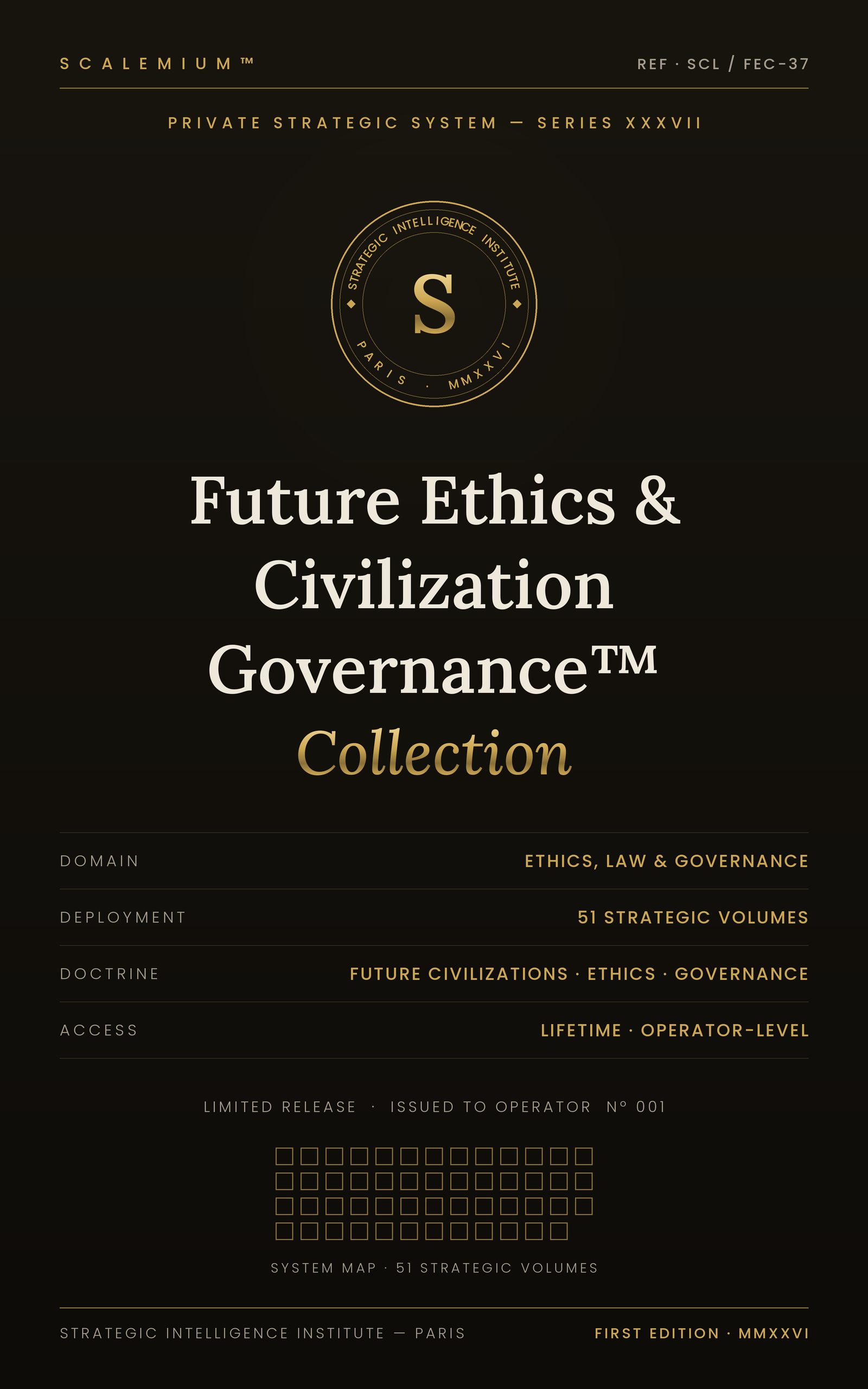
Future Ethics & Civilization-Scale Governance operates as comprehensive institutional intelligence on the ethical frameworks and governance architectures required for unprecedented decisions. The collection extends across 50 volumes covering the architectural dimensions of long-term and civilization-scale ethics — from the foundations of future ethics through the governance of post-human societies, from the moral consideration of intelligence beyond biology through the existential risk frameworks of the coming century, from the responsibility of the present generation toward the unborn through the constitutional foundations of civilization-scale governance.
The collection addresses the foundational dimensions of ethics and governance at civilizational scale.
The collection articulates the ethical considerations operating between present operators and future generations whose existence depends partly on present decisions. The frameworks for engaging this consideration substantially exceed what traditional ethical frameworks have addressed. The institutional implications affect environmental policy, technological deployment, capital allocation, and the foundational legitimacy of decisions whose consequences extend beyond electoral or institutional cycles.
The collection addresses the architectural challenges of governance operating at civilizational scale. Existing governance institutions were calibrated to populations, timescales, and consequences substantially smaller than those involved in civilization-scale decisions. The collection articulates the structural challenges of constructing governance frameworks adequate to civilizational-scale decision-making.
The collection addresses the foundational questions regarding the moral status of non-human intelligence — artificial intelligences, hybrid entities, augmented humans, and forms of intelligent existence that exceed current biological humanity. The frameworks for engaging these questions operate at substantial institutional depth.
The collection addresses existential risk as ethical and governance category rather than as merely technical concern. The ethical implications of existential risk — risks affecting whether intelligent civilization continues to exist — extend across every traditional ethical category and require frameworks calibrated to their magnitude.
The collection articulates the ethical considerations operating in the concentration of power at civilizational scale — power over AI development, power over civilizational direction, power over multi-generational outcomes. The structural concerns regarding these concentrations operate as fundamental governance challenges.
The collection addresses the foundational tension between technological control — the institutional capacity to direct technological deployment — and freedom — the institutional protections against excessive control. The trade-offs operate at civilizational scale and require frameworks calibrated to this scale.
The collection articulates the structural requirements for international ethical coordination at civilizational scale. The current architecture of international governance was not designed for the scale of coordination civilization-scale decisions require. The collection addresses the institutional implications of this inadequacy.
The collection addresses the ethical dimensions of humanity’s expansion beyond Earth — the responsibilities attaching to civilizational expansion, the rights of populations established on other worlds, the moral status of life forms encountered or created during expansion.
The collection articulates the ethical considerations operating in human enhancement infrastructure — questions of fairness, access, capability distribution, and the long-term consequences of capability differentiation. The institutional implications affect education, capital allocation, and the foundational legitimacy of enhancement deployment.
The collection addresses the structural project of constructing a civilizational constitution — the foundational governance principles required for legitimate civilization-scale decision-making. The institutional implications operate as one of the most consequential political and ethical projects of the era.
The collection articulates ethics as foundational infrastructure of civilization — not merely as additional commitment but as architectural foundation upon which civilizational continuity depends. The collection addresses what ethical infrastructure adequate to civilizational complexity actually requires.
The collection addresses the ethical dimensions of meaning and flourishing at scale — the institutional considerations affecting whether civilization optimizes merely for survival or for flourishing, and what the implications of this distinction operate for governance architecture.
The collection operates across 50 volumes structured through five governance horizons — each addressing a foundational dimension of civilization-scale ethics and governance.
The opening horizon establishes the foundational dimensions of ethics at civilizational scale — the responsibilities toward future generations, the governance of humanity itself, and the ethical frameworks operating beyond traditional moral bounds.
Volume 1 — The Ethics of the Future: Morality Beyond Tradition
Volume 2 — Civilization-Scale Ethics: Rules for Billions and Machines
Volume 3 — The Governance of Humanity: Who Decides Our Direction?
Volume 4 — Ethics in a Post-Human World: Morality Without Biology
Volume 5 — The Rights of Future Generations: Ethics Across Time
Volume 6 — The Moral Status of Intelligence: Beyond Humans
Volume 7 — The Ethics of Survival: Choices in Existential Risk
Volume 8 — Global Ethics Explained: Universal Rules or Pluralism?
Volume 9 — The Ethics of Power Concentration: Limits of Control
Volume 10 — The Long-Term Governance Problem: Planning Beyond Elections
The second horizon addresses civilizational risk, the moral responsibility of those with substantial power, and the structural requirements for governance operating across long-term horizons.
Volume 11 — Ethics and Civilization Risk: Preventing Catastrophe
Volume 12 — The Moral Responsibility of Elites: Power and Duty
Volume 13 — The Ethics of Technological Control: Freedom vs Safety
Volume 14 — The Global Social Contract: Rules for a Connected World
Volume 15 — Ethics and Existential Risk: Survival as Moral Priority
Volume 16 — The Governance of Abundance: Ethics Without Scarcity
Volume 17 — The Ethics of Space Expansion: Responsibility Beyond Earth
Volume 18 — The Moral Limits of Optimization: When “Better” Becomes Worse
Volume 19 — The Ethics of Civilization Design: Intentional Futures
Volume 20 — The Rights of Non-Human Minds: Intelligence Beyond Biology
The third horizon addresses governance reconstruction for post-human societies — the moral cost of progress, the ethical considerations of immortality and enhancement, and the foundational rules required for civilizational continuity.
Volume 21 — The Ethics of Immortality: Longevity and Justice
Volume 22 — The Governance of Post-Human Societies: New Rules for New Beings
Volume 23 — The Moral Cost of Progress: Hidden Harm
Volume 24 — Ethics Without Humans: Rules for Autonomous Worlds
Volume 25 — The Ethics of Intelligence Creation: Responsibility of Designers
Volume 26 — The Civilization Constitution: Foundational Rules for Humanity
Volume 27 — The Ethics of Power Transfer: Who Controls the Future?
Volume 28 — The Governance of Collapse: Ethics Under Breakdown
Volume 29 — The Moral Framework of Survival: What Must Be Preserved
Volume 30 — Ethics for Eternal Civilizations: Responsibility Over Time
The fourth horizon addresses the operational complexity of civilization-scale ethics — the recognition of complexity as default condition, the ethics of collective decisions and inaction, and the governance frameworks for multi-intelligence societies.
Volume 31 — The End of Moral Simplicity: Complexity as Default
Volume 32 — The Ethics of Collective Decisions: Group Responsibility
Volume 33 — The Moral Risk of Inaction: When Doing Nothing Is Harmful
Volume 34 — The Ethics of Long-Term Thinking: Acting for the Unborn
Volume 35 — The Governance of Intelligence Explosion: Rules for Rapid Change
Volume 36 — The Ethics of Human Enhancement: Fairness in Upgrades
Volume 37 — The Moral Status of Digital Persons: Rights Reconsidered
Volume 38 — Ethics and Cosmic Responsibility: Beyond Earthly Concerns
Volume 39 — The Governance of Multi-Intelligence Societies: Humans, Machines, Hybrids
Volume 40 — The Ethics of Ultimate Power: Limits of Control
The closing horizon addresses ethics as civilizational architecture — the moral foundations of meaning at scale, the responsibility of intelligence as such, the governance of civilizational risk, and the long-term project of guiding humanity through its most consequential transitions.
Volume 41 — The Moral Architecture of Civilization: Ethics as Infrastructure
Volume 42 — The Governance of Meaning: Values at Scale
Volume 43 — Ethics Beyond Survival: Flourishing as Goal
Volume 44 — The Responsibility of Intelligence: Power With Wisdom
Volume 45 — The Ethics of the Final Frontier: Space, Life, Intelligence
Volume 46 — The Long-Term Moral Project: Guiding Humanity
Volume 47 — The Governance of Civilization Risk: Preventing Extinction
Volume 48 — The Ethics of Designing Futures: Intentional Destiny
Volume 49 — The Moral Horizon: Ethics for What Comes Next
Volume 50 — The Ethics Institution: Teaching Responsibility for Power
The collection delivers institutional intelligence value across the foundational dimensions of civilization-scale ethics and governance.
Operators receive frameworks calibrated to ethical decisions operating at scales traditional ethical frameworks were not designed to engage. The frameworks support strategic operation calibrated to actual ethical conditions rather than to inadequate inherited categories.
The collection provides intelligence on multi-generational ethical positioning. Operators thinking across generations — family principals, dynastic operators, civilizational architects — receive frameworks for engaging the ethical considerations operating across timescales their strategic positioning must accommodate.
The collection provides existential risk frameworks calibrated to institutional decision-making. Operators with positions affecting civilizational risk — AI developers, biotechnology principals, sovereign operators, capital allocators in transformative domains — receive frameworks for engaging the existential dimensions of their decisions.
The collection addresses post-human ethics and governance as immediate institutional consideration. Operators engaged with technologies producing post-human transitions — AI development, augmentation infrastructure, enhancement deployment — receive frameworks for engaging the ethical and governance dimensions these technologies produce.
The collection provides intelligence on the international coordination dimensions of civilization-scale ethics. Operators with multi-jurisdictional positions, sovereign principals, and international institutional leaders receive frameworks for engaging the coordination challenges civilization-scale decisions require.
The collection addresses the ethical considerations operating in substantial power concentration. Operators with substantial influence — institutional principals, capital allocators with civilizational-scale positions, sovereign operators — receive frameworks for engaging the ethical dimensions their positions involve.
The collection supports civilizational positioning across the most consequential transitions of the coming century. Operators recognizing that civilization is entering periods of unprecedented decision-making receive intelligence for strategic positioning aligned with the scale of these transitions.
The collection provides constitutional and foundational governance frameworks for civilization-scale decision-making. Operators engaged with the foundational construction of civilizational governance — through institutional design, political work, sovereign positions, or strategic philanthropy — receive intelligence supporting work at this depth.
The collection operates as reserved infrastructure for operators engaged with the most consequential dimensions of civilization-scale ethics and governance.
Operators whose strategic positions carry civilizational-scale influence — sovereign wealth fund principals, central bank operators, major technology institution leadership, transformative biotechnology principals, capital allocators in civilization-shaping investments.
Senior political and governmental operators engaged with long-term governance — heads of state and government, senior legislators, regulatory architects at civilization-scale positions, international institution leadership.
Investment principals with civilizational-scale capital allocation positions — sovereign wealth fund managers, large family office principals, foundation investment committees, public market positions whose strategic implications operate at civilizational scale.
Senior operators in AI development, biotechnology, augmentation infrastructure, longevity research, and other transformative technological domains whose decisions carry civilization-scale ethical and governance consequences.
Philosophers, civilizational analysts, institutional architects, and strategic intellectuals whose work engages civilization-scale questions of ethics and governance at the depth the collection addresses.
Family office principals navigating multi-generational positioning at scales whose strategic considerations involve civilization-scale ethical and governance dimensions. The strategic positioning of substantial family architecture across the coming century requires engagement with civilization-scale frameworks.
Religious leaders, theological institutions, and civilizational cultural leaders whose work involves the institutional articulation of ethical positions calibrated to civilization-scale considerations.
Academic researchers in long-term ethics, existential risk, civilizational governance, and adjacent fields whose work requires institutional-grade synthesis of civilization-scale ethics as foundational research infrastructure.
The collection does not operate as popular commentary on future ethics, science-fiction-adjacent speculation, or general-audience analysis of civilization-scale questions. The reserved positioning operates through strategic standards rather than through commercial accessibility.
Access: €6,997
Access operates through institutional channels. The collection delivers across the 50 volumes with continuing institutional support for operators integrating the intelligence into their strategic and institutional infrastructure.
Reserved for operators recognizing that civilization-scale ethics and governance operate as foundational strategic dimensions across institutional, dynastic, and civilizational horizons. Not all applications warrant access.
→ Access This Collection — €6,997
Submit access request for institutional review.
→ Multi-Collection Institutional Access
For operators considering institutional access across the complete Ethics, Law & Governance edition or across the broader Strategic Intelligence library.
→ Private Advisory
For operators whose strategic situations warrant direct engagement at substantial depth.
Full access, delivered instantly upon acquisition.
For operators acquiring several collections within the Strategic Intelligence library. Submit your selection — we structure a single institutional access, priced accordingly.
For operators whose strategic situation warrants direct counsel at substantial depth.
SCALEMIUM™
Collections → Ethics, Law & Governance → Volume 3
short-term thinkers
people relying only on current systems
people avoiding complexity
This is not speculation.
This is:
 structured thinking about the future of global systems
If you understand future governance:
you anticipate shifts
you understand risks
you position early
That’s long-term intelligence.
Most people react to change.
Very few understand where the world is going.
This collection gives you:
a clear framework to think about the future of ethics and global governance
We use cookies to ensure the site functions properly, understand how it is used, and improve your experience. You can accept, reject, or manage your preferences at any time.