
|
SCALEMIUM™ — Strategic systems for modern operators. |
€ 6997
Power is the most discussed and least understood subject in strategic operation.
For approximately three thousand years, the most consequential strategic thinkers in every civilization that has produced sustained political reflection have engaged the same foundational questions: What is power? How is it acquired? How is it maintained? Why do some forms of power endure for centuries while others collapse within decades? What is the relationship between visible authority and actual influence? Between formal hierarchies and operational control? Between the power that announces itself and the power that operates beneath the surface of institutional life?
These questions have been engaged by Sun Tzu and Thucydides, by Han Feizi and Kautilya, by Machiavelli and Hobbes, by Clausewitz and Bismarck, by Foucault and Schelling. Across philosophical traditions operating in mutual ignorance, across civilizations separated by millennia, the same structural observations recur with remarkable consistency. Power operates through patterns. These patterns can be identified, articulated, and engaged systematically. The operators who understand these patterns operate with substantial advantages relative to operators who engage power only through immediate experience and accumulated intuition.
Yet the canonical understanding of power remains largely unavailable to contemporary strategic operators.
Most engagement with power in contemporary institutional discourse operates through one of two inadequate registers. The first treats power as morally illegitimate — discussing it primarily in critical or denunciatory terms that obscure its operational mechanics. The second treats power as merely tactical — addressing specific situations through pragmatic advice that lacks the structural depth required for sustained strategic operation. Neither register provides the canonical infrastructure that allows specialized engagement with power across domains — political power, institutional power, economic power, informational power, geopolitical power — to operate as integrated strategic understanding rather than as collection of fragmentary insights.
This gap matters substantially for strategic operators.
The strategic operators of significance — investment principals navigating environments shaped by regulatory and political power, family office principals positioning across jurisdictions whose power dynamics differ substantially, institutional leaders constructing organizations that must operate within and influence broader power environments, sovereign operators engaged directly with the construction and exercise of power — operate within power dynamics whose actual mechanics they engage primarily through intuition refined by experience. The structural intelligence that would allow systematic engagement with power as integrated phenomenon remains largely outside their analytical infrastructure.
The canonical infrastructure has substantial strategic value.
It provides distinguishing capacity — the analytical infrastructure to distinguish substantive power analysis from advocacy disguised as analysis, strategic intelligence from ideological commentary, observed pattern from political prejudice. The discursive environment within which contemporary operators engage power contains substantial volumes of commentary calibrated to particular political or ideological positions. Operators without canonical foundations have limited capacity to engage this commentary critically and to extract structural intelligence from it.
It provides comparative perspective — the recognition that contemporary power dynamics, however unprecedented they appear, frequently recapitulate patterns observable across three thousand years of recorded political history. The operators who recognize these patterns operate with predictive intelligence that operators engaged only with contemporary phenomena cannot match.
It provides integrative perspective — the recognition that power across diverse domains operates through structural mechanisms that can be analyzed through unified frameworks. Political power, economic power, informational power, institutional power, and other power forms share architectural features that canonical analysis articulates and that strategic operators across domains can engage.
This collection addresses that engagement.
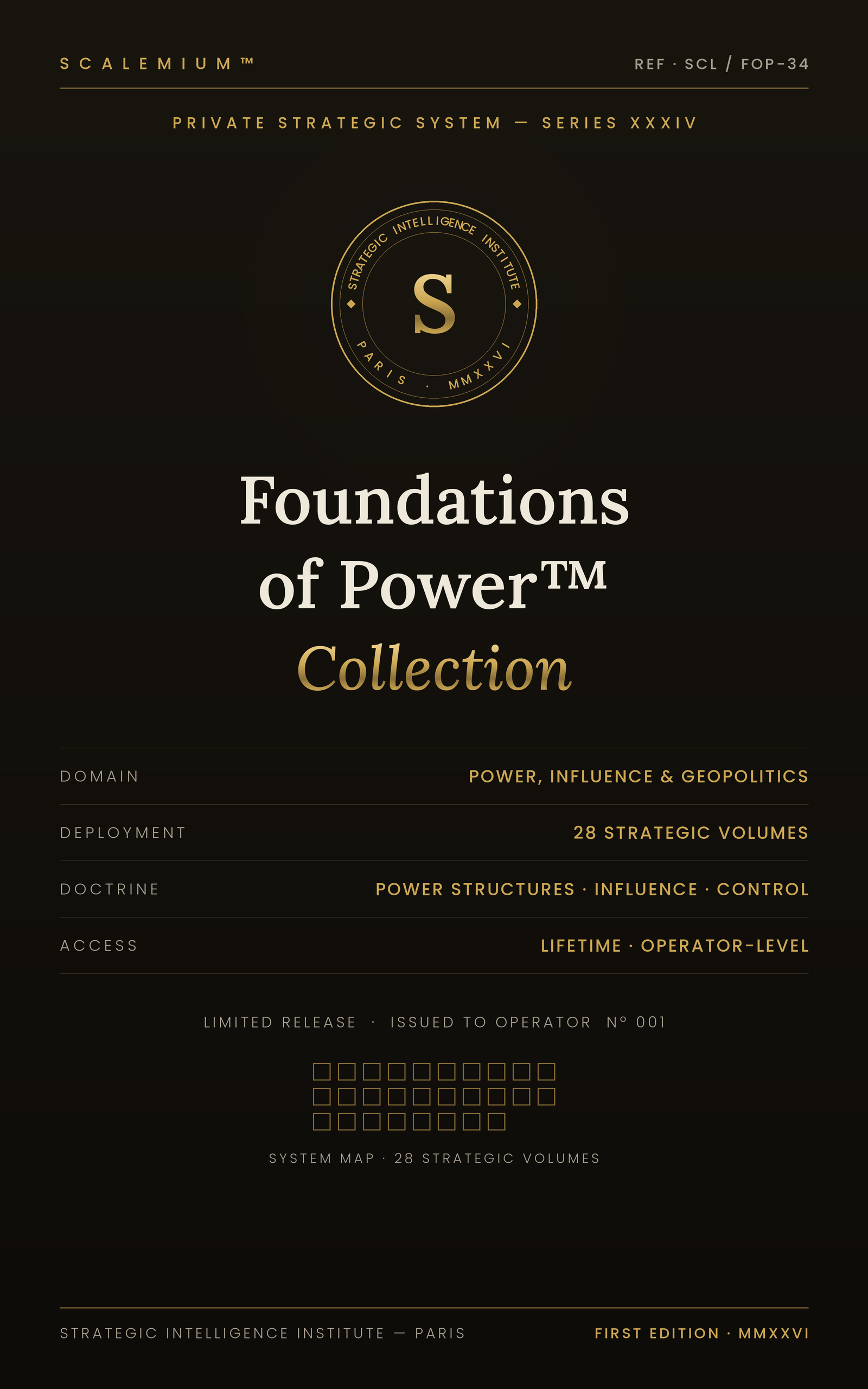
Foundations of Power operates as the foundational canon of the Scalemium Power, Influence & Geopolitics library. It is the collection that establishes the structural architecture from which all other Power collections derive their analytical foundations. The collection extends across 30 volumes covering the architectural foundations of power and influence — from the anatomy of power through the first principles operating across civilizations, from the architecture of authority through the psychology of control, from the symbolic dimensions of power through the institutional infrastructure that determines whether power endures or collapses.
This collection occupies a specific position within the Scalemium Strategic Intelligence library. It operates as foundational canon — the framework from which all other Power, Influence & Geopolitics collections derive their analytical depth.
The other collections in the Power edition address specific domains where power operates — influence and persuasion, geopolitical dynamics, the architecture of empire and sovereign power, the contemporary infrastructure of global power. Each addresses its domain comprehensively. Yet each also rests on foundational understanding of power itself that, if absent, limits the depth of engagement possible with the specialized material.
Foundations of Power establishes this foundational understanding. It is the collection an operator would engage first to build the analytical infrastructure from which the other Power collections become fully accessible. It is the collection that allows specialized engagement with power across domains to operate as canonical knowledge rather than as isolated insight.
The foundational canon establishes the architectural principles that connect:
— The operation of power across visible and invisible dimensions
— The relationship between formal authority and actual influence
— The structural conditions producing institutional endurance and collapse
— The psychology of power’s operation on those who exercise it and those subject to it
— Power across diverse domains as expressions of unified structural mechanisms
— Contemporary power dynamics within the patterns recurring across three thousand years of recorded political history
These architectural principles, once understood, allow specialized engagement with influence, geopolitics, sovereign strategy, and other Power collection domains to operate as applications of canonical understanding rather than as isolated topics.
The collection addresses the foundational dimensions of power essential to strategic operation involving the construction, exercise, anticipation, or resistance of influence and authority.
The collection articulates the structural nature of power — what power is, how it operates as institutional and human phenomenon, why it emerges, what functions it serves. Strategic operators receive structural recognition of power as integrated phenomenon rather than as collection of specific manifestations.
The collection articulates the first principles operating across diverse strategic traditions — principles that recur across political philosophies, military traditions, institutional practices, and historical periods with remarkable consistency. These principles constitute the canonical infrastructure of power analysis from which all subsequent strategic engagement derives.
The collection addresses the architectural dimensions of authority and legitimacy. Power that lacks legitimacy operates expensively through enforcement mechanisms that consume substantial resources. Power that achieves legitimacy operates through voluntary compliance that requires minimal enforcement. The collection articulates the structural foundations of this critical distinction.
The collection articulates the structural distinction between visible power — the power that announces itself through formal authority and explicit institutional position — and invisible power — the power that operates beneath the surface of institutional life through influence, agenda-setting, narrative control, and structural arrangement. The strategic implications of this distinction are substantial for operators whose effectiveness depends on understanding actual operational reality rather than merely formal description.
The collection addresses the multiple currencies through which power operates — attention, trust, fear, dependency, information, capital, narrative authority, institutional position. Different currencies operate differently. The strategic operators who understand the operational characteristics of different power currencies engage power with substantially more sophistication than operators who recognize only one or two currencies.
The collection articulates the structural patterns governing how hierarchies form, sustain themselves, and collapse. These patterns recur across institutional types — political systems, corporate organizations, religious institutions, military commands, social arrangements. The collection addresses the patterns as institutional realities rather than as abstract observations.
The collection addresses how power changes the minds of those who exercise it and those who are subject to it. The psychological dynamics of power operate with substantial consistency across institutional contexts and produce strategic considerations operators in positions of authority — or operating beneath authority — must engage.
The collection articulates the structural distinction between power exercised by individuals through personal capability and power operating through systems that may persist regardless of the individuals occupying positions within them. The systemic perspective provides substantially more strategic intelligence than the personalist perspective.
The collection addresses the structural mechanics of power construction — how power is actually built rather than how its construction is typically described. The mechanics involve combinations of resources, perception, timing, narrative, institutional positioning, and several other elements whose interaction produces the actual power dynamics operators navigate.
The collection articulates the structural conditions producing power’s fragility — the conditions under which seemingly substantial power dissolves — and power’s endurance — the conditions under which power persists across centuries or longer. These conditions can be identified, articulated, and engaged systematically.
The collection addresses the temporal dimensions of power — the structural advantages accruing to operators who think across longer time horizons than their competitors, the strategic significance of timing in power dynamics, and the relationship between immediate tactical power and sustained strategic power.
The collection articulates the symbolic dimensions of power — flags, myths, narratives, ceremonies, and other symbolic infrastructure whose operational significance traditional analyses frequently understate. Symbolic power produces effects that material power alone cannot produce.
The collection addresses power as infrastructure — the relationship between power and the institutional design that determines whether power operates through structures that persist across leadership transitions or whether power depends on specific individuals whose departure produces institutional vulnerability.
The collection operates across 30 volumes structured through three canonical foundations — each addressing an essential dimension of foundational power understanding.
The opening foundation establishes the structural anatomy of power — what power is, how it operates, the first principles governing it across civilizations and historical periods, and the systemic versus individual dimensions of power’s operation.
Volume 1 — The Anatomy of Power: How Influence Is Built, Maintained, and Lost
Volume 2 — First Principles of Power: The Timeless Laws Governing Control and Authority
Volume 3 — Power Systems: Understanding How Control Operates Beyond Individuals
Volume 4 — The Nature of Influence: How Decisions Are Shaped Without Force
Volume 5 — Power Without Illusions: Separating Myth from Reality
Volume 6 — The Architecture of Authority: Institutions, Symbols, and Legitimacy
Volume 7 — Invisible Power: Control Without Visibility
Volume 8 — The Currency of Power: Attention, Trust, Fear, and Dependency
Volume 9 — Power Dynamics: How Hierarchies Form and Collapse
Volume 10 — Strategic Power: Winning Without Conflict
The second foundation addresses the psychological dimensions of power, the structural relationship between power and legitimacy, the operation of hidden power behind institutional surfaces, and the temporal dimensions of strategic power.
Volume 11 — The Psychology of Power: How Control Changes the Mind
Volume 12 — Power as a System: Why Individuals Matter Less Than Structures
Volume 13 — The Power Equation: Resources × Perception × Timing
Volume 14 — Authority and Obedience: Why Humans Comply
Volume 15 — The Illusion of Neutrality: Why Power Always Exists
Volume 16 — Power and Legitimacy: When Control Becomes Accepted
Volume 17 — The Hidden Rulers: How Influence Operates Behind Institutions
Volume 18 — The Power Stack: From Narrative to Enforcement
Volume 19 — Power and Time: Why Long-Term Thinkers Dominate
Volume 20 — The Fragility of Power: Why All Control Is Temporary
The closing foundation addresses the dimensions of power that operate beyond direct force, the structural conditions of power’s endurance, and the contemporary infrastructure of power across modern institutional environments.
Volume 21 — Power Beyond Violence: Influence in Modern Systems
Volume 22 — The Symbolic Dimension of Power: Flags, Myths, and Authority
Volume 23 — The Power Map: Identifying Control Centers
Volume 24 — Power Transfer: How Dominance Changes Hands
Volume 25 — The Logic of Control: Predicting Power Moves
Volume 26 — Power and Dependency: Who Needs Whom More
Volume 27 — The Cost of Power: What Control Demands in Return
Volume 28 — Power as Infrastructure: Systems That Outlast Leaders
Volume 29 — The Endurance of Authority: Why Some Powers Last Centuries
Volume 30 — Power in the Modern World: From Empires to Algorithms
The collection delivers institutional intelligence value across the foundational dimensions of power essential to strategic operation.
Operators receive the foundational canon of power analysis — the structural architecture from which specialized engagement with power across domains derives. The canonical infrastructure enables engagement with specialized power questions as integrated knowledge rather than as fragmented insight.
The collection provides the first principles of power that anchor strategic operation across the diverse contexts in which power operates. Operators making strategic decisions whose effectiveness depends on understanding power receive foundational principles applicable across institutional, political, economic, and informational domains.
The collection provides the canonical foundations enabling critical engagement with the substantial volume of commentary on power calibrated to particular political or ideological positions. Operators receive analytical infrastructure for distinguishing substantive power analysis from advocacy.
The collection provides comparative perspective on contemporary power dynamics. The recognition that contemporary patterns frequently recapitulate patterns observable across millennia provides predictive intelligence that contemporary-only analysis cannot match.
The collection provides integrative frameworks enabling analysis of power across the diverse domains in which it operates — political, economic, institutional, informational, geopolitical. The integrative perspective supports strategic operation across multiple power domains simultaneously.
The collection provides frameworks for engaging the dimensions of power that traditional analyses frequently understate — invisible power operating beneath institutional surfaces, symbolic power producing effects material power alone cannot produce, structural power operating through arrangements rather than through explicit exercise.
The collection supports multi-generational and institutional positioning. Family principals, dynastic operators, and institutional architects receive frameworks for engaging power across timescales their strategic positioning must accommodate.
The collection serves as foundational access to the rest of the Power, Influence & Geopolitics library. Operators having engaged the canonical infrastructure are positioned to engage specialized power collections with substantially greater analytical depth than would otherwise be possible.
The collection operates as reserved infrastructure for operators whose strategic positioning depends on understanding power.
Senior operators in institutional positions whose effectiveness depends on operating sophisticated within power environments — corporate leadership, institutional principals, organizational executives, governance leaders. Every substantial institutional position involves power dynamics that benefit from systematic understanding.
Investment principals whose strategic operation occurs within environments shaped by political, regulatory, and institutional power dynamics. The depth of power understanding shapes strategic positioning across investment domains, particularly for operators with substantial exposure to regulated industries, sovereign-adjacent investments, or geopolitically-sensitive positions.
Family office principals navigating multi-generational positioning under conditions where the power environments their architecture must accommodate vary substantially across jurisdictions and evolve substantially across generations. The strategic positioning of substantial family architecture benefits from canonical understanding of power dynamics.
Senior political operators, sovereign principals, governmental architects, and operators engaged directly with the construction and exercise of state power. The canonical understanding of power provides institutional-grade foundations for engagement at this depth.
Operators whose strategic operation involves the construction and exercise of influence — institutional communicators, public-facing principals, narrative architects, strategic philanthropists. The relationship between communication, influence, and power involves canonical dynamics that fragmentary engagement cannot adequately address.
Operators planning systematic engagement with the Power library benefit from beginning with the foundational canon. The other collections become substantially more accessible when engaged from canonical foundations rather than from fragmentary background.
Academic researchers in political science, international relations, strategic studies, and adjacent fields whose work requires institutional-grade synthesis of foundational power analysis as canonical infrastructure.
Historians, strategic analysts, and intellectual operators whose work engages the patterns of power across historical periods. The canonical infrastructure provides analytical foundations supporting sophisticated historical and contemporary analysis.
The collection operates as canonical foundation rather than as popular commentary on power or general-audience political analysis. The reserved positioning operates through strategic standards rather than through commercial accessibility.
This collection occupies a foundational position within the broader Scalemium Strategic Intelligence library. The Power, Influence & Geopolitics edition extends across five collections:
— Foundations of Power — the canonical foundation (this collection)
Additional collections within the Power edition address specialized dimensions of influence, geopolitical dynamics, and the operational reality of contemporary power infrastructure.
Each collection operates independently as comprehensive intelligence on its specific domain. The Foundations collection serves as canonical infrastructure from which engagement with the specialized collections derives substantially greater depth.
Operators considering systematic engagement with the Power, Influence & Geopolitics library benefit from beginning with the foundational canon. Multi-collection institutional access addresses operators planning systematic engagement across the full edition or across the broader Strategic Intelligence library.
Access: €6,997
Access operates through institutional channels. The collection delivers across the 30 volumes with continuing institutional support for operators integrating the foundational intelligence into their strategic infrastructure.
Reserved for operators recognizing that canonical understanding of power operates as foundational strategic dimension across institutional, professional, dynastic, and civilizational horizons. Not all applications warrant access.
→ Access This Collection — €6,997
Submit access request for institutional review.
→ Multi-Collection Institutional Access
For operators considering institutional access across the complete Power, Influence & Geopolitics edition or across the broader Strategic Intelligence library.
→ Private Advisory
For operators whose strategic situations warrant direct engagement at substantial depth.
Full access, delivered instantly upon acquisition.
For operators acquiring several collections within the Strategic Intelligence library. Submit your selection — we structure a single institutional access, priced accordingly.
For operators whose strategic situation warrants direct counsel at substantial depth.
SCALEMIUM™
Collections → Power, Influence & Geopolitics → Volume 1 — Canonical Foundation
If you understand power:
you read situations correctly
you understand decisions
you navigate systems effectively
 That’s real awareness.
Most people see outcomes.
Very few understand what creates them.
This collection gives you:
clarity on how power actually operates
Lorem ipsum dolor sit amet, consectetur adipiscing elit. Ut elit tellus, luctus nec ullamcorper mattis, pulvinar dapibus leo.
We use cookies to ensure the site functions properly, understand how it is used, and improve your experience. You can accept, reject, or manage your preferences at any time.