
|
SCALEMIUM™ — Strategic systems for modern operators. |
€ 6997
Ethics is the oldest strategic discipline.
For at least three thousand years, the most consequential thinkers in every civilization that has produced sustained written records have engaged the same foundational questions: What is right? What is wrong? On what basis can these determinations be made? How should power be exercised legitimately? What is owed by individuals to one another? What is owed to the institutions that organize collective existence? What is the relationship between law and morality? Between justice and authority? Between individual interest and collective welfare?
These questions have been engaged by Aristotle and Confucius, by Aquinas and Maimonides, by Kant and Hume, by Mill and Nietzsche, by Rawls and Levinas. Across philosophical traditions that operated in mutual ignorance of one another, across civilizations separated by continents and millennia, the same foundational questions have recurred with remarkable consistency — suggesting that they address something structural about the human condition itself rather than something contingent about specific cultural contexts.
The accumulated body of ethical inquiry represents one of humanity’s most substantial intellectual achievements. Three thousand years of disciplined philosophical work, tested against the practical demands of political organization, religious tradition, legal development, and individual moral struggle. The conclusions reached, the frameworks developed, and the unresolved questions identified collectively constitute the canonical infrastructure of moral thought — the body of knowledge from which all subsequent ethical inquiry derives its analytical depth and from which all contemporary ethical engagement gains its institutional weight.
Yet most strategic operators engage ethics fragmentarily.
They encounter it through whichever subdomain became relevant to a specific problem — business ethics for corporate decisions, bioethics for medical questions, AI ethics for technology deployment, political ethics for governance situations. The result is partial intelligence — functional at the boundaries of specific applications but disconnected from the canonical foundations that connect these applications to one another and to the broader architectural principles of moral systems.
What is missing is the canonical infrastructure: the foundational understanding of ethics from which all the subdomains derive. The structural principles that govern how moral systems operate. The architectural features that distinguish robust ethical frameworks from fragile ones. The accumulated wisdom of three thousand years of philosophical inquiry applied to questions that recur across every era and that contemporary operators face in forms their predecessors would recognize despite the surface differences of contemporary conditions.
This foundational engagement is increasingly consequential.
The strategic operators of significance navigate institutional environments in which ethical considerations operate with substantial structural weight. Regulatory frameworks rest on ethical foundations. Reputational capital depends on perceived ethical conduct. Institutional legitimacy requires ethical justification. Investment decisions increasingly incorporate ethical criteria. Personnel relationships operate within ethical expectations. Strategic positioning across long timescales requires ethical frameworks calibrated to multi-generational implications. The operators who engage these dimensions fragmentarily — relying on intuitive ethical responses, partial frameworks, or popular ethical commentary — operate at substantial disadvantage relative to operators who engage from canonical foundations.
The canonical foundations also operate as protection against ethical manipulation. Contemporary discourse contains substantial volumes of ethical commentary calibrated to particular political agendas, commercial interests, or ideological commitments. Operators without canonical foundations have limited capacity to distinguish institutionally rigorous ethical analysis from ethically-framed advocacy. The canonical infrastructure provides this distinguishing capacity.
This collection addresses that engagement.
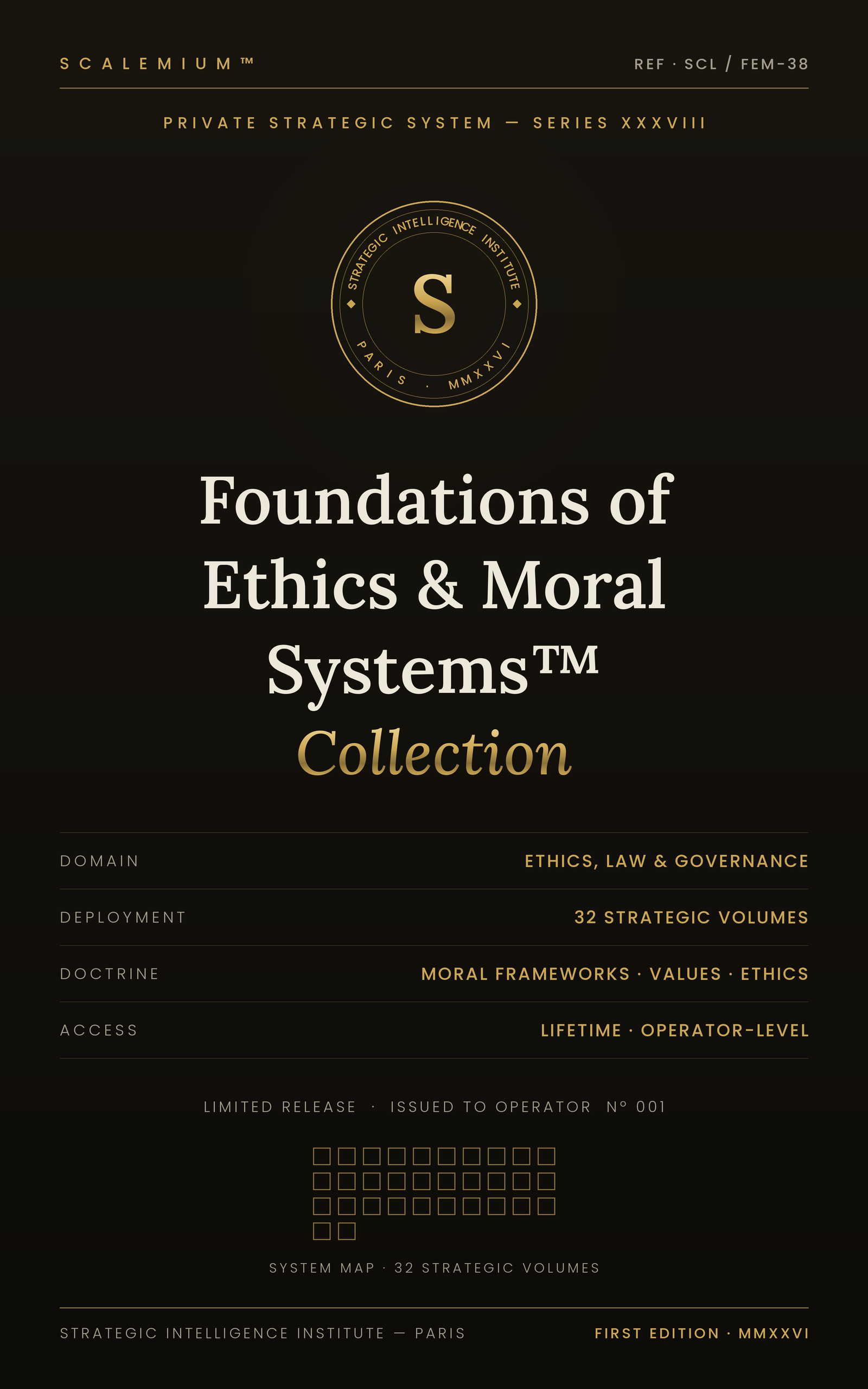
Foundations of Ethics & Moral Systems operates as the foundational canon of the Scalemium Ethics, Law & Governance library. It is the collection that establishes the structural architecture from which all other Ethics collections derive their analytical foundations. The collection extends across 30 volumes covering the architectural foundations of ethics and moral systems — from the nature of ethics through the first principles operating across civilizations, from the architecture of values through the institutional infrastructure of moral systems, from the evolution of morality through the ethical considerations that will define the coming century.
This collection occupies a specific position within the Scalemium Strategic Intelligence library. It operates as foundational canon — the framework from which all other Ethics collections derive their analytical depth.
The other Ethics, Law & Governance collections address specific institutional and applied domains — AI governance, regulatory architecture, corporate ethics, geopolitical and civilizational ethics. Each addresses its domain comprehensively. Yet each also rests on foundational understanding of ethics that, if absent, limits the depth of engagement possible with the specialized material.
Foundations of Ethics & Moral Systems establishes this foundational understanding. It is the collection an operator would engage first to build the analytical infrastructure from which the other Ethics collections become fully accessible. It is the collection that allows specialized ethical intelligence to operate as canonical knowledge rather than as isolated insight.
The foundational canon establishes the architectural principles that connect:
— The nature of ethics to the structures of moral systems
— Individual moral choice to institutional ethical infrastructure
— Universal moral principles to contextual ethical applications
— Historical ethical development to contemporary ethical challenges
— Ethics as philosophical inquiry to ethics as operational infrastructure
— Moral theory to the practical decision-making of strategic operators
These architectural principles, once understood, allow specialized ethical engagement — AI ethics, business ethics, political ethics, bioethics — to be engaged not as isolated topics but as applications of underlying canonical foundations.
The collection addresses the foundational dimensions of ethics essential to strategic operation involving moral consideration.
The collection articulates the structural nature of ethics — why humans create moral rules, what functions moral systems serve, how ethics operates as institutional phenomenon rather than as merely individual preference. Strategic operators receive structural recognition of what ethics is and what it does.
The collection articulates the first principles operating across the major ethical traditions — principles that recur across philosophical schools, religious traditions, and cultural contexts with remarkable consistency. These principles constitute the canonical infrastructure from which all subsequent ethical inquiry derives.
The collection addresses the architectural dimensions of moral systems — how values become institutional structures, how moral systems operate as social infrastructure, how the boundaries and limits of moral systems are determined. Operators engaged with institutional design receive frameworks calibrated to the architectural reality of moral systems.
The collection engages the foundational debate regarding whether ethical principles are objectively grounded or culturally constructed. This debate has substantial institutional implications — affecting how cross-cultural ethical claims operate, how legal universals are justified, how international ethical coordination is possible.
The collection addresses the historical development of moral systems — how ethics has evolved through cooperation, conflict, survival pressures, religious development, and philosophical refinement. The evolutionary perspective supports recognition of which ethical features represent structural necessity and which represent contingent historical development.
The collection articulates the ethical considerations operating in the exercise of power. Power exercised legitimately requires ethical foundations. The collection addresses the structural relationship between power, responsibility, accountability, and legitimacy — relationships of substantial consequence for strategic operators in positions of institutional authority.
The collection addresses the structural reality that ethical decisions frequently involve genuine conflicts between values that cannot be simultaneously honored. Operators receive frameworks for engaging these conflicts as institutional realities rather than as failures of moral system design.
The collection articulates the structural limits of moral systems — the conditions under which moral systems fail, the patterns of moral failure that recur across institutional contexts, and the conditions under which ethical operation breaks down even within otherwise robust systems.
The collection addresses the universal-versus-local question in ethics. The strategic implications of this question affect international operation, cross-cultural institutional design, multi-jurisdictional ethical positioning, and the foundational legitimacy of ethical claims that operate across cultural boundaries.
The collection articulates ethics as infrastructure — the invisible system that holds societies together, that enables cooperation across populations larger than direct relationships can sustain, that provides the legitimacy underlying institutional authority. Operators engaged with institutional construction receive frameworks for understanding ethics as foundational infrastructure rather than as discretionary commitment.
The collection addresses ethical resilience — the structural conditions under which ethical commitments persist across time, across pressure, across changing circumstances, across multi-generational horizons. Operators concerned with sustaining ethical operation across substantial timescales receive frameworks for engaging this concern.
The collection articulates the multi-generational dimensions of ethics — the considerations that operate across timescales extending beyond individual operator engagement. Operators thinking dynastically or civilizationally receive frameworks for engaging ethics as multi-generational rather than as merely contemporary concern.
The collection operates across 30 volumes structured through three foundational orders — each addressing an essential dimension of canonical ethical understanding.
The opening order establishes the foundational nature of ethics, the architectural principles of moral systems, and the first principles operating across civilizations.
Volume 1 — The Nature of Ethics: Why Humans Create Moral Rules
Volume 2 — First Principles of Ethics: Timeless Moral Structures Across Civilizations
Volume 3 — The Moral Architecture: How Values Become Systems
Volume 4 — Ethics Without Illusions: Power, Incentives, and Reality
Volume 5 — The Universal Moral Debate: Are Ethics Objective or Constructed?
Volume 6 — The Evolution of Morality: Survival, Cooperation, and Norms
Volume 7 — Ethics as Infrastructure: Invisible Rules That Hold Societies Together
Volume 8 — Moral Decision-Making: Choosing Under Uncertainty
Volume 9 — The Limits of Ethics: When Moral Systems Fail
Volume 10 — The Ethics of Power: Responsibility of Control
The second order addresses the operational reality of ethics — the conflicts between values, the complexity of moral situations, the relationship between ethics and human nature, and the institutional reality of ethical legitimacy.
Volume 11 — Values in Conflict: Trade-Offs Without Perfect Answers
Volume 12 — Moral Complexity: Ethics Beyond Simple Rules
Volume 13 — Ethics and Human Nature: Instinct vs Principle
Volume 14 — The Cost of Moral Choices: Who Pays the Price?
Volume 15 — Ethics Across Cultures: Universal Rules or Local Norms?
Volume 16 — The Moral Compass: Navigating Right and Wrong
Volume 17 — Ethics in Action: When Theory Meets Reality
Volume 18 — The Responsibility Principle: Accountability for Impact
Volume 19 — The Moral System: How Ethics Scale Beyond Individuals
Volume 20 — Ethics and Legitimacy: Why Authority Needs Morality
The closing order addresses ethics under pressure, the multi-generational dimensions of moral systems, the conditions of ethical resilience, and the recognition that ethics will operate as defining dimension of the coming century.
Volume 21 — The Ethics of Progress: When Advancement Causes Harm
Volume 22 — The Moral Blind Spot: Why Good Intentions Fail
Volume 23 — Ethics Under Pressure: Decisions in Crisis
Volume 24 — The Moral Trade-Off: Choosing Between Harms
Volume 25 — Ethical Resilience: Maintaining Values Over Time
Volume 26 — The Ethics of Survival: Morality in Extreme Conditions
Volume 27 — The Moral Boundary: Where Ethics Stop
Volume 28 — Ethics and Trust: The Foundation of Cooperation
Volume 29 — The Moral Legacy: Ethics Across Generations
Volume 30 — The Ethical Century: Why Morality Will Define the Future
The collection delivers institutional intelligence value across the foundational dimensions of ethics essential to strategic operation.
Operators receive the foundational canon of moral philosophy — the structural architecture from which specialized ethical intelligence derives. The canonical infrastructure enables engagement with specialized ethical questions as integrated knowledge rather than as fragmented insight.
The collection provides the first principles of ethics that anchor strategic operation across institutional contexts. Operators making decisions involving moral consideration receive foundational principles that apply across the specific contexts in which strategic operation occurs.
The collection provides frameworks for navigating the genuine complexity of ethical situations — the conflicts between values, the trade-offs without perfect answers, the moral choices whose costs distribute unevenly across affected parties. Operators receive analytical infrastructure calibrated to ethical reality rather than to simplified ethical idealizations.
The collection provides foundational intelligence on the universal-versus-local question in ethics. Operators with multi-jurisdictional, multi-cultural, or international operational contexts receive frameworks for engaging the ethical dimensions of these contexts.
The collection articulates the structural relationship between ethics and legitimacy. Operators in positions of institutional authority receive frameworks for understanding what ethical foundations their legitimacy rests upon and what structural conditions sustain or erode that legitimacy.
The collection provides frameworks for sustaining ethical operation across time, across pressure, across changing circumstances. Operators concerned with long-term ethical consistency receive analytical infrastructure for engaging this concern at substantial depth.
The collection supports multi-generational ethical positioning. Family principals, dynastic operators, and institutional architects thinking across generations receive frameworks for engaging ethics as multi-generational concern rather than as merely contemporary commitment.
The collection serves as foundational access to the rest of the Ethics, Law & Governance library. Operators having engaged the canonical infrastructure are positioned to engage the specialized Ethics collections — AI governance, regulatory architecture, applied ethics, civilizational ethics — with substantially greater analytical depth than would otherwise be possible.
The collection provides foundational capacity to distinguish institutionally rigorous ethical analysis from ethically-framed advocacy. The canonical foundations enable critical engagement with the substantial volume of ethical commentary calibrated to particular agendas — an increasingly valuable capacity in contemporary discursive environments.
The collection operates as reserved infrastructure for operators whose strategic operation depends on integrated ethical understanding.
Senior operators in positions of institutional authority — corporate leadership, foundation principals, organizational executives, governance principals. The exercise of institutional authority requires ethical foundations whose canonical depth determines the legitimacy and resilience of that authority.
Senior legal practitioners, regulatory architects, and legal scholars whose work depends on the relationship between law and ethics. The collection provides foundational intelligence on this relationship at the depth this work requires.
Investment principals whose strategic operation incorporates ethical considerations — ESG investment, mission-aligned capital, family office investments with ethical screening. The institutional weight of these considerations depends on ethical foundations whose canonical depth determines their analytical rigor.
Family office principals navigating multi-generational positioning that includes ethical dimensions extending across generations. The strategic positioning of family architecture frequently involves ethical considerations whose canonical depth shapes the institutional coherence of multi-generational planning.
Operators whose work involves the public articulation of ethical positions — institutional spokespersons, public intellectuals, ethical theorists, communications principals. The canonical foundations support institutional-grade ethical articulation.
Operators planning systematic engagement with the Ethics, Law & Governance library benefit from beginning with the foundational canon. The other collections become substantially more accessible when engaged from canonical foundations rather than from fragmentary background.
Academic researchers in moral philosophy, applied ethics, political philosophy, and adjacent fields whose work requires institutional-grade synthesis of foundational ethics as canonical infrastructure.
Religious leaders, theological scholars, and spiritual principals whose work involves the institutional articulation of ethical and moral positions. The canonical foundations of ethical thought provide analytical infrastructure for work at this depth.
The collection operates as canonical foundation rather than as introductory ethics or popular moral commentary. The reserved positioning operates through strategic standards rather than through commercial accessibility.
This collection occupies a foundational position within the broader Scalemium Strategic Intelligence library. The Ethics, Law & Governance edition extends across five collections:
— Foundations of Ethics & Moral Systems — the canonical foundation (this collection)
— Ethics, Law & AI Governance — the institutional governance of artificial intelligence
Additional collections within the Ethics, Law & Governance edition address specialized institutional and applied dimensions of ethics and governance.
Each collection operates independently as comprehensive intelligence on its specific domain. The Foundations collection serves as canonical infrastructure from which engagement with the specialized collections derives substantially greater depth.
Operators considering systematic engagement with the Ethics, Law & Governance library benefit from beginning with the foundational canon. Multi-collection institutional access addresses operators planning systematic engagement across the full Ethics, Law & Governance edition or across the broader Strategic Intelligence library.
Access: €6,997
Access operates through institutional channels. The collection delivers across the 30 volumes with continuing institutional support for operators integrating the foundational intelligence into their strategic infrastructure.
Reserved for operators recognizing that canonical ethical understanding operates as foundational strategic dimension across all institutional, professional, and multi-generational horizons. Not all applications warrant access.
→ Access This Collection — €6,997
Submit access request for institutional review.
→ Multi-Collection Institutional Access
For operators considering institutional access across the complete Ethics, Law & Governance edition or across the broader Strategic Intelligence library.
→ Private Advisory
For operators whose strategic situations warrant direct engagement at substantial depth.
Full access, delivered instantly upon acquisition.
For operators acquiring several collections within the Strategic Intelligence library. Submit your selection — we structure a single institutional access, priced accordingly.
For operators whose strategic situation warrants direct counsel at substantial depth.
SCALEMIUM™
Collections → Ethics, Law & Governance → Volume 2 — Canonical Foundation
Most people live inside moral systems…
Without ever seeing them.
This collection gives you what few people ever develop:
 ethical awareness at a strategic level
We use cookies to ensure the site functions properly, understand how it is used, and improve your experience. You can accept, reject, or manage your preferences at any time.