
|
SCALEMIUM™ — Strategic systems for modern operators. |
€ 6997
Wealth is constructed. It does not happen.
The structural difference between operators who build sustained wealth across generations and operators who do not is not luck, intelligence, or work ethic. It is architecture. The architecture is foundational — operating through structural principles that have been articulated across approximately three hundred years of serious financial inquiry, that recur with remarkable consistency across operators who achieve sustained wealth, and that remain largely outside the analytical infrastructure of most strategic operators despite being neither secret nor inaccessible.
Most operators encounter wealth through inadequate frameworks.
They understand income, which is not wealth. They understand markets, which are not the structural conditions producing wealth. They understand specific investment categories — equities, real estate, private companies, alternative assets — without understanding the structural architecture within which these categories operate as expressions of underlying capital principles. They engage financial decisions through fragmentary intelligence accumulated through specific situations rather than through canonical understanding of the structural mechanics governing capital itself. The gap between fragmentary financial intelligence and canonical capital architecture has substantial consequences for sustained wealth construction.
The strategic operators of significance who engage capital architecture systematically operate with structural advantages.
They understand the difference between assets and liabilities at the level of structural analysis rather than at the level of accounting category. They understand the structural relationship between time and capital that produces the compounding dynamics distinguishing sustained wealth from cyclical accumulation. They understand the architecture of risk, return, and the trade-offs whose mechanics determine whether capital deployment produces sustained value or systematic erosion. They understand the structural conditions producing wealth concentration — the patterns observable across markets, generations, and historical periods that explain why capital accumulates in certain configurations and dissipates in others. They understand the institutional architecture of finance — the systems, intermediaries, instruments, and structural relationships through which serious capital operation actually occurs.
The operators who lack canonical capital architecture operate with substantial structural disadvantage relative to operators with it.
This disadvantage is not visible during expansion phases of financial cycles. During expansions, fragmentary financial engagement produces apparent returns that mask the structural inadequacy of the underlying frameworks. The disadvantage becomes visible — often catastrophically — during contraction phases, crisis events, and the broader structural transitions that recur across financial history with substantial regularity. The operators whose wealth construction operates through canonical architecture survive these transitions and frequently emerge with strengthened positioning. The operators whose wealth construction operates through fragmentary engagement experience these transitions as discrete catastrophes rather than as structural events whose dynamics could have been anticipated and engaged.
The gap is widening.
The financial environments of the coming decades operate within conditions substantially more complex than those operating during recent decades. Monetary architecture is destabilizing. Asset categories are restructuring. Capital flows operate through emerging infrastructures whose structural characteristics differ from traditional frameworks. Wealth preservation across multi-generational timescales operates within institutional environments substantially different from those operating during the relatively stable post-WWII period. The operators positioning strategically for the coming decades require canonical capital architecture substantially more sophisticated than fragmentary financial intelligence provides.
This collection addresses that architecture.
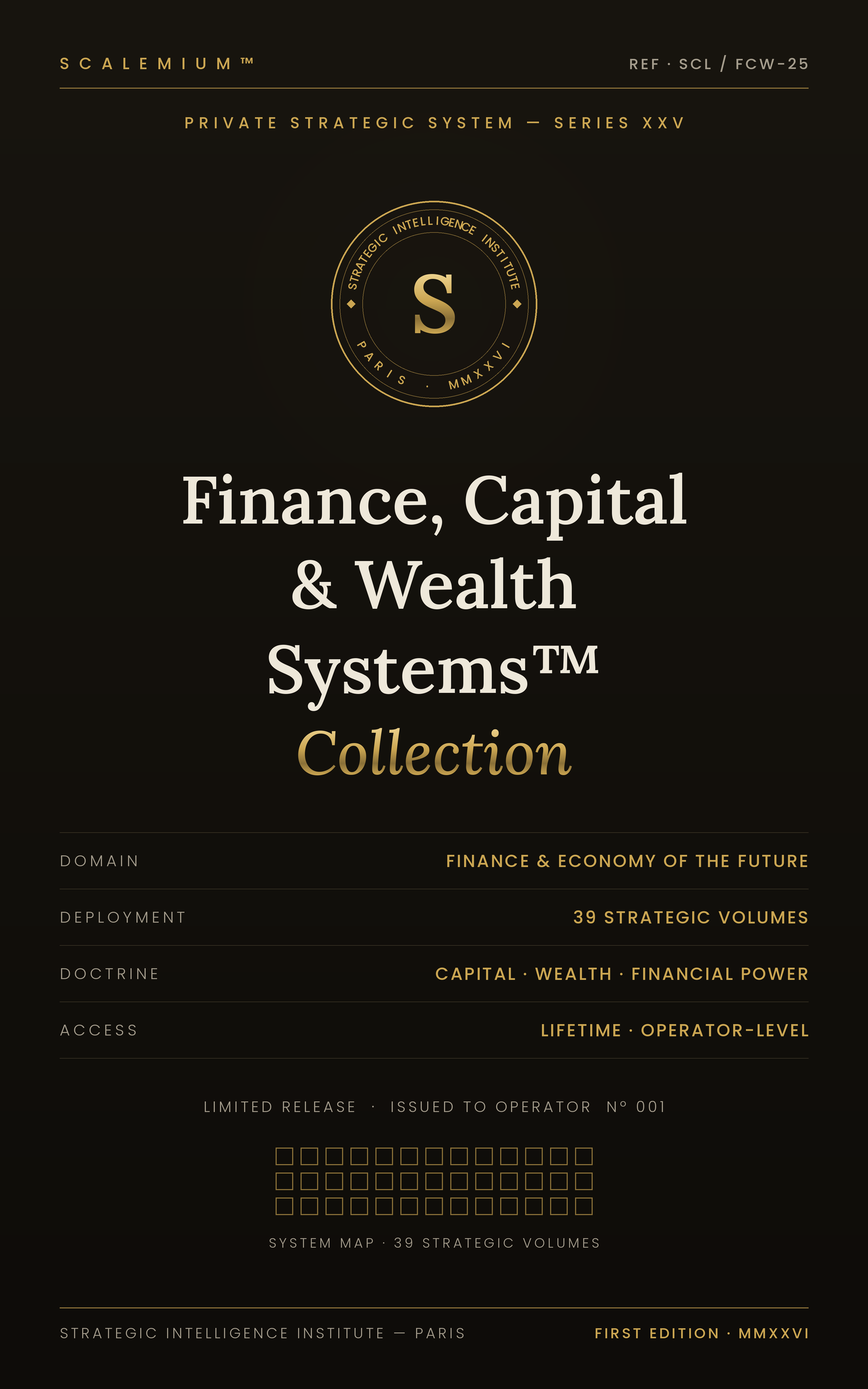
Finance, Capital & Wealth Systems operates as the architectural foundation of the Scalemium Finance & Economy of the Future library. It is the collection that establishes the canonical infrastructure from which all other Finance collections derive their analytical foundations. The collection extends across 40 volumes covering the architectural dimensions of capital and wealth — from the foundational mechanics of how money produces more money through the structural architecture of investor sophistication, from the logic of long-term capital operation through the institutional reality of how substantial capital actually operates, from the patterns of wealth concentration through the doctrine of multi-generational wealth preservation.
This collection occupies a specific position within the Scalemium Strategic Intelligence library. It operates as architectural foundation — the framework from which all other Finance collections derive their analytical depth.
The other collections in the Finance edition address specific domains where capital operates — the future of money and monetary systems, investment infrastructure and emerging asset categories, the economics of transformation and the financial systems of the coming decades. Each addresses its domain comprehensively. Yet each also rests on foundational understanding of capital itself that, if absent, limits the depth of engagement possible with the specialized material.
Finance, Capital & Wealth Systems establishes this foundational understanding. It is the collection an operator would engage first to build the analytical infrastructure from which the other Finance collections become fully accessible. It is the collection that allows specialized engagement with finance to operate as canonical knowledge rather than as isolated insight.
The foundational architecture establishes the principles that connect:
— Capital as instrument and capital as substrate
— Wealth as accumulated value and wealth as institutional infrastructure
— Investment as activity and investment as integrated discipline
— Risk as exposure and risk as analytical category
— Time and capital as inseparable strategic dimensions
— Individual capital decisions and the institutional architecture within which they operate
— Contemporary financial operation and the canonical principles operating across three hundred years of financial inquiry
These principles, once understood, allow specialized engagement with monetary systems, investment infrastructure, and the broader Finance library to operate as applications of canonical understanding rather than as isolated topics.
The collection addresses the foundational dimensions of capital and wealth essential to strategic operation involving financial decisions.
The collection articulates capital as structural phenomenon — what capital is, how it operates as institutional and economic infrastructure, why it accumulates in certain configurations and dissipates in others. Strategic operators receive structural recognition of capital as integrated phenomenon rather than as collection of specific financial categories.
The collection addresses wealth as architectural construct rather than as accumulated balance. Wealth operates through structures — asset configurations, ownership architectures, leverage relationships, liquidity arrangements — whose interaction determines whether accumulated value produces sustained advantage or systematic erosion across time.
The collection articulates investment as integrated discipline operating through structural principles rather than as activity addressing specific opportunities. The discipline integrates risk, return, time, information, and institutional positioning into coherent framework supporting investment decisions across the diverse situations operators encounter.
The collection addresses the structural relationship between time and capital that produces compounding dynamics. Time operates as the most powerful asset in capital architecture — yet time advantages compound only through structural arrangements that operators must construct deliberately. The collection articulates these arrangements with the depth their strategic implications require.
The collection articulates risk as integrated analytical category rather than as occasional concern. Risk operates across multiple dimensions — market risk, credit risk, liquidity risk, structural risk, tail risk, geopolitical risk, regulatory risk — whose interaction determines actual capital exposure. The collection addresses risk intelligence as foundational strategic capability.
The collection addresses the structural patterns producing wealth concentration. These patterns recur across markets, generations, and historical periods with substantial consistency. The operators who recognize these patterns operate with strategic intelligence that pattern-blind engagement cannot match.
The collection articulates the structural reality of financial cycles. Markets do not produce smooth linear development. They operate through cycles whose structural mechanics produce expansion, peak, contraction, and reset across timescales operators must navigate strategically. The collection addresses these mechanics as institutional realities rather than as occasional disruptions.
The collection addresses leverage and ownership as integrated strategic categories. Leverage operates as multiplier — both upward and downward — whose strategic mechanics differ substantially across applications. Ownership operates as foundational strategic category distinguishing operators with structural position from operators without it.
The collection articulates liquidity as integrated strategic capability rather than as merely operational consideration. Liquidity operates as the capacity to act when others cannot — to acquire when others must sell, to position when others must liquidate, to operate strategically when broader markets operate reactively. The strategic significance of liquidity exceeds what traditional liquidity analysis addresses.
The collection addresses how substantial capital actually operates — the institutional infrastructure, the intermediaries, the instruments, the relationships, and the structural conditions through which serious capital deployment occurs. The institutional reality differs substantially from retail-investor frameworks that dominate popular financial discourse.
The collection articulates wealth preservation as integrated multi-generational discipline. Wealth construction operates differently from wealth preservation. The structural conditions producing wealth accumulation differ from the conditions producing wealth endurance across generations. The collection addresses preservation doctrine with the depth its multi-generational implications require.
The collection addresses the structural dynamics of financial systems under stress. Crises follow patterns. The operators who recognize these patterns navigate crises with strategic capability that crisis-blind engagement cannot match. The collection articulates these patterns as institutional intelligence rather than as historical observation.
The collection addresses the institutional dimensions of finance that operate substantially outside public visibility. Substantial capital operation occurs through infrastructure — institutional, jurisdictional, structural — that retail-oriented financial discourse does not adequately address. The collection articulates this hidden architecture with appropriate analytical depth.
The collection articulates capital operation under conditions of structural instability. The financial environments of the coming decades will operate under conditions substantially different from the relatively stable conditions of recent decades. The operators positioning for these environments require frameworks calibrated to actual conditions.
The collection operates across 40 volumes structured through four capital structures — each addressing a foundational dimension of finance, capital, and wealth systems.
The opening structure establishes the foundational architecture of capital and wealth — the mechanics through which capital produces capital, the structural foundations of wealth, the architecture of financial power, and the foundational principles of investment operation.
Volume 1 — The Capital Engine: How Money Is Turned Into More Money
Volume 2 — The Structure of Wealth: Assets, Leverage, and Ownership
Volume 3 — Financial Power Structures: Who Controls Capital
Volume 4 — The Investor Mindset: Thinking in Probabilities, Not Certainties
Volume 5 — Capital Allocation Mastery: Where Money Creates Maximum Impact
Volume 6 — The Financial Stack: Cash, Credit, Assets, Derivatives
Volume 7 — The Logic of Investment: Risk, Return, and Time Horizons
Volume 8 — Wealth Building Systems: Repeatable Paths to Capital Growth
Volume 9 — The Power of Compounding: Time as the Ultimate Asset
Volume 10 — Financial Decision-Making: Choosing Under Uncertainty
The second structure addresses portfolio architecture, capital preservation, financial cycle dynamics, and the structural patterns governing wealth concentration and capital hierarchy.
Volume 11 — The Portfolio Mind: Diversification and Concentration Explained
Volume 12 — Capital Preservation: Protecting Wealth in Volatile Times
Volume 13 — The Financial Cycle: Boom, Bust, Reset
Volume 14 — Smart Money Behavior: How Capital Thinks
Volume 15 — The Economics of Leverage: When Debt Becomes Power
Volume 16 — The Asset Economy: Owning vs Working
Volume 17 — Financial Risk Intelligence: Seeing Danger Before It Hits
Volume 18 — The Investor’s Edge: Information, Timing, Discipline
Volume 19 — Wealth Concentration Dynamics: Why the Rich Get Richer
Volume 20 — The Capital Hierarchy: Who Gets Paid First
The third structure addresses financial crisis dynamics, the strategic significance of liquidity, the discipline of long-term capital operation, and the structural foundations of ownership and capital infrastructure.
Volume 21 — The Financial Crisis Playbook: Surviving System Shocks
Volume 22 — Liquidity and Power: Cash as Strategic Weapon
Volume 23 — The Long-Term Investor: Winning Beyond Speculation
Volume 24 — Capital as Infrastructure: Financing the World
Volume 25 — The Economics of Ownership: Control Through Equity
Volume 26 — Wealth Defense: Hedging, Diversification, Strategy
Volume 27 — The Hidden Costs of Capital: What Returns Don’t Show
Volume 28 — Financial Systems Under Stress: Crisis Dynamics
Volume 29 — The Future of Investment: Beyond Traditional Assets
Volume 30 — Capital Intelligence: Making Money Decisions With Clarity
The closing structure addresses private wealth strategy, the institutional reality of substantial capital operation, the hidden architecture of finance, and the multi-generational doctrine of capital endurance under conditions of structural instability.
Volume 31 — Private Wealth Strategy: Long-Term Capital Stewardship
Volume 32 — The Economics of Scale: Why Size Matters Financially
Volume 33 — The Risk-Reward Frontier: Pushing Without Breaking
Volume 34 — The Institutional Investor: How Big Money Thinks
Volume 35 — Capital Formation: Turning Ideas Into Funded Reality
Volume 36 — The Wealth Preservation Doctrine: Keeping What You Build
Volume 37 — Financial Strategy for Elites: Managing Large Capital Pools
Volume 38 — The Hidden Architecture of Finance: What the Public Never Sees
Volume 39 — The Endurance Portfolio: Designing for Decades
Volume 40 — Capital in an Unstable World: Strategy Under Volatility
The collection delivers institutional intelligence value across the foundational dimensions of capital and wealth essential to strategic operation.
Operators receive the foundational architecture of capital — the structural framework from which specialized engagement with finance derives. The architecture enables engagement with specialized financial questions as integrated knowledge rather than as fragmented insight.
The collection provides the first principles of capital that anchor strategic operation across the diverse contexts in which financial decisions occur. Operators making decisions involving capital receive foundational principles applicable across investment, allocation, preservation, and broader capital deployment.
The collection provides frameworks for navigating financial cycles and crisis events. The structural patterns governing market dynamics across expansion, contraction, and reset operate with substantial consistency. Operators receive intelligence calibrated to actual cyclical reality rather than to expansion-phase frameworks that fail under stress.
The collection provides risk intelligence as foundational strategic capability rather than as occasional analytical exercise. Operators whose strategic positioning involves substantial capital receive integrated risk intelligence calibrated to the multiple dimensions of actual capital exposure.
The collection articulates wealth preservation as integrated multi-generational discipline. Family principals, dynastic operators, and institutional architects navigating wealth across generations receive frameworks for engaging preservation as structural project rather than as continuation of accumulation activity.
The collection provides intelligence on how substantial capital actually operates institutionally. Operators with substantial capital — or operators positioning to engage substantial capital — receive intelligence on institutional infrastructure that retail-oriented financial frameworks do not address adequately.
The collection provides intelligence on the institutional dimensions of finance operating substantially outside public visibility. Strategic operators benefit from understanding these dimensions rather than from operating within visibility-limited frameworks that fragmentary engagement provides.
The collection provides frameworks for capital operation under conditions of structural instability. Operators positioning for the coming decades benefit from intelligence calibrated to actual structural conditions rather than to assumptions about stability that historical experience does not support.
The collection serves as foundational access to the rest of the Finance & Economy of the Future library. Operators having engaged the architectural foundation are positioned to engage specialized Finance collections with substantially greater analytical depth than would otherwise be possible.
The collection operates as reserved infrastructure for operators whose strategic positioning involves substantial capital dimensions.
Senior investment principals — venture capital partners, private equity principals, family office investment committees, foundation investment leadership, sovereign wealth fund operators. The foundational architecture supports investment decision-making at the depth substantial capital positions require.
Family office principals navigating wealth construction, preservation, and multi-generational positioning. The architecture supports family wealth operation across timescales no individual operator can fully oversee, requiring canonical foundations rather than fragmentary engagement.
Senior corporate leadership — CFOs, treasury principals, corporate development leaders, senior executives whose decisions involve substantial capital deployment. The architecture supports financial decision-making at the depth corporate-scale capital operation requires.
Senior private bankers, wealth advisors, family office advisors, and financial professionals whose work involves substantial client capital. The collection provides institutional-grade synthesis supporting professional engagement at substantial depth.
Founders and operators whose business success has produced substantial capital requiring strategic deployment beyond business reinvestment. The transition from operational founder to capital allocator requires frameworks the operational success itself does not provide.
Senior operators in strategic intelligence functions whose work requires institutional-grade synthesis of capital architecture as foundational professional infrastructure.
Operators planning systematic engagement with the Finance & Economy of the Future library benefit from beginning with the architectural foundation. The other collections become substantially more accessible when engaged from foundational architecture rather than from fragmentary background.
Academic researchers in finance, economics, capital theory, and adjacent fields whose work requires institutional-grade synthesis of foundational capital architecture as canonical infrastructure.
The collection does not operate as popular financial commentary, retail-investor education, or general-audience content on money management. The reserved positioning operates through strategic standards rather than through commercial accessibility.
This collection occupies a foundational position within the broader Scalemium Strategic Intelligence library. The Finance & Economy of the Future edition extends across five collections, with this collection serving as architectural foundation:
— Finance, Capital & Wealth Systems — the architectural foundation (this collection)
Additional collections within the Finance edition address specialized dimensions of monetary systems, investment infrastructure, economic transformation, and the financial systems of the coming decades.
Each collection operates independently as comprehensive intelligence on its specific domain. The Finance, Capital & Wealth Systems collection serves as canonical infrastructure from which engagement with the specialized collections derives substantially greater depth.
Operators considering systematic engagement with the Finance & Economy of the Future library benefit from beginning with the architectural foundation. Multi-collection institutional access addresses operators planning systematic engagement across the full edition or across the broader Strategic Intelligence library.
Access: €6,997
Access operates through institutional channels. The collection delivers across the 40 volumes with continuing institutional support for operators integrating the foundational intelligence into their strategic infrastructure.
Reserved for operators recognizing that canonical capital architecture operates as foundational strategic dimension across investment, institutional, dynastic, and civilizational horizons. Not all applications warrant access.
→ Access This Collection — €6,997
Submit access request for institutional review.
→ Multi-Collection Institutional Access
For operators considering institutional access across the complete Finance & Economy of the Future edition or across the broader Strategic Intelligence library.
→ Private Advisory
For operators whose strategic situations warrant direct engagement at substantial depth.
Full access, delivered instantly upon acquisition.
For operators acquiring several collections within the Strategic Intelligence library. Submit your selection — we structure a single institutional access, priced accordingly.
For operators whose strategic situation warrants direct counsel at substantial depth.
SCALEMIUM™
Collections → Finance & Economy of the Future → Volume 1 — Architectural Foundation
If you understand capital:
you multiply resources
you create leverage
you control outcomes
 That’s financial power.
Most people chase money.
Very few build wealth.
This collection gives you:
the system behind financial power
We use cookies to ensure the site functions properly, understand how it is used, and improve your experience. You can accept, reject, or manage your preferences at any time.