
|
SCALEMIUM™ — Strategic systems for modern operators. |
€ 6997
A new sovereign is being constructed.
For most of recorded history, the entities exercising substantial power over human populations have been comprehensible to those populations. Kings could be observed. Governments could be petitioned. Corporations could be sued. Even bureaucracies, opaque as they often became, were ultimately staffed by humans whose decisions could be traced, contested, and challenged through institutional channels developed across centuries of legal and political evolution. Power, however unequal its distribution, operated through entities whose nature was recognizable to those subject to it.
This historical pattern is now ending.
The artificial intelligence systems currently entering deployment across institutional, governmental, judicial, financial, and military domains exercise forms of power that do not fit traditional governance categories. They make decisions affecting human lives, capital allocation, legal outcomes, and strategic positioning. They operate at speeds that exceed human deliberation. They process information at scales that exceed human comprehension. They produce outputs whose reasoning is frequently opaque even to their developers. And they are being integrated into the foundational decision-making infrastructure of contemporary civilization with substantially less regulatory oversight than that governing the most trivial categories of consumer products.
The governance gap is structural.
Legal systems that took centuries to develop adequate frameworks for industrial corporations are now confronting AI systems that exceed corporations in operational complexity, in decision velocity, and in the scope of their potential consequences. Ethical frameworks developed through millennia of philosophical inquiry are being asked to govern entities whose nature philosophy has only begun to characterize. Regulatory institutions designed to oversee discrete technological products are confronting infrastructure-level technologies that operate across every regulated domain simultaneously and whose deployment outpaces regulatory adaptation by margins that compound annually.
The strategic operators of significance recognize this gap as one of the most consequential institutional challenges of the coming decades — comparable in scope to the construction of corporate law in the nineteenth century or the development of international financial regulation in the twentieth, but compressed into timescales that allow substantially less institutional learning before consequential mistakes propagate at scale.
The questions emerging are foundational and unanswered.
Who is responsible when an AI system produces consequential harm? Under what legal framework can algorithmic decisions be challenged? What constitutes adequate transparency in systems whose internal operations exceed human interpretive capability? How does due process operate when judgments are produced by systems incapable of explaining their reasoning? What rights, if any, attach to artificial intelligences? What rights do humans retain in environments where consequential decisions are increasingly made by non-human systems? What governance frameworks accommodate the international dimension of AI deployment when regulatory approaches across major jurisdictions are diverging rather than harmonizing? How is democratic legitimacy preserved when increasing portions of public administration operate through systems whose decisions cannot be meaningfully understood by the populations they govern?
These questions are not being addressed adequately by the institutional infrastructure currently engaging them. The technical sophistication required to engage AI governance substantively exceeds what most legislators possess. The legal sophistication required to construct appropriate frameworks exceeds what most technologists understand. The philosophical depth required to address the underlying ethical questions exceeds what most regulatory specialists have engaged. The cross-domain integration required to address governance comprehensively exceeds what current institutional structures support.
The institutional architecture of AI governance is being constructed now — through legislative initiatives, regulatory determinations, judicial precedents, corporate self-governance frameworks, international standard-setting bodies, and the market dynamics of AI deployment itself. The frameworks that emerge during the current decade will shape the governance of intelligent systems for substantially longer periods, potentially across multiple generations.
Most operators encounter AI governance as topic of regulatory commentary, occasional ethical discussion, or background institutional development. The strategic operators of significance recognize it as immediate operational reality with consequences that propagate across every domain of strategic operation involving artificial intelligence — which is, increasingly, every domain of strategic operation.
This collection addresses that operation.
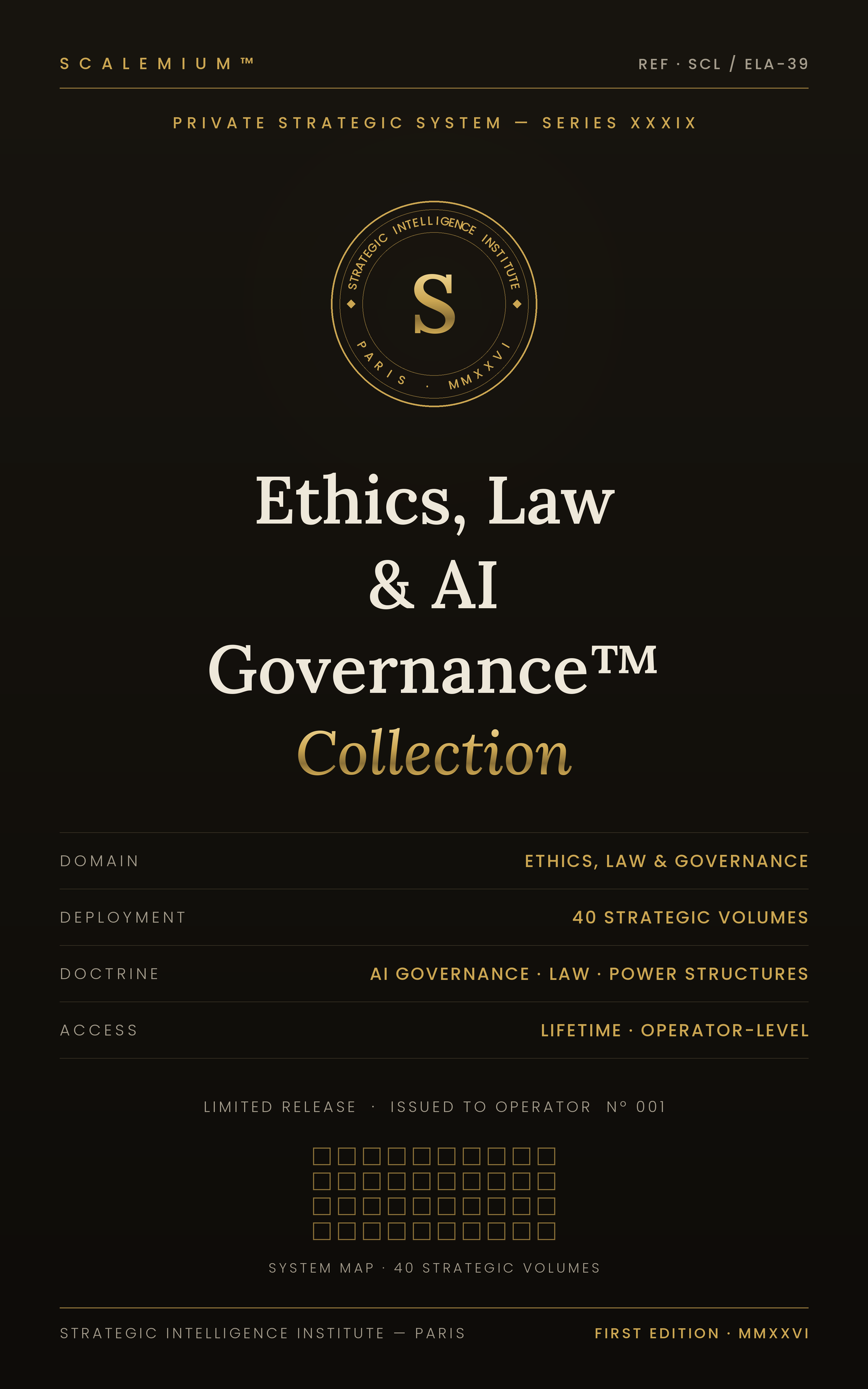
Ethics, Law & AI Governance operates as comprehensive institutional intelligence on the governance of artificial intelligence. The collection extends across 40 volumes covering the architectural dimensions of AI governance — from the foundations of AI ethics through the structural challenges of algorithmic accountability, from the legal frameworks of AI liability through the constitutional dimensions of intelligent power, from the regulatory architectures emerging across jurisdictions through the governance challenges of autonomous systems operating at superhuman scales.
The collection addresses the foundational dimensions of AI governance across institutional, legal, regulatory, and ethical horizons.
The collection articulates the structural foundations of AI ethics as institutional infrastructure rather than as abstract philosophical inquiry. AI ethics operates as the foundational framework within which subsequent legal and regulatory architecture is constructed. The collection addresses these foundations with the rigor their institutional consequences require.
The collection addresses the structural questions of accountability and responsibility for AI systems. When an AI system produces consequential harm, who bears responsibility? The developer? The deployer? The user? The system itself? The collection articulates the frameworks emerging to address these questions and the strategic implications of different framework choices.
The collection addresses the legal personhood and liability dimensions of AI governance. Current legal frameworks rest on personhood categories developed for natural persons and corporate entities. AI systems fit neither category cleanly. The structural reconstruction of liability frameworks accommodating AI systems operates as one of the most consequential legal developments of the era.
The collection addresses the structural challenges to justice and due process emerging as AI systems make consequential decisions in legal, judicial, administrative, and institutional contexts. The collection articulates these challenges and the governance frameworks emerging to address them.
The collection addresses the structural problem of transparency in AI systems. Many AI systems operate as effective black boxes — producing decisions whose reasoning is opaque even to their developers. Traditional governance models depend on the ability to understand and challenge decisions affecting governed populations. The structural mismatch between AI opacity and governance transparency requirements operates as foundational challenge.
The collection addresses the regulatory architecture of AI governance emerging across jurisdictions. The European Union, United States, China, United Kingdom, and other major regulatory authorities are constructing substantially divergent regulatory approaches. The collection articulates these approaches and the strategic implications of operating across multiple AI regulatory regimes.
The collection addresses the governance challenges of autonomous and agentic AI systems — systems that take consequential actions rather than merely producing outputs for human evaluation. The governance frameworks for these systems operate beyond what traditional regulatory architectures have addressed.
The collection addresses AI governance in high-stakes domains where governance failures produce consequences extending beyond individual cases — autonomous weapons systems, criminal justice algorithms, electoral integrity infrastructure, democratic stability mechanisms. The governance considerations in these domains operate at substantially elevated institutional depth.
The collection addresses the structural concerns regarding AI power concentration. AI development is currently concentrated in a small number of organizations whose technical capabilities exceed those of regulators charged with overseeing them. The collection articulates the governance challenges this concentration creates and the institutional frameworks emerging to address them.
The collection addresses AI safety as governance challenge — distinct from but related to traditional regulatory concerns. The governance of advanced AI systems carries dimensions of existential risk that traditional governance frameworks were not designed to address. The collection articulates these dimensions with appropriate institutional gravity.
The collection addresses the international governance dimensions of AI. Effective AI governance ultimately requires international coordination that current institutional frameworks have not fully constructed. The collection articulates the international dimensions and the strategic considerations they raise.
And no one fully controls it yet.
The collection operates across 40 volumes structured through four governance domains — each addressing a foundational dimension of AI ethics, law, and governance.
The opening domain establishes the foundational architecture of AI ethics, the structural challenges of AI accountability, and the legal and ethical frameworks emerging to address AI systems as institutional entities.
Volume 1 — The AI Ethics Imperative: Controlling Power Before It Controls Us
Volume 2 — Ethics for Intelligent Systems: Encoding Values Into Machines
Volume 3 — The AI Responsibility Problem: Who Is Accountable?
Volume 4 — Law in the Age of AI: Rules for Autonomous Systems
Volume 5 — The Algorithmic Justice Problem: Bias, Fairness, Control
Volume 6 — AI and Human Rights: Protecting Dignity at Scale
Volume 7 — The Governance of Algorithms: Oversight Without Understanding?
Volume 8 — The AI Liability Gap: Responsibility Without Intent
Volume 9 — The Ethics of Automation: Delegating Moral Decisions
Volume 10 — AI and Due Process: Fairness in Automated Judgments
The second domain addresses the operational architecture of AI governance — compliance frameworks, transparency requirements, surveillance considerations, and the institutional mechanisms emerging to oversee AI systems at scale.
Volume 11 — The AI Compliance Stack: Regulation, Audits, Enforcement
Volume 12 — The Black Box Problem: Power Without Transparency
Volume 13 — AI Safety as Governance: Rules That Prevent Catastrophe
Volume 14 — The Ethics of Surveillance: Security vs Freedom
Volume 15 — AI and Consent: Data, Autonomy, Rights
Volume 16 — The Algorithmic Social Contract: Citizens vs Systems
Volume 17 — AI in Criminal Justice: Prediction, Risk, Responsibility
Volume 18 — The Ethics of Prediction: Acting Before Events Happen
Volume 19 — AI and Democratic Stability: Elections, Influence, Trust
Volume 20 — The AI Governance Gap: Technology Faster Than Law
The third domain addresses the structural questions of AI power, the architectures of regulation, the governance of autonomous systems, and the legal and ethical reconstruction required by AI deployment.
Volume 21 — The Ethics of AI Power: Concentration and Control
Volume 22 — AI Regulation Explained: What Works, What Fails
Volume 23 — The AI Audit Standard: Verifying Intelligent Systems
Volume 24 — The Ethics of Synthetic Media: Truth After Deepfakes
Volume 25 — AI and Accountability Design: Building Traceable Systems
Volume 26 — The Governance of Autonomous Agents: Rules for Action
Volume 27 — AI and Warfare Ethics: Autonomous Weapons
Volume 28 — The Ethics of Superintelligence: Preparing for Superior Minds
Volume 29 — AI and Legal Personhood: Should Machines Have Rights?
Volume 30 — The End of Human-Only Law: Mixed Intelligence Governance
The closing domain addresses systemic risk governance, international coordination, and the constitutional dimensions of AI power across the coming decades.
Volume 31 — AI Risk Governance: Preventing Systemic Failure
Volume 32 — The Ethics of Data Power: Ownership and Control
Volume 33 — AI and Social Scoring: Incentives as Control
Volume 34 — The Governance of Machine Decisions: Oversight Models
Volume 35 — AI and Global Regulation: Harmonization vs Fragmentation
Volume 36 — The Ethics of Delegated Authority: Machines in Power
Volume 37 — AI Transparency vs Performance: Trade-Offs
Volume 38 — The Ethics of AI Dependence: Cognitive Risk
Volume 39 — AI Governance for Humanity: Beyond National Rules
Volume 40 — The AI Constitution: Principles for Intelligent Power
The collection delivers institutional intelligence value across the foundational dimensions of AI governance.
Operators receive structural recognition of the governance gap between AI capability and governance infrastructure. The recognition supports strategic operation calibrated to actual governance conditions rather than to assumptions about governance adequacy that current institutional reality does not support.
The collection provides frameworks for engaging the liability and accountability dimensions of AI deployment. Operators deploying AI systems, investing in AI infrastructure, or operating in environments shaped by AI receive intelligence on the structural responsibility considerations these positions involve.
The collection provides comprehensive intelligence on the regulatory architectures emerging across major jurisdictions. Operators with multi-jurisdictional AI exposure receive analytical infrastructure supporting strategic decisions about deployment, compliance, and operational positioning across divergent regulatory regimes.
The collection provides intelligence on the algorithmic justice dimensions affecting operations in legal, judicial, administrative, and consumer-facing contexts. Operators deploying AI in these contexts receive frameworks for engaging the structural considerations involved.
The collection provides frameworks for engaging the transparency and interpretability dimensions of AI governance. Operators constructing AI systems, deploying AI infrastructure, or operating in regulated environments receive intelligence on the structural requirements emerging in these domains.
The collection provides intelligence calibrated to AI deployment in high-stakes domains — military applications, criminal justice, electoral systems, financial infrastructure. The governance considerations in these domains substantially exceed those operating in standard commercial contexts.
The collection addresses the structural questions of AI power concentration. Operators engaging with AI infrastructure as developers, deployers, investors, or governance professionals receive intelligence on these structural dynamics and their long-term institutional implications.
The collection provides constitutional and foundational frameworks for understanding AI governance at its deepest institutional level. Operators engaged with the foundational construction of AI governance — through legislative work, regulatory positions, judicial roles, institutional design, or strategic philanthropy — receive intelligence supporting work at this depth.
The collection supports strategic positioning within the AI governance frameworks currently under construction. Operators with substantial AI exposure benefit from understanding the governance trajectory rather than from operating reactively to governance developments as they emerge.
The collection operates as reserved infrastructure for operators engaged with the foundational dimensions of AI governance.
Senior legal practitioners, regulatory architects, and legal scholars whose work involves the construction or application of AI governance frameworks. The collection provides institutional-grade synthesis of the field’s foundational dimensions.
Institutional principals, corporate leadership, and senior executives whose institutions deploy AI infrastructure and bear the regulatory, ethical, and liability consequences of that deployment. The governance considerations these positions involve are substantial and structurally complex.
Investment principals with substantial AI infrastructure exposure — venture capital partners, family office AI investments, sovereign wealth fund AI positions, public market AI exposure. The regulatory trajectory affects valuation, exit timing, and strategic positioning across these investments.
Government officials, regulatory architects, sovereign principals, and policy operators engaged with AI governance construction. The strategic considerations these positions involve operate at the foundational level the collection addresses.
Leaders of civil society organizations, ethical institutes, and foundations engaged with AI governance from non-governmental positions. The institutional infrastructure of AI governance increasingly depends on civil society participation that operates at substantial institutional depth.
Academic researchers in AI ethics, technology law, governance studies, and adjacent fields whose work requires institutional-grade synthesis of the foundational dimensions of AI governance as research infrastructure.
Strategic principals whose operations occur within environments substantially shaped by AI deployment — financial services, healthcare, defense, education, media. The governance trajectory affects strategic operation across these domains and merits the depth of engagement the collection supports.
Family office principals navigating multi-generational positioning under conditions where AI governance will substantially shape the institutional, legal, and ethical environments their successors inherit.
The collection does not operate as introductory AI ethics, popular regulatory commentary, or general-audience analysis of AI policy. The reserved positioning operates through strategic standards rather than through commercial accessibility.
The ethical challenges created by AI systems
The limits of current legal frameworks
How responsibility is redefined in automated systems
Governance models for AI and digital systems
How to analyze AI impact on society and institutions
Access: €6,997
Access operates through institutional channels. The collection delivers across the 40 volumes with continuing institutional support for operators integrating the intelligence into their strategic and institutional infrastructure.
Reserved for operators recognizing that AI governance operates as foundational strategic dimension across institutional, legal, regulatory, and civilizational horizons. Not all applications warrant access.
→ Access This Collection — €6,997
Submit access request for institutional review.
→ Multi-Collection Institutional Access
For operators considering institutional access across the complete Ethics, Law & Governance edition or across the broader Strategic Intelligence library.
→ Private Advisory
For operators whose strategic situations warrant direct engagement at substantial depth.
Full access, delivered instantly upon acquisition.
For operators acquiring several collections within the Strategic Intelligence library. Submit your selection — we structure a single institutional access, priced accordingly.
For operators whose strategic situation warrants direct counsel at substantial depth.
SCALEMIUM™
Collections → Ethics, Law & Governance → Volume 1
This is not about AI tools.
This is:
 understanding how AI reshapes power, responsibility, and control
If you understand AI governance:
you anticipate risks
you understand systems
you position early
That’s future advantage.
Most people use AI.
Very few understand how it changes the rules.
This collection gives you:
clarity on how ethics, law, and governance evolve in the age of AI
We use cookies to ensure the site functions properly, understand how it is used, and improve your experience. You can accept, reject, or manage your preferences at any time.