Cognitive Psychology and Thinking

 6997

A premium 5-volume collection exploring human psychology, cognition, behavior, and decision-making in a complex modern world.

COGNITIVE PSYCHOLOGY & THINKING

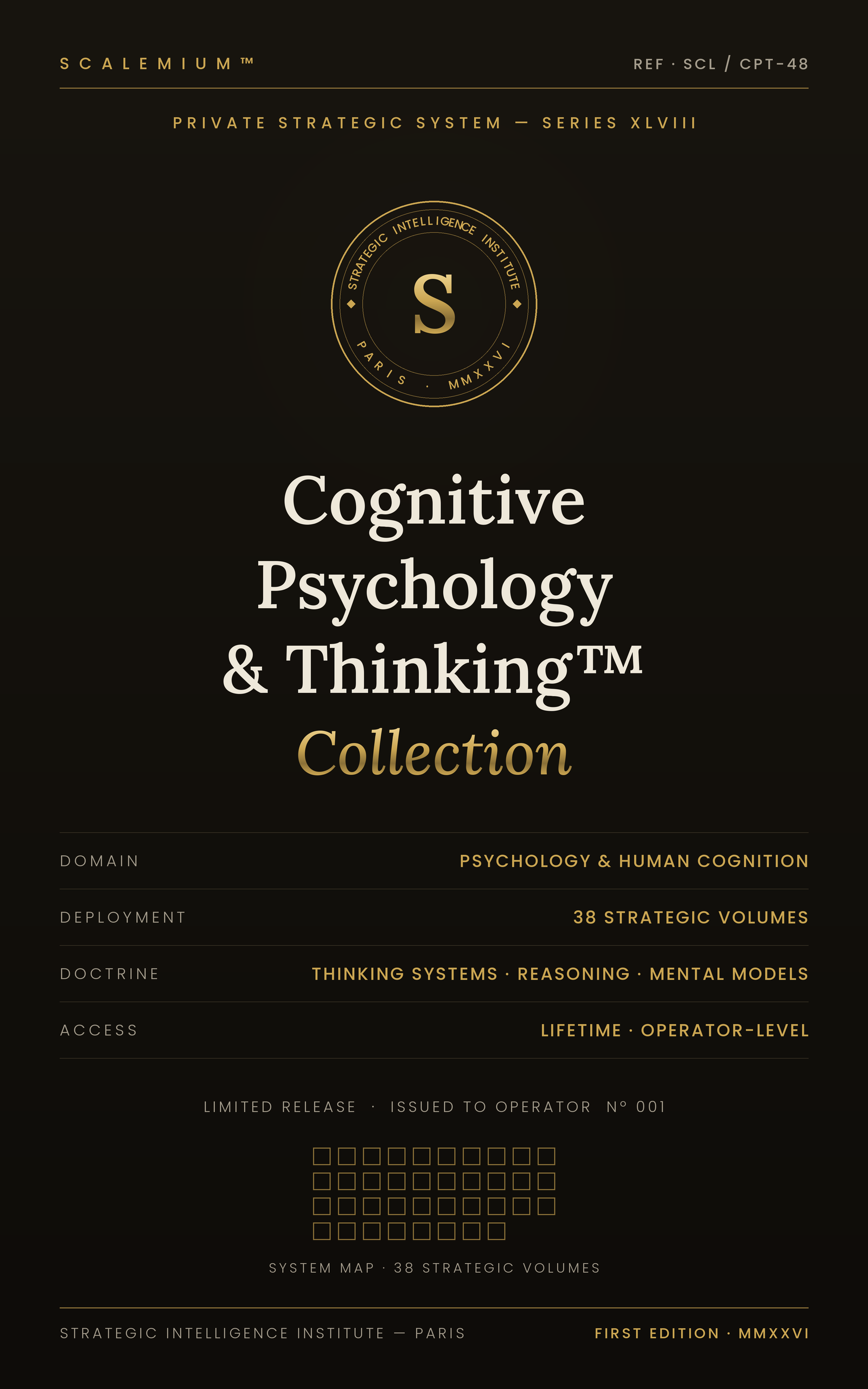
The institutional collection on the architecture of human cognition — 40 volumes of strategic intelligence on attention, reasoning, memory, perception, and the structural foundations of how the human mind operates.

The strategic situation.

Thinking is not what it appears to be.

The subjective experience of thought — the felt sense of deliberate reasoning, of clear perception, of accurate memory, of focused attention — bears little resemblance to the actual structural operation of human cognition. What the cognitive scientist Daniel Kahneman called the “machinery of the mind” operates largely beneath conscious access, through processes that the thinker neither designed nor controls, producing outputs that the thinker experiences as their own deliberate conclusions.

The gap between subjective experience of thinking and structural reality of cognition represents one of the most consequential blindspots in human strategic operation.

Operators making decisions experience themselves as reasoning. Investors evaluating opportunities experience themselves as analyzing. Leaders considering strategic options experience themselves as deliberating. In each case, the subjective experience of cognitive operation diverges substantially from what is actually occurring at the structural level. The reasoning is shaped by mental models the operator did not consciously construct. The analysis is filtered through perception architectures that systematically distort certain categories of information. The deliberation occurs within attention systems that operate selectively, memory systems that operate reconstructively, and inference systems that operate predictively rather than evidentially.

The result is structural: operators routinely make consequential decisions based on cognitive processes whose actual mechanics they do not understand, while experiencing certainty about the validity of those decisions. The certainty is itself a cognitive output — produced by systems optimized for action rather than for accuracy.

The institutional research on human cognition has expanded substantially across the past several decades. Cognitive science, neuroscience, behavioral psychology, attention research, memory research, perception studies, and decision science have collectively produced a substantial body of knowledge about how cognition actually operates. Yet this knowledge has translated unevenly into institutional strategic infrastructure. Most operators encounter cognitive psychology as topic — interesting, occasionally useful, but not foundational. Few operators engage cognitive psychology as strategic infrastructure — the substrate within which all their strategic operation occurs.

This collection addresses that engagement.

Cognitive Psychology & Thinking operates as comprehensive institutional intelligence on the architecture of human cognition — how thinking actually works, what its structural limits are, how attention, memory, perception, and reasoning interact, and what the implications are for strategic operators whose work depends on the quality of their cognitive infrastructure. The collection extends across 40 volumes covering the full architectural dimension of human cognition — from the foundations of information processing through the dynamics of attention and memory, from the architecture of inference to the cognitive interface between mind and world.

Thinking feels natural.

What this collection addresses.

The collection addresses the structural foundations of strategic operator cognition across multiple dimensions.

The cognitive infrastructure of strategic decision-making.

The collection articulates the structural foundations of how strategic decisions are actually made — distinguishing the subjective experience of reasoning from the underlying cognitive processes producing the reasoning outputs. Operators receive structural recognition of their own cognitive infrastructure.

Attention as strategic resource.

The collection addresses attention as foundational strategic resource — finite, depletable, selectively allocated through processes operating beneath conscious control. Operators receive frameworks for understanding attention as the substrate of all strategic operation and for constructing attention infrastructure aligned with strategic objectives rather than against them.

Memory architecture and strategic reliability.

The collection articulates the structural reality of human memory — reconstructive rather than reproductive, selectively encoded, systematically distorted across categories. Operators relying on memory for strategic decision-making (their own memory, their teams’ memory, institutional memory) receive intelligence on the structural limits of memory-based reasoning.

The architecture of perception and interpretation.

The collection addresses how perception operates — not as neutral reception of reality but as active interpretation through cognitive filters constructed across developmental, cultural, and experiential dimensions. Operators receive frameworks for recognizing the interpretive nature of perception and the strategic implications of perception architecture.

Reasoning, inference, and the limits of logic.

The collection articulates the structural mechanics of human reasoning — distinguishing logical operation from intuitive inference, deliberate analysis from heuristic shortcut, evidential reasoning from predictive expectation. Operators engaged in strategic analysis receive intelligence on the actual cognitive operations producing their analytical outputs.

Cognitive load, friction, and strategic capacity.

The collection addresses the strategic implications of cognitive load — how mental bandwidth operates as finite resource, how complexity produces cognitive friction, and how strategic capacity depends on cognitive infrastructure that can be structurally optimized or systematically degraded.

Cognitive operation under pressure and uncertainty.

The collection addresses how cognition operates under conditions of stress, uncertainty, complexity, and high consequence — domains where strategic operators routinely function and where cognitive infrastructure most frequently produces decisions whose subjective certainty diverges most substantially from objective accuracy.

🚨 PROBLEM

The 40 volumes architecture.

The collection operates across 40 volumes structured through five thematic constellations — each addressing a foundational dimension of human cognition.

Constellation I — The Architecture of Thought (Volumes 1-8)

The opening constellation establishes structural foundations: how the mind processes information, how cognition is architecturally organized, and how the subjective experience of thinking relates to its structural operation.

Volume 1 — The Thinking Machine (Human Edition): How the Mind Processes Information
Volume 2 — Cognitive Architecture: How Reasoning, Memory, and Attention Interact
Volume 3 — How Humans Think: Logic, Intuition, and Error
Volume 4 — The Attention Economy of the Mind: What Focus Really Is
Volume 5 — Thinking Fast, Thinking Wrong: Why Humans Make Predictable Errors
Volume 6 — Mental Bandwidth: Limits of Human Cognition
Volume 7 — The Illusion of Rationality: Why Logic Often Fails
Volume 8 — The Memory Engine: How Humans Store, Distort, and Recall Reality

Constellation II — Cognitive Load, Focus, and Decision Architecture (Volumes 9-16)

The second constellation addresses the operational dimensions of cognition — how attention is structured, how decisions are architected, and how mental models simplify complexity for strategic operation.

Volume 9 — Cognitive Load: Why the Brain Gets Overwhelmed
Volume 10 — The Focus Problem: Attention in a Distracted World
Volume 11 — Decision Architecture: How Choices Are Structured in the Mind
Volume 12 — The Reasoning Trap: When Thinking Becomes a Liability
Volume 13 — Mental Models of Reality: How Humans Simplify Complexity
Volume 14 — The Prediction Mind: How Humans Anticipate the Future
Volume 15 — Thinking Under Uncertainty: Decisions Without Full Information
Volume 16 — The Cognitive Shortcut: Why the Brain Prefers Speed Over Accuracy

Constellation III — Perception, Memory, and the Construction of Reality (Volumes 17-24)

The third constellation addresses how reality is constructed cognitively — the architectures of perception, the mechanics of memory, the patterns of bias creation, and the systematic limits of intelligence itself.

Volume 17 — The Perception Filter: How Reality Is Interpreted, Not Seen
Volume 18 — The Limits of Intelligence: Why Smart People Still Fail
Volume 19 — The Memory Myth: Why Recall Is Reconstruction
Volume 20 — Cognitive Bias Mechanics: How Errors Are Created
Volume 21 — The Attention Switch: What Captures and Holds Focus
Volume 22 — The Mental Stack: Layers of Thought Processing
Volume 23 — The Thinking Environment: How Context Shapes Cognition
Volume 24 — Human Inference: How Conclusions Are Drawn

Constellation IV — Cognitive Flexibility and Strategic Navigation (Volumes 25-32)

The fourth constellation addresses the dimensions of cognitive operation most directly relevant to strategic navigation — flexibility, mapping, systems thinking, prediction architecture, and cognition under pressure.

Volume 25 — The Illusion of Objectivity: Why Neutral Thinking Is Rare
Volume 26 — Mental Flexibility: Adapting Thought in Changing Worlds
Volume 27 — The Cognitive Map: How Humans Navigate Information
Volume 28 — Thinking in Systems: Beyond Linear Logic
Volume 29 — The Brain’s Prediction Engine: Expectation vs Reality
Volume 30 — Cognitive Friction: Why Thinking Is Hard
Volume 31 — The Mind Under Pressure: Stress and Cognitive Collapse
Volume 32 — The Cost of Attention: Mental Energy as a Resource

Constellation V — The Strategic Implications of Cognitive Architecture (Volumes 33-40)

The closing constellation addresses the strategic implications of cognitive architecture — the historical consequences of cognitive operation, the hierarchy of cognitive processes, the cognitive interface between mind and world, and what makes human cognition structurally unique.

Volume 33 — Thinking Errors That Shape History: When Minds Change the World
Volume 34 — The Cognitive Hierarchy: From Reflex to Reflection
Volume 35 — The Mind’s Blind Spots: What Humans Systematically Miss
Volume 36 — Reason vs Intuition: The Hidden Power Balance
Volume 37 — The Cognitive Interface: Language, Symbols, Meaning
Volume 38 — Mental Efficiency: Thinking Better With Less Effort
Volume 39 — The Fragile Mind: Why Cognition Breaks Under Complexity
Volume 40 — The Thinking Species: What Makes Human Cognition Unique

💣 THE TRUTH

What operators receive.

The collection delivers institutional intelligence value across the foundational dimensions of strategic operator cognition.

Structural recognition of cognitive operation.

Operators receive structural recognition of how their own cognition actually operates — distinguishing subjective experience of thinking from the structural processes producing the experience. The recognition supports strategic engagement with cognitive infrastructure that surface awareness cannot enable.

Attention architecture frameworks.

The collection provides frameworks for understanding and constructing attention infrastructure. Operators receive analytical tools for treating attention as strategic resource — to be allocated deliberately, protected structurally, and optimized for strategic objectives rather than fragmented across reactive demands.

Memory and reasoning intelligence.

The collection addresses the structural limits of memory and reasoning as decision infrastructure. Operators relying on memory and reasoning for strategic decisions (which is, in practice, all strategic operators) receive intelligence on what these cognitive systems can and cannot reliably deliver.

Perception and interpretation architecture.

The collection provides intelligence on perception as interpretation — the cognitive filters through which all incoming information passes before becoming available to strategic reasoning. Operators receive frameworks for recognizing their own perceptual architecture and the strategic implications of perceiving reality through specific interpretive filters.

Cognitive performance under strategic conditions.

The collection addresses cognitive operation under the specific conditions in which strategic operators actually function — pressure, uncertainty, complexity, time constraint, high consequence. The frameworks provided are calibrated to actual strategic operational reality rather than to laboratory conditions.

Cognitive infrastructure design.

The collection provides foundational intelligence for designing cognitive infrastructure — at individual, team, organizational, and institutional levels. Operators constructing cognitive architecture within their institutions receive analytical tools for designing systems aligned with cognitive reality.

The strategic implications of cognitive limits.

The collection addresses the strategic implications of cognitive limits at scale. Operators thinking across multi-year, multi-decade, or multi-generational horizons receive intelligence on how cognitive architecture shapes strategic possibility and constrains strategic ambition.

💡 SOLUTION

For whom this collection operates.

The collection operates as reserved infrastructure for operators whose strategic operation depends on cognitive quality.

Strategic decision principals.

Operators whose decisions carry substantial consequence — capital allocators, institutional principals, executive operators, strategic architects. The quality of cognitive infrastructure determines the quality of strategic output across these roles.

Investment principals and analysts.

Investment principals, portfolio managers, family office investment committees, and strategic analysts whose work depends on the integrity of analytical cognition under conditions of uncertainty and complexity.

Researchers and intellectual operators.

Academic researchers, cognitive scientists, decision researchers, and intellectual operators whose work requires institutional-grade synthesis of cognitive psychology research as foundational infrastructure.

Strategic communicators and educators.

Operators whose work involves shaping the cognition of others — communicators, educators, institutional architects, organizational designers. Understanding cognitive architecture is foundational to constructing institutional infrastructure that operates with rather than against cognitive reality.

Operators of significance navigating complexity.

Operators of significance navigating strategic situations of substantial complexity, multi-dimensional analysis, and high-consequence decision. The cognitive demands of these situations exceed what untrained cognitive infrastructure can reliably deliver.

The collection does not operate as introductory cognitive science, popular psychology content, or general-audience commentary on thinking. The reserved positioning operates through strategic standards rather than through commercial accessibility.

🧱 WHAT YOU’LL MASTER

  • How the brain processes information

  • The structure of reasoning and thinking systems

  • Mental models and cognitive frameworks

  • The limits of human thinking

  • How to improve clarity and judgment

🧬 STRUCTURE OF THE COLLECTION

Access architecture.

Access: €6,997

Access operates through institutional channels. The collection delivers across the 40 volumes with continuing institutional support for operators integrating the intelligence into their cognitive infrastructure.

Reserved for operators recognizing that cognitive architecture operates as foundational strategic dimension across all operational, professional, and strategic horizons. Not all applications warrant access.

🎯 WHO THIS IS FOR

  • 🚪 Reserved Engagement.

    Access This Collection — €6,997
    Submit access request for institutional review.

    Multi-Collection Institutional Access
    For operators considering institutional access across multiple collections within the Strategic Intelligence library.

    Private Advisory
    For operators whose strategic situations warrant direct engagement at substantial depth.

🚫 WHO THIS IS NOT FOR

  • SCALEMIUM™
    Collections → Psychology → Volume 4

⚔️ POSITIONING

This is not theory.

This is:

👉 understanding how thinking actually works

💰 VALUE

If you understand cognition:

  • you think more clearly

  • you avoid errors

  • you make better decisions

👉 That’s cognitive leverage.

💸 PRICE

297€

🔒 FINAL CLOSE

Most people trust their thinking.

Very few understand it.

This collection gives you:

👉 clarity on how your mind actually works

Cognitive Psychology and Thinking

Access the complete collection