|
Scalemium™ — New experiences coming soon.
|
Every strategic decision an operator makes operates through cognitive infrastructure they did not design and rarely examine. The architecture of human judgment — the mental shortcuts, the systematic biases, the heuristic patterns, the emotional substrates of choice — was constructed by evolutionary forces operating across hundreds of thousands of years. It was optimized for survival in ancestral environments, not for strategic decision-making in institutional ones.
The result is structural: humans are predictably irrational. Not occasionally irrational. Not sometimes wrong. Predictably irrational — operating through bias patterns that are systematic, identifiable, and consistent across populations, cultures, and time periods.
The cost of this structural irrationality is rarely visible to the operators experiencing it. Bias operates beneath awareness. Heuristics produce decisions that feel rational, deliberate, considered. The decision-maker experiences certainty. The structural conditions producing the certainty remain invisible. And the cost — measured in capital misallocation, strategic miscalculation, institutional failure, missed opportunity, and accumulated error — compounds across timeframes that exceed individual cognitive horizons.
Most operators understand this in abstract. They know cognitive bias exists. They have heard of confirmation bias, of anchoring, of loss aversion. What most operators lack is structural intelligence on how these forces operate within their own decision infrastructure — and how they propagate through the institutions, teams, and strategic architectures they construct.
The institutional research on cognitive bias has accumulated across half a century. Kahneman and Tversky’s foundational work. Subsequent advances in behavioral economics, neuroeconomics, decision theory, and choice architecture. The body of knowledge is substantial. Yet its translation into institutional strategic infrastructure remains incomplete. Most operators encounter cognitive bias as topic. Few engage it as structural force.
This collection addresses that gap.
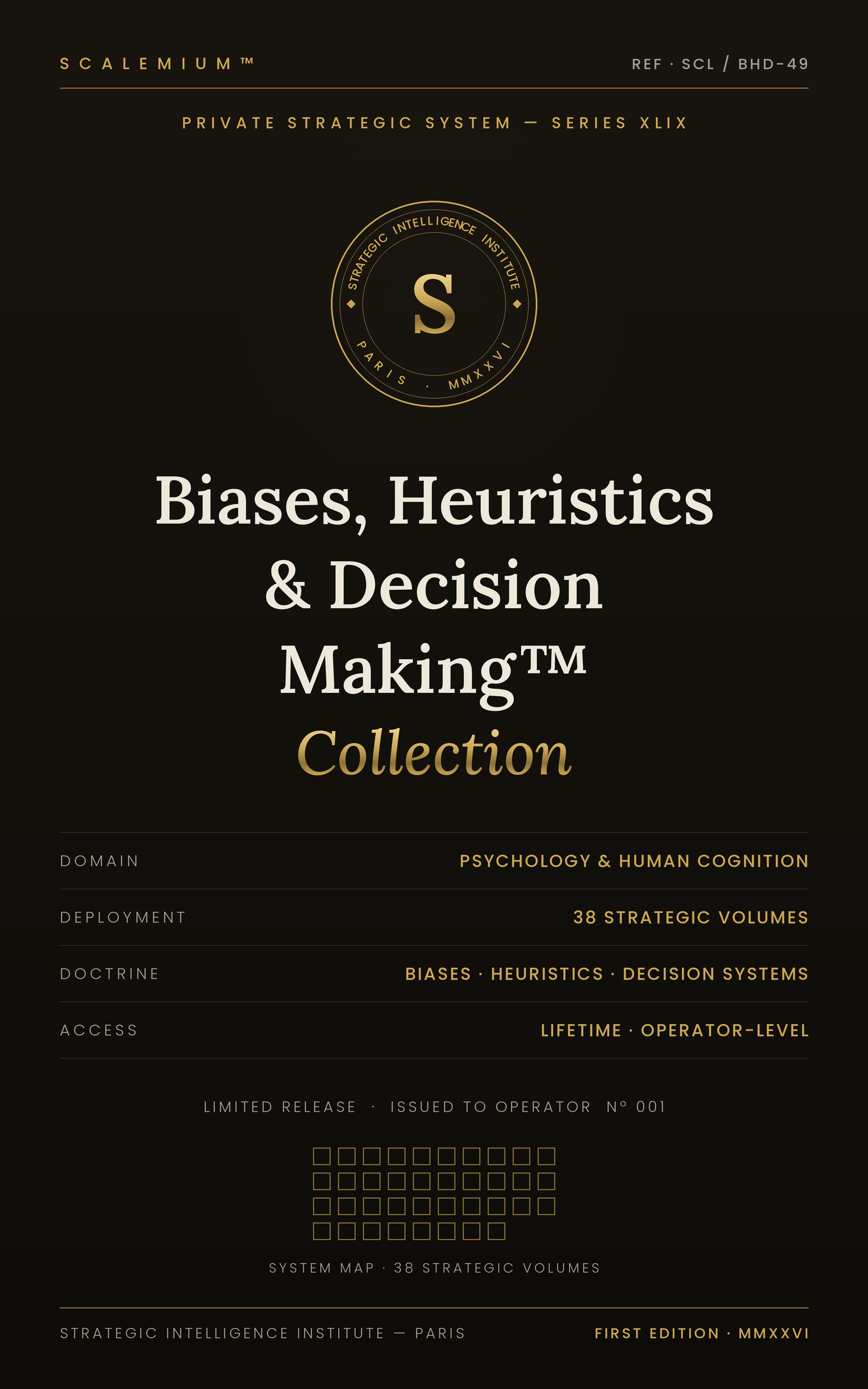
Biases, Heuristics & Decision-Making operates as comprehensive institutional intelligence on the architecture of human judgment — the systematic patterns of error, the heuristic mechanisms of cognitive shortcut, the conditions under which judgment fails and the conditions under which it can be structurally improved. The collection extends across 40 volumes covering the full architectural dimension of cognitive bias and decision-making — from foundational mechanisms to leadership-level error, from individual psychology to organizational decision architecture, from the rationality myth to decision intelligence frameworks for institutional design.

The collection addresses strategic situations across multiple dimensions of operator and institutional decision-making.
The collection addresses the structural conditions affecting operator decision-making — the patterns of bias affecting individual judgment, the heuristic mechanisms shaping perception, the emotional substrates of choice, and the institutional implications of these patterns operating beneath operator awareness.
The collection addresses the specific cognitive distortions operating under conditions of authority and power. Leadership amplifies certain biases while introducing others. The collection articulates how power restructures cognition and the institutional consequences of leadership-level cognitive distortion.
The collection extends beyond individual psychology to address organizational decision architecture — how groups make decisions, how institutions construct decision infrastructure, how groupthink emerges and operates, and how cognitive bias propagates through hierarchies.
The collection addresses cognitive bias and decision-making in high-stakes domains — finance, medicine, military operation, regulatory environment, crisis management. These domains exhibit specific bias patterns and require specific decision frameworks distinct from low-stakes contexts.
The collection provides foundational intelligence on the psychology of probability, risk perception, and uncertainty reasoning. Operators allocating capital, managing institutional risk, or navigating uncertain strategic situations operate within cognitive architecture that systematically misreads probabilistic information.
The collection addresses the question of whether and how cognitive bias can be structurally mitigated. The intersection of human judgment with technological augmentation, decision architecture design, and institutional debiasing frameworks represents the leading edge of decision intelligence.
The collection operates across 40 volumes structured through four progressive movements — from foundational recognition of the bias machine through advanced articulation of decision intelligence and the institutional implications of structural irrationality.
The opening movement establishes the structural foundations of human judgment and its predictable patterns of failure.
Volume 1 — The Bias Machine: How the Human Mind Distorts Reality
Volume 2 — The Decision Illusion: Why Choice Is Rarely Free
Volume 3 — The Hidden Logic of Error: Why Humans Think Wrong Predictably
Volume 4 — Bias by Design: How Evolution Shaped Mental Shortcuts
Volume 5 — The Psychology of Bad Decisions: Understanding Failure Before It Happens
Volume 6 — Heuristics Explained: The Brain’s Survival Tools
Volume 7 — Why Smart People Make Stupid Choices: Cognitive Bias in Action
Volume 8 — Decision Fatigue: When Choice Becomes a Burden
Volume 9 — The Confidence Trap: When Certainty Signals Error
Volume 10 — The Risk Perception Gap: Why Humans Misjudge Danger
The second movement addresses how bias operates under conditions of authority, power, and collective decision-making — the domains where individual cognitive error translates into institutional and strategic consequence.
Volume 11 — The Choice Architecture: How Decisions Are Influenced
Volume 12 — Bias in Leadership: How Power Distorts Judgment
Volume 13 — The Irrational Crowd: Decision-Making at Scale
Volume 14 — The Overconfidence Effect: When Belief Exceeds Reality
Volume 15 — Cognitive Blindness: Failing to See What’s Obvious
Volume 16 — The Anchoring Mind: First Impressions That Control Thought
Volume 17 — Loss Aversion: Why Fear Dominates Choice
Volume 18 — The Confirmation Trap: Protecting Beliefs at All Costs
Volume 19 — Bias in Business: Strategic Errors Explained Psychologically
Volume 20 — The Framing Effect: How Presentation Changes Reality
The third movement addresses the recurring patterns of decision failure — the loops, paradoxes, and structural distortions that govern collective and individual choice across institutional contexts.
Volume 21 — The Decision Loop: How Humans Repeat Mistakes
Volume 22 — The Illusion of Control: Why Humans Overestimate Influence
Volume 23 — Groupthink Dynamics: When Consensus Kills Intelligence
Volume 24 — Bias and Power: How Authority Warps Reasoning
Volume 25 — The Psychology of Risk: Fear, Reward, and Uncertainty
Volume 26 — Decision Making Under Stress: Why Crisis Changes Thinking
Volume 27 — The Status Quo Bias: Why Humans Resist Change
Volume 28 — Mental Accounting: How Humans Mismanage Value
Volume 29 — The Choice Paradox: When More Options Reduce Freedom
Volume 30 — Bias-Resistant Thinking: Designing Better Decisions
The final movement addresses the strategic question of decision intelligence — how cognitive bias can be structurally mitigated, how decision environments can be designed for better judgment, and what the limits of debiasing reveal about the nature of human rationality.
Volume 31 — Cognitive Debiasing: Can Humans Think Better?
Volume 32 — The Rationality Myth: Why Humans Are Predictably Irrational
Volume 33 — Bias in Technology: When Machines Learn Human Error
Volume 34 — The Decision Architect: Designing Environments for Better Choices
Volume 35 — Intuition vs Evidence: Choosing Under Ambiguity
Volume 36 — The Emotional Decision Engine: Feeling Before Thinking
Volume 37 — Bias in High-Stakes Environments: Medicine, Finance, War
Volume 38 — The Psychology of Probability: Why Humans Misread Numbers
Volume 39 — Decision Intelligence: Augmenting Human Judgment
Volume 40 — The End of Pure Rationality: Accepting Human Limits
The collection delivers institutional intelligence value across multiple strategic dimensions.
Operators receive comprehensive structural recognition of how cognitive bias operates within their own decision infrastructure. The recognition extends beyond awareness (“I know bias exists”) to structural understanding (“I recognize how bias is operating in this specific decision under these specific conditions”).
The collection provides decision frameworks operating at institutional architecture level. Operators constructing institutions, teams, or strategic infrastructure receive analytical tools for designing decision environments that mitigate predictable bias patterns rather than reproducing them.
The collection provides domain-specific intelligence for high-stakes decision environments — finance, medicine, military operation, crisis management. Operators engaged in these domains receive frameworks calibrated to the specific bias patterns operating within each.
The collection provides foundational intelligence on probability reasoning and risk perception. Operators making capital allocation decisions, managing institutional risk, or navigating uncertain strategic environments receive analytical infrastructure addressing the systematic ways human cognition misreads probabilistic information.
The collection addresses the specific cognitive distortions operating under conditions of authority and leadership. Operators in leadership positions — or constructing leadership architecture within their institutions — receive frameworks for recognizing and structurally addressing leadership-level cognitive error.
The collection provides foundational intelligence on the leading edge of decision intelligence — the augmentation of human judgment through structural design, technological integration, and institutional architecture. Operators engaging with AI augmentation, decision support systems, or institutional debiasing frameworks receive intelligence on what is structurally achievable and what is not.
The collection operates as reserved infrastructure for specific operator categories.
Operators whose decisions affect substantial capital allocation, institutional architecture, or strategic positioning at scale. The cost of cognitive bias compounds with decision consequence.
Investment principals, portfolio managers, family office investment committees, and capital allocators operating across uncertain probabilistic environments where systematic bias produces systematic capital cost.
Senior operators in domains where individual judgment carries high consequence — physicians making diagnostic decisions, judges and legal principals, regulatory architects. The bias patterns in these domains have been extensively researched and the structural intelligence is institutionally substantial.
Operators whose work involves designing decision environments — choice architects, institutional designers, organizational strategists, regulatory architects. The collection provides architectural intelligence for constructing decision infrastructure aligned with human cognitive reality rather than against it.
Academic researchers, behavioral economists, decision scientists, and intellectual operators whose work requires institutional-grade synthesis of the cognitive bias research as foundational infrastructure.
The collection does not operate as introductory behavioral economics, popular psychology content, or general-audience commentary on cognitive bias. The reserved positioning operates through strategic standards rather than through commercial accessibility.
Access: €6,997
Access operates through institutional channels. The collection delivers across the 40 volumes with continuing institutional support for operators integrating the intelligence into their decision infrastructure.
Reserved for operators recognizing that cognitive bias and decision architecture operate as foundational strategic dimensions across institutional, professional, and multi-generational horizons. Not all applications warrant access.
→ Access This Collection — €6,997
Submit access request for institutional review.
→ Multi-Collection Institutional Access
For operators considering institutional access across multiple collections within the Strategic Intelligence library.
→ Private Advisory
For operators whose strategic situations warrant direct engagement at substantial depth.
SCALEMIUM™
Collections → Psychology → Volume 3
people believing humans are fully rational
people avoiding complexity
people unwilling to question their thinking
This is not psychology theory.
This is:
understanding where thinking breaks
If you understand biases:
you avoid costly mistakes
you predict behavior
you gain decision advantage
That’s strategic insight.
Most people trust their decisions.
Very few understand how flawed they are.
This collection gives you:
a clear view of how and why humans make mistakes
We use cookies and similar technologies to ensure the proper functioning of this website, to analyze traffic, and to improve your experience.
You can accept all cookies, reject non-essential cookies, or customize your preferences at any time.