|
Scalemium™ — New experiences coming soon.
|
A civilizational transition is underway.
For the first time in the history of the species, the biological substrate of human existence is becoming an object of deliberate modification rather than an inherited condition. Cognitive capability — once distributed across populations through genetic and developmental lottery — is becoming engineerable. Memory, attention, processing speed, sensory range, physical performance, longevity itself — each is becoming subject to augmentation through pharmacological, technological, neural, and computational means that did not exist a single generation ago.
The transition is not theoretical. It is operational.
Brain-computer interfaces have moved from laboratory curiosity to commercial product. Cognitive enhancement pharmaceuticals are normalized across competitive professional environments. Computational augmentation through AI integration is restructuring what individual cognitive performance even means. Genetic engineering is advancing toward heritable modification. Neural prosthetics, sensory expansion, biological-digital integration — each of these technologies is moving from speculation through development into deployment within timeframes that compress what previous generations would have understood as multi-century transformations into single-decade transitions.
The strategic implications are foundational and uneven.
The first operators to integrate augmentation infrastructure will operate with cognitive, perceptual, and performance capabilities that unenhanced humans cannot match. The capability differential will compound. The competitive landscape in domains depending on cognitive performance — finance, science, strategic decision-making, creative production, institutional leadership — will restructure around enhanced operators. The social, economic, and political consequences of capability divergence will reshape institutional architecture, regulatory environments, and the foundational assumptions on which human civilization has organized itself for millennia.
The transition raises questions that humanity has never previously faced at scale: What is the human being when biological inheritance ceases to be destiny? What is identity when the cognitive substrate of selfhood becomes engineerable? What is fairness when capability stratification operates through access to enhancement rather than through traditional advantages? What is governance when the entities being governed include hybrid biological-technological beings? What is the future of the human species itself when modification of that species becomes a matter of strategic choice rather than evolutionary process?
Most operators encounter these questions abstractly — as topics of philosophical discussion, science-fiction speculation, or distant ethical concern. The strategic operators of significance recognize them as immediate institutional reality — forces already operating, already restructuring capability landscapes, already producing the conditions within which strategic operation across the coming decades will occur.
This collection addresses that recognition.
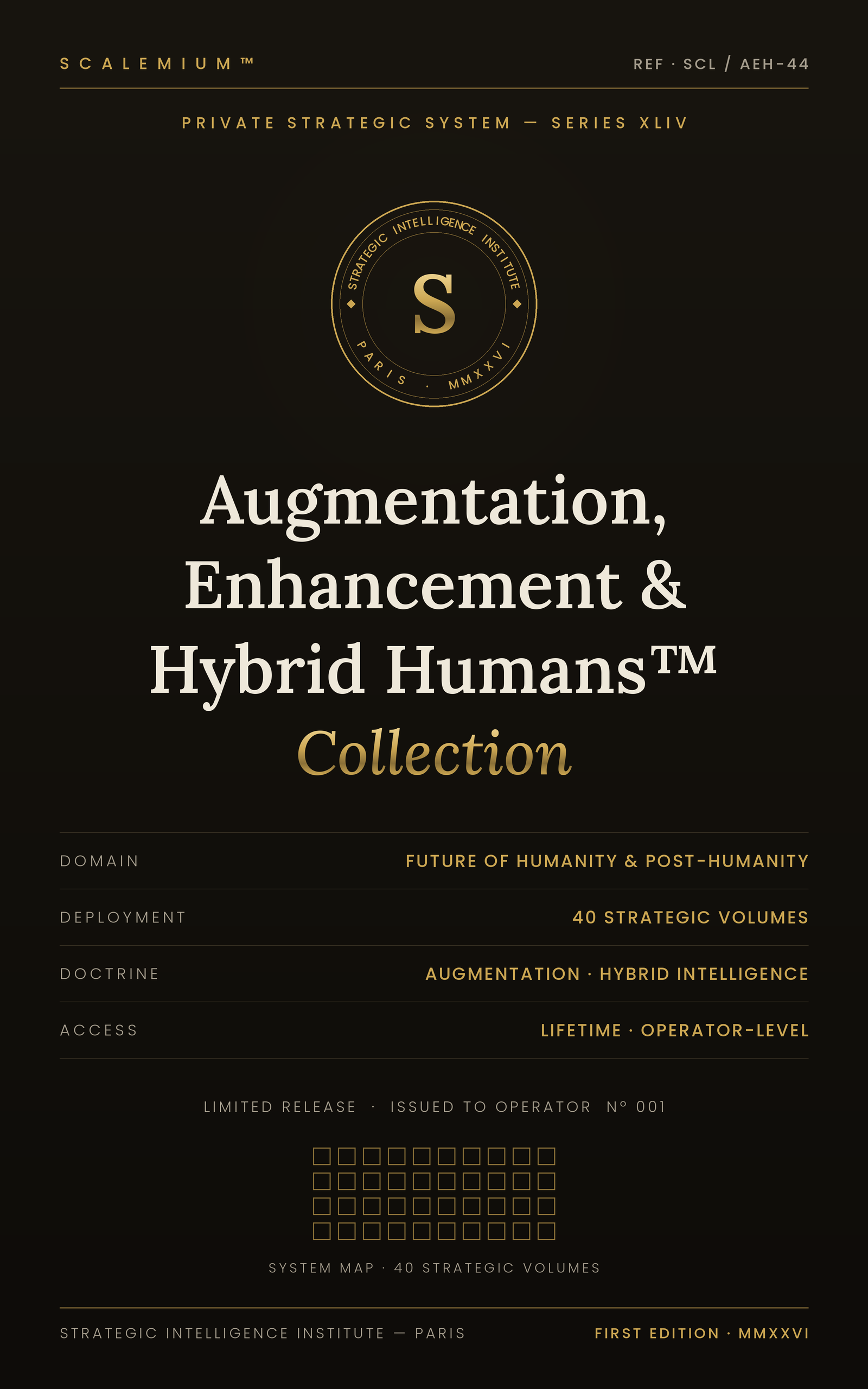
Augmentation, Enhancement & Hybrid Humans operates as comprehensive institutional intelligence on the structural transition from biological to augmented humanity. The collection extends across 40 volumes covering the architectural dimensions of human enhancement — from the foundations of cognitive augmentation through the architecture of human-AI symbiosis, from the economics of intelligence as engineered asset through the political and ethical implications of capability stratification, from the questions of identity under enhancement through the governance challenges of hybrid civilization.

The collection addresses the strategic dimensions of human enhancement across multiple foundational horizons.
The collection articulates the structural foundations of cognitive enhancement — how memory, attention, reasoning, and information processing become subject to engineering; how the boundaries between biological cognition and technological augmentation dissolve into integrated systems; what the operational characteristics of enhanced cognition are and how they differ from biological baseline.
The collection addresses the structural transition from human-as-biological-entity to human-as-hybrid-system. Brain-computer interfaces, neural prosthetics, AI co-cognition, and computational extension of biological cognition are producing operational entities that do not fit prior categories of either humans or machines. The collection articulates the architecture of these hybrid systems.
The collection addresses the structural consequences of capability divergence — the institutional, economic, and political stratification that emerges when human capability ceases to be roughly comparable across populations and becomes substantially differentiated through enhancement access. The collection articulates how stratification by capability is likely to operate and what its strategic implications are.
The collection addresses the competitive landscape across domains where cognitive and perceptual performance determines strategic outcomes. Finance, science, institutional leadership, creative production, strategic decision-making — each of these domains will restructure as enhanced operators outperform unenhanced operators. The collection articulates the strategic implications of this restructuring.
The collection addresses the emergence of intelligence as engineered asset — the economic infrastructure organizing around enhanced cognition, the markets emerging around neural and cognitive augmentation, the institutional architecture of an economy where mental capability becomes purchasable rather than inherited.
The collection addresses the foundational questions of identity that enhancement raises. When the cognitive substrate of selfhood becomes engineerable, what is identity? When memory becomes modifiable, what is personal continuity? When intelligence becomes augmentable, what defines the boundaries of the self? The collection articulates these questions as strategic considerations rather than abstract philosophical puzzles.
The collection addresses the institutional dimensions of enhancement — who governs enhancement access, who decides what modifications are permissible, how enhancement is regulated across jurisdictions, what political conflicts emerge around enhancement-based capability differentials, and what the institutional architecture of a hybrid civilization is likely to require.
The collection addresses the transition period as strategic environment. The decades during which enhancement infrastructure deploys, normalizes, and reshapes civilization will operate as distinct strategic environment — neither the prior biological baseline nor the eventual hybrid steady-state. Operators navigating this transition require intelligence specific to transitional dynamics.
The collection operates across 40 volumes structured through four trajectories — each tracing a dimension of the augmentation transition from emergence through structural transformation.
The opening trajectory establishes the foundations of cognitive and capability augmentation — the structural emergence of enhanced humanity from biological baseline.
Volume 1 — The Augmented Human: Intelligence, Memory, and Capability Beyond Biology
Volume 2 — Cognitive Enhancement: Expanding the Human Mind
Volume 3 — The Hybrid Species: Humans and Machines as One System
Volume 4 — The Extended Mind: When Thought Lives Outside the Brain
Volume 5 — The Brain-Interface Era: Thought as Input
Volume 6 — Human Performance Reimagined: Beyond Natural Limits
Volume 7 — The Intelligence Amplifier: Tools That Multiply Thinking
Volume 8 — The AI Co-Mind: Shared Cognition Between Human and Machine
Volume 9 — The End of Average Humans: Capability Divergence
Volume 10 — The New Elite: Enhanced Intelligence as Advantage
The second trajectory addresses the institutional dimensions of enhancement — the economic structures, ethical questions, and competitive dynamics that emerge as augmentation deploys across populations.
Volume 11 — The Neuro-Upgrade Economy: Intelligence as Asset
Volume 12 — Human Enhancement Ethics: Who Gets Upgraded First?
Volume 13 — The Bionic Human: Merging Flesh and Machine
Volume 14 — The Cognitive Arms Race: Humans Competing With Augmentation
Volume 15 — The Mind Expansion Era: Beyond Natural Intelligence
Volume 16 — The Augmented Society: Stratification by Capability
Volume 17 — The Post-Human Workforce: Performance Without Limits
Volume 18 — Human-AI Symbiosis: Cooperation or Dependency?
Volume 19 — The End of Cognitive Equality: Intelligence Gaps
Volume 20 — The Designed Mind: Engineering Thought
The third trajectory addresses the infrastructure of an enhanced civilization — the systems through which enhanced intelligence operates, the identity transformations enhancement produces, and the stratification dynamics emerging across enhanced and unenhanced populations.
Volume 21 — The Neural Economy: Brains as Infrastructure
Volume 22 — The Human API: Interfacing Thought With Systems
Volume 23 — The Enhancement Divide: Access, Ethics, Power
Volume 24 — The Accelerated Human: Speed as Evolution
Volume 25 — The Upgraded Self: Identity After Enhancement
Volume 26 — The Intelligence Class System: Social Stratification by Mind
Volume 27 — The Mind-as-a-Service Model: Renting Intelligence
Volume 28 — Human Limits Removed: Opportunity or Collapse?
Volume 29 — The Cognitive Upgrade Path: Stages of Enhancement
Volume 30 — The Hybrid Civilization: Living With Enhanced Minds
The closing trajectory addresses the institutional and existential dimensions of an enhanced civilization — governance challenges, identity restructuring, political dynamics, and the architecture of the enhanced human future.
Volume 31 — Human Enhancement Governance: Who Decides What Is Allowed?
Volume 32 — The Post-Human Advantage: Competing With Biology Alone
Volume 33 — The Neuro-Political Era: Power Over Minds
Volume 34 — The Engineered Self: Identity by Design
Volume 35 — The End of Natural Talent: Intelligence as Choice
Volume 36 — The Augmented Identity Crisis: Who Am I Now?
Volume 37 — The Superhuman Debate: Capability vs Humanity
Volume 38 — The Brain-Machine Social Contract: Rights and Limits
Volume 39 — The Human Upgrade Stack: Hardware, Software, Intelligence
Volume 40 — The Enhanced Future: Living With Modified Minds
The collection delivers institutional intelligence value across the foundational dimensions of strategic operation during the enhancement transition.
Operators receive structural recognition of the transition underway — distinguishing speculative futurism from operational reality, distant possibility from immediate institutional consequence. The recognition supports strategic operation calibrated to actual transitional dynamics rather than to outdated baseline assumptions.
The collection provides competitive intelligence on capability differentials emerging across enhanced and unenhanced operators. Operators in domains where cognitive and perceptual performance determines outcomes receive frameworks for understanding the strategic implications of operating in capability-stratified environments.
The collection provides strategic frameworks for engagement with enhancement — for operators considering personal augmentation, for institutions designing enhancement policies, for organizations operating in enhanced-population environments. The frameworks address the strategic considerations enhancement raises at multiple levels.
The collection provides foundational intelligence on the emerging neuro-economy — the economic infrastructure organizing around enhanced cognition, the markets in cognitive augmentation, the asset class characteristics of intelligence as engineered capability. Investment principals and capital allocators receive intelligence on this emerging strategic landscape.
The collection provides frameworks for engaging the identity questions enhancement raises. Operators considering personal enhancement, family principals thinking about generational enhancement, and institutional leaders navigating enhanced populations receive intelligence on the structural dimensions of identity under enhancement.
The collection provides foundational intelligence on the governance challenges enhancement creates. Regulatory architects, institutional principals operating across multiple jurisdictions, and operators navigating the political dimensions of enhancement receive frameworks for engaging this domain strategically.
The collection supports multi-generational strategic positioning during the enhancement transition. Operators thinking across generations recognize that the enhancement landscape their children and grandchildren will navigate operates within structurally different conditions than the landscape they themselves navigated. The collection provides intelligence supporting multi-generational strategic positioning aligned with these conditions.
The collection operates as reserved infrastructure for specific operator categories.
Operators whose strategic operation depends on cognitive, perceptual, or physical performance — investment principals, scientific leaders, creative directors, strategic decision-makers, institutional architects. The competitive landscape in these domains is restructuring around enhancement.
Family office principals navigating multi-generational strategic positioning under conditions where the enhancement landscape will transform substantially across the lifespans of current and future generations. Decisions about education, capital allocation, and generational strategic positioning operate within this transformative landscape.
Institutional leaders, organizational architects, and regulatory principals operating during the enhancement transition. The institutional infrastructure of the coming decades will require accommodation to enhanced populations, capability stratification, and governance challenges that prior institutional designs did not anticipate.
Investment principals, family office investment committees, and capital allocators with exposure to or interest in the emerging neuro-economy — cognitive enhancement pharmaceuticals, brain-computer interface technologies, AI-cognition integration platforms, and the broader enhancement infrastructure economy.
Operators considering personal engagement with enhancement infrastructure — pharmacological cognitive enhancement, AI integration, neural augmentation as it becomes accessible. The collection provides strategic frameworks for these considerations.
Academic researchers, bioethicists, technology strategists, and intellectual operators whose work requires institutional-grade synthesis of the enhancement transition as foundational research infrastructure.
The collection does not operate as introductory futurism, popular science commentary on enhancement, or general-audience speculation about post-humanity. The reserved positioning operates through strategic standards rather than through commercial accessibility.
Access: €6,997
Access operates through institutional channels. The collection delivers across the 40 volumes with continuing institutional support for operators integrating the intelligence into their strategic infrastructure.
Reserved for operators recognizing that the enhancement transition operates as foundational strategic dimension across institutional, generational, and civilizational horizons. Not all applications warrant access.
→ Access This Collection — €6,997
Submit access request for institutional review.
→ Multi-Collection Institutional Access
For operators considering institutional access across multiple collections within the Future of Humanity edition or the broader Strategic Intelligence library.
→ Private Advisory
For operators whose strategic situations warrant direct engagement at substantial depth.
SCALEMIUM™
Collections → Future of Humanity → Volume 1
people resistant to technological change
people attached to static views of humanity
people avoiding complexity
This is not science fiction.
This is:
human transformation in progress
If you understand augmentation:
you anticipate capability shifts
you understand new competitive advantages
you adapt before others
That’s future leverage.
Most people will adapt late.
Very few will understand early.
This collection gives you:
a clear view of how humans are evolving through technology
Lorem ipsum dolor sit amet, consectetur adipiscing elit. Ut elit tellus, luctus nec ullamcorper mattis, pulvinar dapibus leo.
We use cookies and similar technologies to ensure the proper functioning of this website, to analyze traffic, and to improve your experience.
You can accept all cookies, reject non-essential cookies, or customize your preferences at any time.