|
Scalemium™ — New experiences coming soon.
|
Most strategic thinking operates within timescales that humans can intuitively grasp. Decade-level planning is considered long-term. Multi-generational planning — thinking across 50 to 100 years — is considered exceptional. Century-level strategic positioning is rare even among the most institutionally sophisticated operators. The question of what happens to intelligent civilization across thousands of years, across millions of years, across the cosmic timescales within which planetary civilizations actually exist — this question is almost universally absent from strategic discourse.
This absence is itself the strategic situation.
The forces currently restructuring humanity — technological acceleration, automation, augmentation, the emergence of artificial intelligence as civilizational infrastructure — are operating at a pace and scale that exceeds the temporal frames within which strategic thinking has traditionally occurred. The transition humanity is entering is not adequately understood within decade-frames or even century-frames. It requires temporal perspective that strategic operators of significance increasingly recognize as essential, even as the institutional infrastructure for such perspective remains underdeveloped.
The cosmic situation is structural.
Earth is a single planetary body within a solar system that will eventually become uninhabitable. The species that constructed civilization on this planet across approximately ten thousand years is now developing — for the first time — the technological capability to extend that civilization beyond planetary boundaries. The question of whether this extension occurs, how it occurs, what forms of intelligence and consciousness persist across the transition, and what civilizational architecture supports survival across cosmic timescales — these questions are now operational rather than speculative.
The transition from planetary to multi-planetary species has happened before in the history of life only in the sense that intelligent biological systems have never previously attempted it. There is no historical precedent. There are no established institutional frameworks. The operators, principals, and civilizational architects engaging this transition are doing so without the accumulated wisdom of prior species that have successfully navigated similar transitions, because no such prior species — within accessible cosmic history — has done so.
Most operators recognize the space transition as topic for scientific speculation, business venture, or distant generational concern. The strategic operators of significance recognize it as immediate civilizational reality — already operational, already restructuring institutional landscapes, already producing the conditions within which strategic thinking across substantial timescales must occur.
The transition raises questions that exceed traditional strategic categories.
What is humanity when humanity exists on multiple worlds? What is identity when subsequent generations exist in environments biologically and culturally divergent from Earth? What is governance when the entities being governed include populations separated by light-minutes or light-hours of communication delay? What is responsibility when the consequences of present decisions extend across timescales no human will personally witness? What is meaning when individual existence is contextualized within civilizational arcs that may extend across millions of years?
Beyond these questions lies a deeper one: what is intelligent civilization itself? Is it bound to biological substrate? Bound to Earth? Bound to humanity? Or does humanity represent — as some strategic thinkers increasingly suspect — a transitional phase in a longer civilizational arc whose terminal forms may bear no biological resemblance to current humans, may not exist on planetary surfaces, may operate across timescales that current human institutions cannot comprehend?
This collection addresses these questions as operational strategic intelligence rather than as philosophical abstraction.
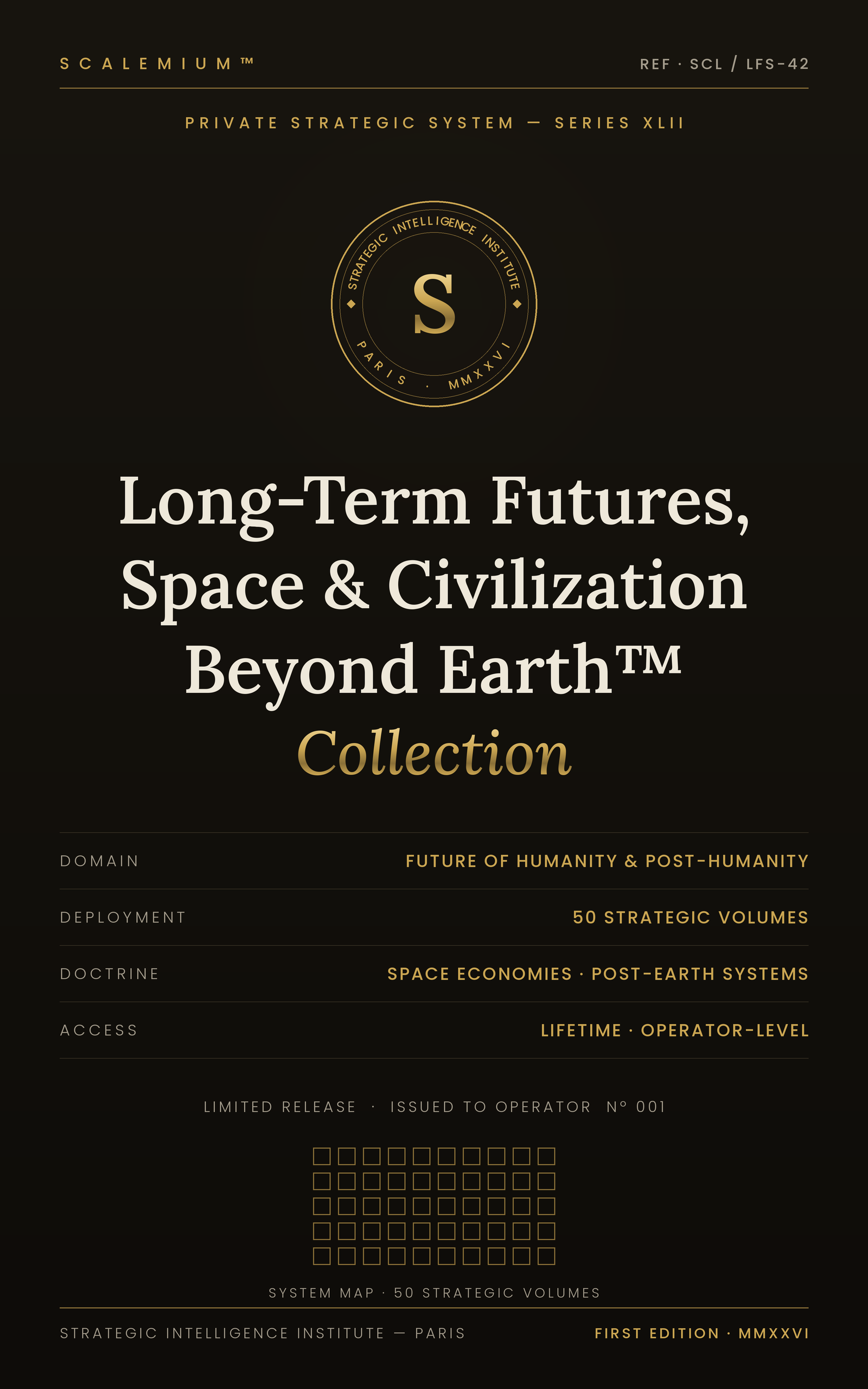
Long-Term Futures, Space & Civilization Beyond Earth operates as comprehensive institutional intelligence on the cosmic dimensions of intelligent civilization. The collection extends across 50 volumes covering the architectural dimensions of humanity’s transition beyond Earth and beyond present-form humanity — from the foundations of multi-planetary existence through the ethics of cosmic expansion, from the long-term survival of intelligence itself through the post-human futures that may extend across millennia and millions of years.

The collection addresses the long-term and cosmic dimensions of intelligent civilization across multiple foundational horizons.
The collection articulates the structural transition humanity is entering — from species bound to a single planet to civilization extending across multiple worlds. The transition’s strategic implications affect institutional architecture, generational planning, ethical frameworks, and the very category of “humanity” itself.
The collection addresses the question of long-term survival — what does it take for intelligent civilization to persist across thousands of years, across millions of years, across the cosmic timescales within which planetary civilizations actually exist? The institutional, technological, ethical, and psychological infrastructures required for such persistence are substantially different from those organizing present civilization.
The collection addresses the ethical dimensions of cosmic expansion. The expansion of intelligent civilization beyond Earth raises ethical questions of unprecedented scale — questions about the responsibilities of intelligence-bearing entities, the rights of populations across multiple worlds, the moral status of civilizations created or transformed across cosmic timescales, and the ethical implications of decisions whose consequences extend across millennia.
The collection articulates the structural possibility that humanity, in its current biological form, represents a transitional phase in a longer civilizational arc. What forms might intelligent civilization take across millions of years? What is the relationship between humanity and the civilizations that may succeed it? What ethical and strategic responsibilities does the present generation bear toward these futures?
The collection addresses the structural challenge of civilizational continuity across substantial timescales. Civilizations have collapsed throughout recorded history. The institutional architectures that have allowed continuity across centuries are different from those required for continuity across millennia. The collection articulates the structural conditions affecting long-term civilizational persistence.
The collection engages the question of intelligence as cosmic phenomenon. Whether intelligence is unique to Earth or widely distributed across the cosmos has substantial implications for how humanity should understand its own civilizational position and responsibilities. The collection addresses this question as strategic consideration rather than as scientific speculation.
The collection addresses the legacy and stewardship dimensions of present strategic decisions. Operators making decisions today whose consequences extend across millennia operate with stewardship responsibilities that prior generations did not face at comparable scale. The collection articulates these responsibilities as strategic operating principles.
The collection provides intelligence on the architectural design of long-term civilization — what institutional, technological, cultural, and ethical infrastructures support civilizational survival and flourishing across the timescales relevant to multi-planetary intelligent civilization.
The collection operates across 50 volumes structured through five cosmic dimensions — each addressing a foundational aspect of intelligent civilization across long-term and cosmic timescales.
The opening dimension establishes the structural foundations of humanity’s transition from planetary to multi-planetary civilization.
Volume 1 — The Cosmic Human: Humanity Beyond Earth
Volume 2 — The Spacefaring Mind: Intelligence in Extreme Environments
Volume 3 — Post-Human Space Civilization: Life Beyond Planetary Limits
Volume 4 — The Expansion Imperative: Survival Beyond Earth
Volume 5 — The Interplanetary Human: Identity Without Home Planet
Volume 6 — The Post-Earth Economy: Resources Beyond Scarcity
Volume 7 — The Civilization Continuity Problem: Survival Over Millennia
Volume 8 — The Long-Term Species Strategy: Thinking in Centuries
Volume 9 — The Galactic Mindset: Civilization-Scale Thinking
Volume 10 — Humanity as a Phase: Not the Final Form
The second dimension addresses the ethical, evolutionary, and strategic dimensions of multi-world civilization across substantial timescales.
Volume 11 — The Ethics of Space Colonization: Rights Beyond Earth
Volume 12 — The Multi-Planet Species: Evolution Across Worlds
Volume 13 — The Post-Human Explorer: Intelligence Without Fragility
Volume 14 — The Long Game of Civilization: Survival, Expansion, Meaning
Volume 15 — The End of Planetary Dependence: Life Beyond Earth
Volume 16 — The Cosmic Intelligence Question: Are We Alone?
Volume 17 — The Universal Mind Hypothesis: Intelligence as Cosmic Phenomenon
Volume 18 — The Post-Human Legacy: What We Leave Behind
Volume 19 — The Civilization Beyond Humanity: Futures Without Us
Volume 20 — The Long-Term Intelligence Project: Beyond Human Timescales
The third dimension addresses civilizational survival, the legacy implications of present decisions, and the cosmic responsibilities of intelligence-bearing entities.
Volume 21 — The Ethics of Creating Civilizations: Responsibility of Expansion
Volume 22 — The Survival of Intelligence: Beyond Species
Volume 23 — The Final Frontier of Mind: Consciousness in the Cosmos
Volume 24 — The End of the Human Era: Transition, Not Extinction
Volume 25 — The Continuity of Meaning: Purpose Across Species
Volume 26 — The Post-Human Story: Who Writes It?
Volume 27 — The Civilization Blueprint: Designing Long-Term Futures
Volume 28 — The Intelligence Legacy: What Endures After Humans
Volume 29 — The Cosmic Responsibility: Intelligence as Steward
Volume 30 — The Future of Existence: Beyond Biology and Earth
The fourth dimension addresses the institutional architectures, eternal-timescale ethics, and meta-civilizational considerations that emerge across millions of years of intelligent civilization.
Volume 31 — The Post-Human Institution: Teaching Futures Beyond Humanity
Volume 32 — The Long View of Intelligence: Millions of Years Ahead
Volume 33 — The Ethics of Eternity: Responsibility Over Infinite Time
Volume 34 — The End of the Human Narrative: Beginning of a Larger One
Volume 35 — The Civilization Continuum: Past, Present, Post-Human
Volume 36 — The Cosmic Governance Question: Order Beyond Earth
Volume 37 — The Final Responsibility: Intelligence as Guardian of Life
Volume 38 — The Future of Consciousness: Minds Beyond Matter
Volume 39 — The Legacy of Humanity: What Survives Us
Volume 40 — The Intelligence Civilization: Beyond Species Boundaries
The closing dimension synthesizes the collection’s architecture — the post-human ethics, the universal civilization project, and the recognition of humanity as opening phase of a far longer civilizational arc.
Volume 41 — The Post-Human Ethic: Morality Without Humanity
Volume 42 — The Universal Civilization Project: Intelligence at Scale
Volume 43 — The End of Human Exceptionalism: Intelligence as Continuum
Volume 44 — The Civilization of Minds: Beyond Flesh and Form
Volume 45 — The Long-Term Meaning Problem: Purpose Across Epochs
Volume 46 — The Cosmic Stewardship Doctrine: Intelligence as Caretaker
Volume 47 — The Post-Human Century: Transition Phase
Volume 48 — The Intelligence Future: Beyond Human Time
Volume 49 — The End of the Beginning: Humanity as Phase One
Volume 50 — The Future of the Human Project: From Species to Civilization
The collection delivers institutional intelligence value across the long-term and cosmic dimensions of intelligent civilization.
Operators receive structural intelligence on temporal perspective — frameworks for engaging strategic considerations across timescales substantially longer than those addressed by traditional strategic thinking. The intelligence supports strategic operation calibrated to actual civilizational timescales rather than to compressed temporal frames.
The collection provides frameworks for understanding and designing civilizational architecture across substantial timescales. Operators engaged in institutional design, multi-generational planning, or civilization-scale strategic projects receive analytical tools calibrated to the actual scale of these undertakings.
The collection provides intelligence on the strategic dimensions of multi-planetary civilization. Operators engaged with space-related ventures, multi-planetary investment, or institutional positioning aligned with the cosmic expansion of humanity receive frameworks supporting strategic operation within this domain.
The collection articulates ethical frameworks calibrated to long-term and cosmic timescales. Traditional ethical frameworks were developed for considerations operating within human-scale timescales and within Earth-bound contexts. Operators whose decisions carry consequences across substantially longer timescales require ethical infrastructure aligned with these conditions.
The collection provides intelligence on the structural conditions affecting civilizational continuity across substantial timescales. Family principals, institutional architects, and civilizational thinkers engaged with continuity questions receive intelligence on the actual structural requirements for long-term persistence.
The collection provides frameworks for engaging the post-human futures that may emerge across cosmic timescales. Operators recognizing that humanity in its current form may represent a transitional phase receive intelligence on the strategic and ethical implications of this recognition.
The collection articulates cosmic stewardship as strategic operating principle. Operators whose decisions affect intelligent civilization at scale receive intelligence on the stewardship dimensions of these decisions and the responsibilities they entail.
The collection supports civilizational positioning across cosmic timescales. The most ambitious strategic operators — those engaged with civilization-scale projects, multi-generational dynastic positioning, or long-term institutional construction — receive intelligence calibrated to the actual scale of their strategic ambition.
Access: €6,997
Access operates through institutional channels. The collection delivers across the 50 volumes with continuing institutional support for operators integrating the intelligence into their strategic infrastructure.
Reserved for operators recognizing that the long-term and cosmic dimensions of intelligent civilization operate as foundational strategic considerations across dynastic, institutional, and civilizational horizons. Not all applications warrant access.
→ Access This Collection — €6,997
Submit access request for institutional review.
→ Multi-Collection Institutional Access
For operators considering institutional access across the complete Future of Humanity edition or across the broader Strategic Intelligence library.
→ Private Advisory
For operators whose strategic situations warrant direct engagement at substantial depth.
visionaries
strategists
long-term thinkers
founders building for the future
People who think beyond the present.
short-term thinkers
people focused only on current systems
people uncomfortable with scale
This is not futurism.
This is:
civilization-scale thinking
If you understand long-term futures:
you think ahead of cycles
you anticipate major shifts
you operate at a higher level
That’s strategic vision.
Most people think in years.
Very few think in decades.
Almost no one thinks in centuries.
This collection gives you:
a framework to understand and navigate the future beyond Earth
We use cookies and similar technologies to ensure the proper functioning of this website, to analyze traffic, and to improve your experience.
You can accept all cookies, reject non-essential cookies, or customize your preferences at any time.