
|
SCALEMIUM™ — Strategic systems for modern operators. |
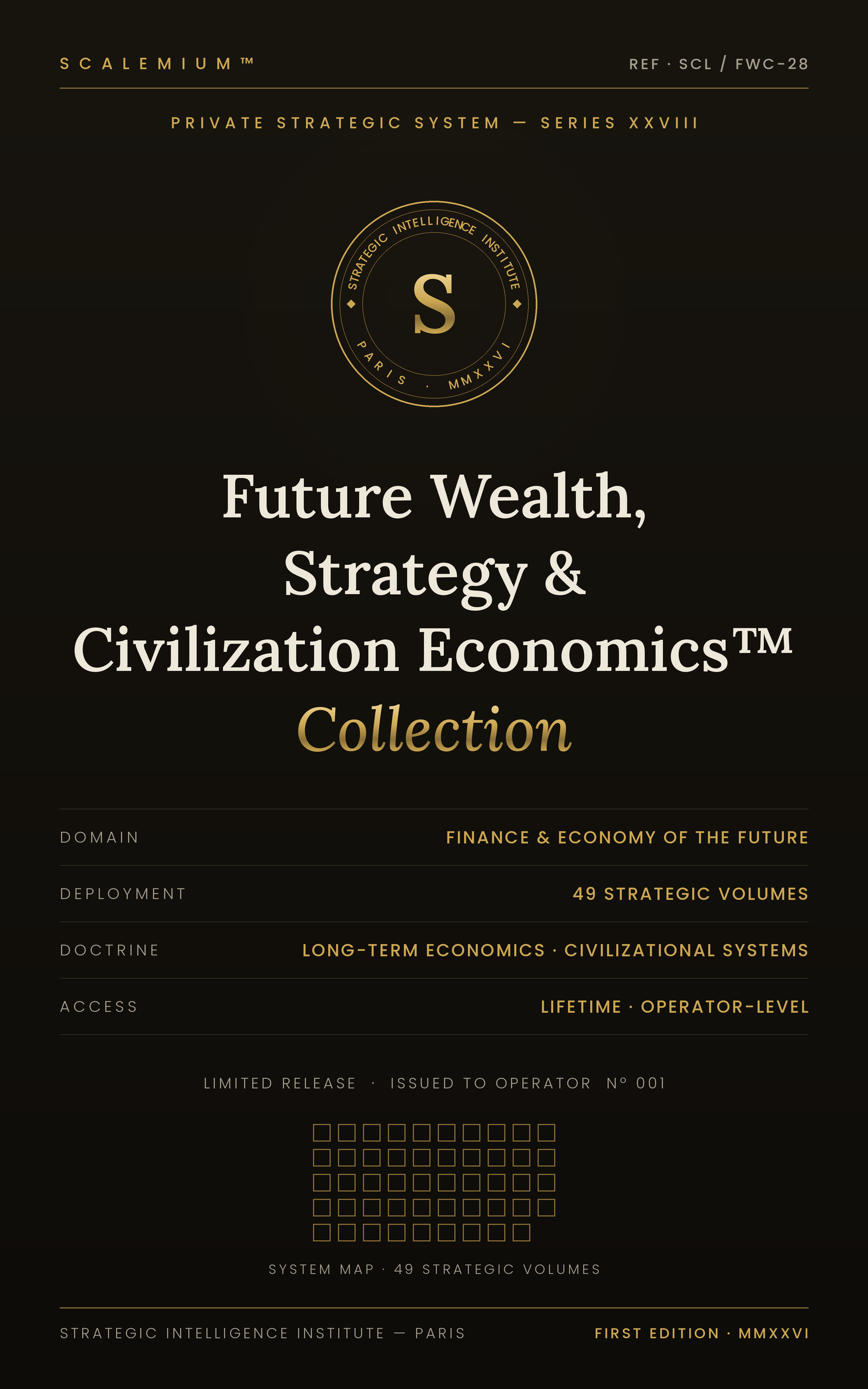
€ 6997
The economic frameworks operating today were not designed for the conditions emerging tomorrow.
For approximately seventy years following the construction of the post-WWII economic order, strategic operators across investment, institutional, and dynastic domains operated within economic conditions characterized by relative stability across foundational dimensions. Growth was the default expectation. Employment was the foundational mechanism of income distribution. National economies operated as the primary unit of economic analysis. Financial institutions operated through frameworks developed and refined across the post-war decades. Capital accumulated through patterns whose mechanics were well understood by professional operators within the established economic infrastructure. The strategic operators of this period could engage economic positioning through frameworks that, while requiring sophistication, operated within structural conditions whose continuity was reasonable to assume across the strategic horizons their operation required.
This period is ending.
Not gradually. Not theoretically. Structurally — through the simultaneous operation of foundational developments whose interactions produce the most consequential economic restructuring since the construction of the post-war order. Artificial intelligence is dissolving the foundational relationship between human cognitive labor and economic value, producing structural conditions for which existing economic frameworks were not designed. Demographic transitions are restructuring the population dynamics within which economic systems were calibrated to operate. Longevity extensions are producing operational lifespans that traditional economic frameworks for retirement, accumulation, and intergenerational wealth transfer were not designed to accommodate. Climate dynamics are restructuring resource availability, geographic positioning, and the foundational physical conditions within which economic activity occurs. Energy transitions are restructuring the foundational infrastructure on which industrial civilization has rested. Geopolitical restructuring is destabilizing the international economic order within which contemporary economic frameworks operate.
The strategic implications extend across every dimension of substantial economic operation.
Investment principals positioning capital across the coming decades operate within environments whose foundational structural conditions differ substantially from those operating during recent decades. The frameworks that produced sustained returns during the relatively stable period now require recalibration to conditions of substantial structural change. The asset categories that operated as primary value stores during the stable period may operate differently under restructured conditions. The institutional infrastructure within which capital allocation occurred during the stable period is itself undergoing substantial transformation.
Family office principals navigating multi-generational positioning operate within environments where the economic conditions their successors will inhabit differ substantially from the conditions within which family wealth was constructed. The strategic positioning of substantial family architecture requires frameworks calibrated to actual emerging conditions rather than to assumptions about continuity that historical experience does not support.
Corporate leadership navigating multi-decade strategic positioning operates within economic environments where the foundational assumptions of corporate operation — labor markets, capital markets, regulatory environments, technological substrates, geopolitical conditions — are simultaneously restructuring.
Sovereign operators engaging economic dimensions of national strategy operate within international economic environments whose architecture is itself under construction through the very strategic decisions sovereign operators are making.
The strategic operators of significance recognize this restructuring as one of the most consequential economic developments of the modern era. The frameworks emerging during the coming decades will determine substantially how capital operates across timescales no current operator will personally witness, affecting populations no current operator will personally know.
Most operators encounter civilization-scale economics through inadequate registers.
They engage it through popular commentary calibrated to particular political or commercial agendas rather than through canonical analysis. They consume forecasts whose accuracy is rarely validated and whose underlying methodology is rarely articulated. They engage specific transformative developments — AI, longevity, energy transition, demographic change — through fragmentary intelligence rather than through integrated frameworks recognizing these developments as connected dimensions of singular civilizational restructuring. The result is fragmentary engagement with civilizational economic dynamics that operate as integrated phenomenon.
The strategic operators of significance who engage civilization-scale economics systematically operate with substantial advantages.
They understand the structural mechanics of the transitions underway rather than engaging them as collection of discrete events. They construct strategic positioning calibrated to actual emerging conditions rather than to historical conditions that no longer fully apply. They engage the foundational economic questions of the coming decades — what produces value when traditional value-creation mechanisms restructure, where capital accumulates when traditional accumulation patterns dissolve, how wealth operates when the foundational economic frameworks that defined wealth are themselves transforming — as integrated strategic considerations rather than as fragmentary topics.
The questions emerging are foundational.
What is wealth when traditional employment dissolves as the foundational income mechanism? What is capital when artificial intelligence systems perform cognitive work at scale? What is value when abundance dynamics restructure the scarcity foundations on which traditional economic analysis rests? What is investment when the asset categories that operated as primary value stores during the stable period may operate differently under restructured conditions? What is wealth preservation across multi-generational timescales when the economic conditions across those generations will differ substantially from current conditions? How should strategic operators position themselves within economic environments characterized by accelerating change, structural restructuring, and the broader civilizational dynamics that require frameworks calibrated to actual emerging conditions?
Beyond these structural questions lies a deeper strategic recognition: the operators positioning strategically for the coming decades who engage civilization-scale economics sophisticatedly will operate with advantages that fragmentary engagement cannot provide. The operators who continue engaging through frameworks calibrated to substantially different conditions will operate at substantial structural disadvantage relative to operators with adequate intelligence.
This collection addresses that engagement.
Future Wealth, Strategy & Civilization-Scale Economics operates as comprehensive institutional intelligence on the economic dimensions of civilizational transition. The collection extends across 50 volumes covering the architectural dimensions of future economic operation — from the future of wealth across coming decades through the economics of post-work conditions, from the strategic dimensions of long-term capital operation through the economics of civilizational risk and resilience, from the emerging conditions of new economic paradigms through the institutional architecture of capital strategy across the most consequential economic restructuring in modern history.
The collection addresses the foundational dimensions of future wealth and civilization-scale economics across institutional, technological, demographic, and strategic horizons.
The collection articulates the structural dimensions of wealth across the coming decades — what wealth will mean under conditions substantially different from those operating during recent decades, how wealth will operate as economic and institutional infrastructure, and what strategic positioning operators require for sustained wealth across emerging conditions.
The collection addresses the structural emergence of intelligence as foundational economic category. Artificial intelligence is not merely additional technological development — it is restructuring the foundational relationship between cognitive labor and economic value. The strategic implications affect capital allocation, business strategy, multi-generational positioning, and the broader institutional infrastructure within which economic activity occurs.
The collection articulates the structural emergence of post-work economic conditions. Traditional employment as foundational income mechanism is restructuring as AI and automation address cognitive and physical labor across expanding domains. The economic frameworks operating beyond the traditional employment-income nexus require systematic articulation that fragmentary commentary cannot provide.
The collection addresses economics at civilization scale. Most economic analysis operates within national-economic frameworks calibrated to nation-state populations and timescales. Civilization-scale economics operates across populations, timescales, and integrative dimensions that traditional analysis does not adequately address.
The collection articulates the economic implications of longevity extensions. Operational lifespans extending substantially beyond traditional retirement frameworks produce strategic implications across personal financial planning, multi-generational wealth transfer, and the broader institutional infrastructure of life-cycle economics.
The collection addresses strategic investment as integrated discipline operating across multi-decade horizons. Most contemporary investment analysis operates within cyclical horizons that systematic decade-length analysis transcends. The strategic operators of significance require frameworks calibrated to actual strategic horizons.
The collection articulates the structural reorganization of elite economic positioning across the coming decades. The mechanisms producing elite economic positioning during recent decades may operate differently under restructured conditions. Skills, access, intelligence infrastructure, and broader institutional positioning will determine elite economic positioning through mechanisms substantially different from historical patterns.
The collection addresses the structural dynamics affecting wealth distribution across the coming decades. Wealth concentration patterns observable across recent decades may accelerate, decelerate, or restructure under emerging conditions. The strategic and political implications of these dynamics operate as foundational considerations for institutional and sovereign operators.
The collection articulates the emerging significance of meaning, satisfaction, and value categories beyond traditional GDP measurement. As traditional economic frameworks restructure, alternative value frameworks emerge as structural considerations across personal, institutional, and civilizational dimensions.
The collection addresses the emerging capital categories of the coming decades. Traditional capital categories — financial capital, physical capital, intellectual property — operate alongside emerging categories including data, computational capacity, and increasingly scarce talent in specific domains. The strategic implications of these emerging capital forms affect capital allocation and institutional positioning.
The collection articulates economic resilience as integrated discipline. The conditions of the coming decades suggest substantial probability of system shocks across financial, monetary, geopolitical, technological, and broader civilizational dimensions. The economics of resilience — the structural conditions producing capacity to survive and benefit from shocks — operate as foundational consideration.
The collection addresses long-term capital strategy as integrated discipline operating across multi-decade and multi-generational timescales. The strategic operators of significance require frameworks calibrated to actual long-term dynamics rather than to compressed cyclical horizons.
The collection articulates the economic dynamics of system collapse and the architectural conditions producing crisis resilience. While system collapse remains contingent rather than certain, the structural conditions affecting collapse dynamics warrant systematic engagement as strategic risk consideration.
The collection addresses the economic dimensions of AI governance. AI development incentives, the economic conditions affecting AI safety, and the broader institutional infrastructure of AI economic operation produce strategic considerations across investment, institutional, and sovereign dimensions.
The collection articulates the emerging economic dimensions of space operation. Space economy is no longer speculative — it is operational, accelerating, and producing strategic considerations across capital allocation, geopolitical positioning, and the broader institutional infrastructure of multi-planetary economic operation.
The collection addresses the substantive dimensions of post-capitalist debate. Whether contemporary economic systems are evolving toward fundamentally different arrangements or maintaining structural continuity with capitalist frameworks operates as foundational consideration affecting strategic positioning across institutional dimensions.
The collection articulates the structural transition from scarcity-based to abundance-based economic dynamics in many domains, alongside the emergence of new scarcity categories — attention, trust, meaning — that traditional economic frameworks did not address as scarce.
The collection addresses long-term competitive positioning at national scale. The wealth strategies of nations operating across multi-decade timescales differ substantially from the cyclical-horizon strategies dominating contemporary political discourse.
The collection articulates the economics of civilization-scale risk. Existential risk, civilizational fragility, and the broader risk categories operating at civilization scale produce strategic implications that traditional risk frameworks do not adequately address.
The collection addresses civilizational accounting — the integrated assessment of civilization-scale assets, liabilities, and future obligations operating beyond traditional national-economic accounting. The civilization balance sheet operates as strategic frame supporting integrated long-term analysis.
The collection articulates economic coordination across populations larger than direct relationships can encompass. Coordination dynamics operate as foundational economic infrastructure whose emerging conditions produce strategic implications across institutional and civilizational dimensions.
The collection addresses the structural transformation of ownership across digital economic infrastructure. Ownership frameworks calibrated to physical assets and traditional intellectual property operate differently under digital and algorithmic infrastructure where control mechanisms differ substantially.
The collection articulates cognitive capital as foundational economic category. Cognitive capital — human and artificial — emerges as foundational asset category whose strategic dimensions operators must engage systematically.
The collection addresses the emerging questions of economic paradigm transition. Whether contemporary growth-based economic frameworks remain applicable across coming decades, what alternative paradigms may emerge, and what strategic implications follow operate as foundational considerations.
The collection operates across 50 volumes structured through five future-economic horizons — each addressing a foundational dimension of future wealth, strategy, and civilization-scale economics.
The opening horizon establishes the structural reality of the economic transition underway — the future of wealth, the economic implications of AI, the emergence of post-work conditions, and the foundational dimensions of civilization-scale economics.
Volume 1 — The Future of Wealth: What Will Matter Economically in 2050
Volume 2 — Economic Power in the AI Age: Intelligence as Capital
Volume 3 — The Post-Work Economy: Income Without Employment
Volume 4 — Civilization-Scale Economics: Managing Abundance and Risk
Volume 5 — The Economics of Longevity: Wealth Over Longer Lives
Volume 6 — The Strategic Investor: Thinking in Decades
Volume 7 — The New Elite Economy: Skills, Access, Intelligence
Volume 8 — The Wealth Gap Problem: Stability vs Inequality
Volume 9 — The Economics of Meaning: Value Beyond GDP
Volume 10 — The Capital of the Future: Data, Compute, Talent
The second horizon addresses the structural requirements for resilience, long-term capital operation, and the strategic management of civilization-scale economic considerations.
Volume 11 — The Economics of Resilience: Surviving System Shocks
Volume 12 — Long-Term Capital Strategy: Planning Beyond Cycles
Volume 13 — The Economics of Collapse: Preparing for Breakdown
Volume 14 — The Wealth of Nations Revisited: Old Theory, New World
Volume 15 — Economic Strategy for Humanity: Managing Global Resources
Volume 16 — The Economics of AI Governance: Incentives for Safety
Volume 17 — The Intelligence Dividend: Societal Gains From AI
Volume 18 — The New Growth Question: Limits and Opportunities
Volume 19 — The Economics of Space: Resources Beyond Earth
Volume 20 — The Financial Future of Cities: Urban Capital
The third horizon addresses the structural debates regarding post-capitalist transitions, the economics of abundance and new scarcity, the wealth strategies of nations, and the integrated long-term capital frameworks operators of significance require.
Volume 21 — The Post-Capitalist Debate: Evolution or Illusion?
Volume 22 — The Economics of Abundance: Managing Plenty
Volume 23 — The New Scarcity: Attention, Trust, Meaning
Volume 24 — The Wealth Strategy of Nations: Competing Long Term
Volume 25 — The Economics of Civilization Risk: Pricing Survival
Volume 26 — The Long Game of Capital: Endurance Over Speed
Volume 27 — Economic Intelligence Systems: AI for Macro Strategy
Volume 28 — The Economics of Power: Capital as Control
Volume 29 — The Future of Financial Institutions: Reinvention or Collapse
Volume 30 — The Global Wealth Map: Where Value Will Accumulate
The fourth horizon addresses the structural dimensions of investment in human potential, the economics of automation risk, the wealth of cognitive capital, and the integrated civilizational accounting that frames long-term economic analysis.
Volume 31 — The Economics of Human Potential: Investing in Minds
Volume 32 — The Strategic Allocation of Humanity: Resources, Intelligence, Time
Volume 33 — The Next Economic Paradigm: After Growth
Volume 34 — The Economics of Automation Risk: Stability Under Change
Volume 35 — The Wealth of Intelligence: Cognitive Capital
Volume 36 — The Civilization Balance Sheet: Assets, Liabilities, Future
Volume 37 — The Economics of Coordination: Cooperation at Scale
Volume 38 — The Future of Ownership: Control in Digital Economies
Volume 39 — The Economics of Trust Collapse: Financial Systems Under Strain
Volume 40 — The Financial Ethics of Power: Responsibility of Wealth
The closing horizon synthesizes the collection’s architecture — addressing the structural design of long-term economic compacts, civilizational capital allocation, the economics of survival under extreme conditions, the future of human wealth after automation, and the foundational institutional infrastructure of the emerging economic order.
Volume 41 — The Long-Term Economic Compact: Global Stability Strategy
Volume 42 — Economic Design for the 21st Century: Intentional Systems
Volume 43 — The Capital Allocation of Civilization: What Humanity Funds
Volume 44 — The Economics of Survival: Preparing for Extremes
Volume 45 — The Wealth of the Future Human: Value After Automation
Volume 46 — The Global Economic Brain: AI Managing Markets
Volume 47 — The End of Naive Economics: Complexity Takes Over
Volume 48 — The Economics of Intelligence Explosion: Managing Rapid Growth
Volume 49 — The New Economic Order: After the Transition
Volume 50 — The Future Economy Institution: Teaching Wealth for a New World
The collection delivers institutional intelligence value across the foundational dimensions of future wealth and civilization-scale economics.
Operators receive frameworks calibrated to economic decisions operating at scales traditional economic frameworks were not designed to engage. The frameworks support strategic operation calibrated to actual emerging economic conditions.
The collection provides intelligence on economic positioning across multi-decade and multi-generational timescales. Operators thinking across substantial horizons receive frameworks for engaging economic considerations operating across timescales their strategic positioning must accommodate.
The collection provides comprehensive frameworks for the economic implications of artificial intelligence at structural level. Operators with substantial AI exposure or with positioning affected by AI economic dynamics receive intelligence calibrated to these foundational dynamics.
The collection provides intelligence on the economic dimensions of post-work conditions. Operators positioning for the substantial probability that traditional employment-income mechanisms will restructure across coming decades receive frameworks for engaging this structural development.
The collection provides risk and resilience frameworks calibrated to civilization-scale considerations. Operators of significance with substantial exposure to civilization-scale dynamics receive frameworks substantially exceeding traditional risk analysis.
The collection provides intelligence on the emerging capital categories of the coming decades — data, compute, talent, attention, trust, meaning. Operators positioning strategically benefit from understanding emerging capital categories rather than from operating within frameworks calibrated to traditional categories alone.
The collection provides long-term economic strategy frameworks for operators engaging strategic positioning across multi-decade and multi-generational timescales. The frameworks support strategic operation at the depth substantial long-term positioning requires.
The collection supports civilizational positioning across the most consequential economic restructuring in modern history. Operators recognizing the scale of the transition underway benefit from intelligence calibrated to the actual scale rather than to compressed cyclical analysis.
The collection provides strategic foresight infrastructure for the emerging economic order. The operators positioning for the order that emerges from the current transition receive intelligence supporting strategic foresight that operators engaging only contemporary conditions cannot match.
The collection operates as reserved infrastructure for operators engaged with the most consequential dimensions of future wealth and civilization-scale economics.
Senior investment principals whose strategic positioning operates across multi-decade horizons and involves substantial exposure to civilization-scale economic developments — sovereign wealth fund principals, large family office investment committees, foundation investment leadership, capital allocators in transformative domains.
Family office principals navigating multi-generational positioning under conditions where the economic environments their successors will inhabit differ substantially from current conditions. The strategic positioning of substantial family architecture requires frameworks calibrated to actual emerging conditions.
Senior governmental operators, sovereign principals, central bank operators, and national economic strategists engaged with long-term economic positioning at national and international scales.
Senior corporate leadership whose strategic responsibility extends substantially beyond cyclical horizons — particularly principals of multi-generational corporations, foundation-controlled institutions, and corporations whose strategic positioning operates across multi-decade timescales.
Senior operators in AI development, biotechnology, longevity research, and other transformative technological domains whose work involves substantial economic considerations operating at civilization scale.
Senior leadership of strategic intelligence institutions, macro-strategy firms, foreign policy institutes, and operators engaged with the institutional construction of long-term economic intelligence.
Academic researchers, futurists, civilizational analysts, and intellectual operators whose work requires institutional-grade synthesis of civilization-scale economics as foundational research infrastructure.
Strategic principals whose decisions affect substantial economic outcomes across multi-decade timescales — capital allocation decisions affecting civilization-scale resource flows, institutional design decisions affecting economic infrastructure across generations, sovereign decisions affecting national positioning across decades.
The collection does not operate as popular commentary on future economics, ideologically-positioned analysis of contemporary economic developments, or general-audience content on AI economics and futurism. The reserved positioning operates through strategic standards rather than through commercial accessibility.
Access: €6,997
Access operates through institutional channels. The collection delivers across the 50 volumes with continuing institutional support for operators integrating the intelligence into their strategic and institutional infrastructure.
Reserved for operators recognizing that future wealth and civilization-scale economics operate as foundational strategic dimensions across investment, institutional, dynastic, and civilizational horizons. Not all applications warrant access.
→ Access This Collection — €6,997
Submit access request for institutional review.
→ Multi-Collection Institutional Access
For operators considering institutional access across the complete Finance & Economy of the Future edition or across the broader Strategic Intelligence library.
→ Private Advisory
For operators whose strategic situations warrant direct engagement at substantial depth.
Full access, delivered instantly upon acquisition.
For operators acquiring several collections within the Strategic Intelligence library. Submit your selection — we structure a single institutional access, priced accordingly.
For operators whose strategic situation warrants direct counsel at substantial depth.
SCALEMIUM™
Collections → Finance & Economy of the Future → Volume 3
short-term thinkers
people chasing trends
people avoiding complexity
This is not about making money today.
This is about:
 building advantage over time
If you understand long-term economics:
you anticipate shifts
you avoid being late
you build durable systems
That’s strategic power.
Most people react to the future.
Very few position before it happens.
This collection gives you:
a long-term strategic view of wealth and economic evolution
Lorem ipsum dolor sit amet, consectetur adipiscing elit. Ut elit tellus, luctus nec ullamcorper mattis, pulvinar dapibus leo.
We use cookies to ensure the site functions properly, understand how it is used, and improve your experience. You can accept, reject, or manage your preferences at any time.