
|
SCALEMIUM™ — Strategic systems for modern operators. |
€ 6997
The economy itself is becoming intelligent.
For approximately the entire history of human civilization, economic activity has been mediated by human cognition. Humans made the decisions. Humans set the prices. Humans evaluated the risks. Humans allocated the capital. Humans performed the work. Even when machines extended human capability — through agricultural mechanization, industrial production, computational processing — the cognitive substrate of economic decision-making remained substantially human. Economic systems were systems of human coordination, even when the coordination occurred at scales humans could not individually comprehend.
This foundational arrangement is now ending.
Not gradually. Not theoretically. Structurally — through the deployment of artificial intelligence systems that increasingly mediate the cognitive operations on which economic activity depends. Markets trade through algorithmic systems operating at speeds and volumes human cognition cannot match. Capital allocation increasingly involves AI systems whose decisions affect investment outcomes at substantial scale. Pricing operates through algorithmic systems that adjust continuously across millions of transactions. Risk evaluation involves AI systems processing information at scales human analysts cannot approach. Productivity itself — the foundational economic measure of value creation per unit of input — is restructuring as AI systems perform cognitive labor across domains where humans previously held monopoly. The economy is not merely adopting AI as additional tool. The economy is becoming AI-structured at substrate level.
The strategic implications are foundational and unprecedented.
For approximately two and a half centuries of industrial civilization, the relationship between technology and economic value followed patterns that, while undergoing substantial revisions across the period, maintained foundational continuity. Technology extended human capability. Humans operated technology to produce value. Economic returns accrued to capital, labor, and the institutional infrastructure within which capital and labor combined to produce value. This basic arrangement is now restructuring as AI systems increasingly substitute for rather than extend human cognitive capability across expanding economic domains.
The structural questions emerging are unprecedented in modern economic history.
What is value creation when intelligent systems perform the cognitive labor previously performed by humans? What are economic returns when the automation of cognitive labor expands across domains where labor previously commanded substantial market wages? What is capital when AI systems themselves become the primary productive assets of economic operation? What is productivity when machines perform tasks at scales and speeds human productivity cannot approach? What is competition when algorithmic systems operate as primary market actors? What is wealth concentration when the ownership of AI infrastructure becomes the foundational determinant of economic returns?
These questions are not theoretical. They are operational — already shaping economic outcomes across investment, corporate, sovereign, and dynastic dimensions. The operators positioning strategically for the coming decades face economic environments substantially restructured by these dynamics, requiring frameworks calibrated to actual emerging conditions rather than to assumptions about continuity that contemporary developments do not support.
Most operators encounter the AI economy through inadequate registers.
They engage it through technology product announcements rather than through structural economic analysis. They consume commentary calibrated to particular commercial or political agendas rather than through systematic intelligence on the structural dynamics underway. They engage AI through tactical applications — specific tools, particular productivity improvements, discrete automation projects — without engaging it as foundational economic restructuring. The result is fragmentary engagement with structural transformation that operates as integrated phenomenon requiring integrated strategic intelligence.
The strategic operators of significance who engage the AI economy systematically operate with substantial advantages.
They understand the structural mechanics of the economic restructuring underway rather than engaging discrete AI developments. They recognize that AI is not merely additional technology but foundational economic infrastructure restructuring the substrate of economic operation itself. They construct strategic positioning calibrated to the substantial probability that traditional economic frameworks will operate increasingly inadequately as AI infrastructure expands. They engage the foundational questions of the AI economy — productivity dynamics, capital concentration patterns, labor market restructuring, wealth distribution mechanics — as integrated strategic considerations rather than as fragmentary topics.
This collection addresses that engagement.
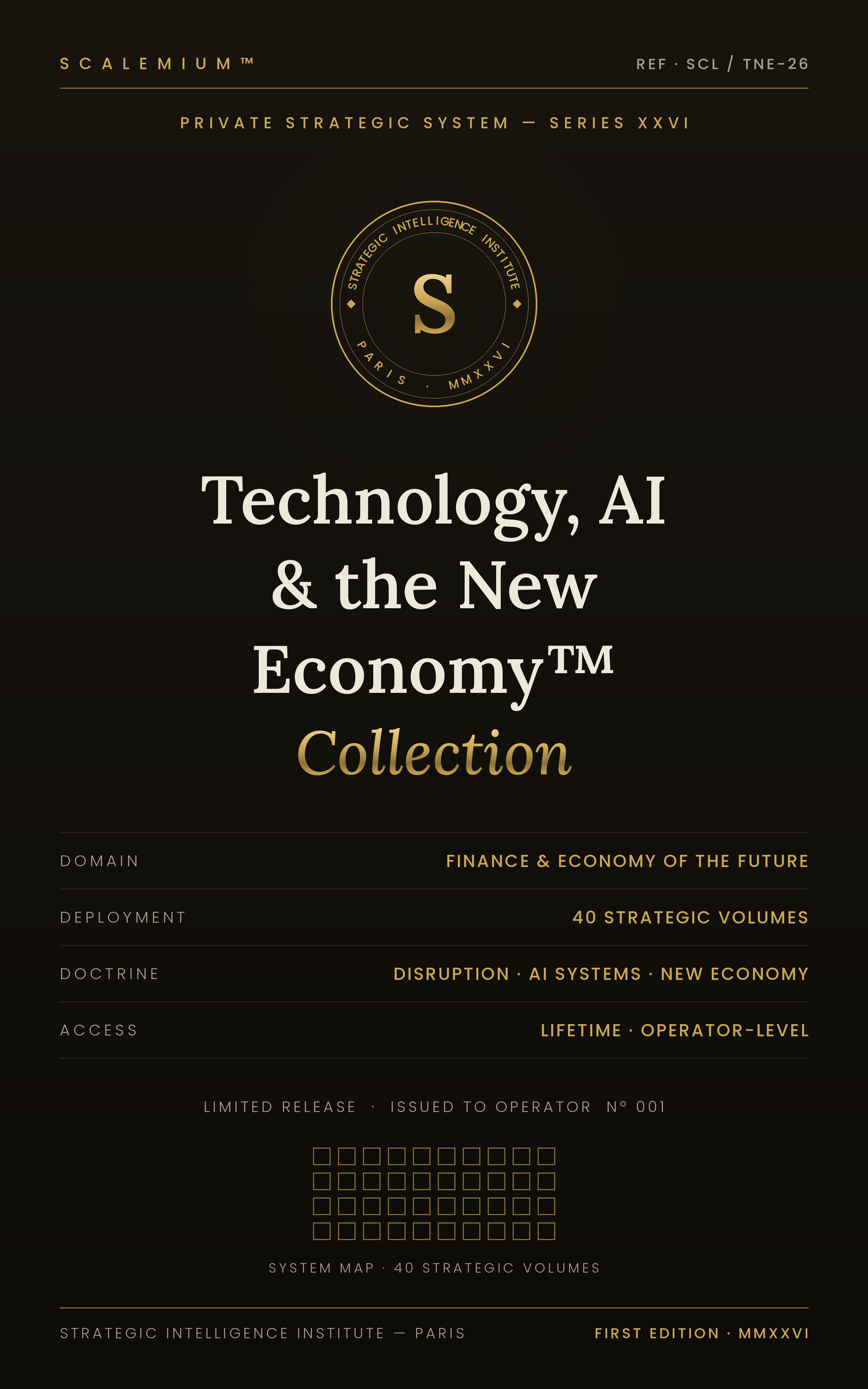
Technology, AI & the New Economy operates as comprehensive institutional intelligence on the structural transformation of economic operation through AI and technological infrastructure. The collection extends across 40 volumes covering the architectural dimensions of the AI economy — from the productivity and automation dynamics of AI deployment through the structural restructuring of labor and capital, from the platform and data economies through the algorithmic operation of contemporary markets, from the emergence of digital and tokenized assets through the foundational questions of what wealth, value, and productivity will mean across the coming decades.
This collection completes the Finance & Economy of the Future edition and the broader Scalemium Strategic Intelligence library. It addresses the economic dimension of the foundational restructuring engaged across multiple editions of the library — providing operators with the integrated intelligence necessary for strategic operation across the coming decades.
The collection addresses the foundational dimensions of the AI economy and technological transformation across investment, institutional, labor, and broader economic horizons.
The collection articulates the AI economy as foundational restructuring rather than as incremental technological adoption. AI is restructuring the substrate of economic operation across multiple dimensions simultaneously, producing economic conditions that traditional analytical frameworks inadequately address.
The collection addresses the structural mechanics through which AI restructures productivity. AI systems are producing productivity gains at scales that, if sustained across coming decades, will substantially exceed productivity dynamics observable across recent decades. The strategic implications of these productivity dynamics affect investment positioning, corporate strategy, and broader institutional operation.
The collection articulates the structural question of how AI-generated value will be distributed. The automation of cognitive and physical labor produces substantial economic value. The structural mechanics determining how this value is distributed across capital owners, labor providers, and the broader economy operate as foundational consideration affecting strategic positioning across multiple dimensions.
The collection addresses the structural reality of contemporary algorithmic markets. Markets increasingly operate through algorithmic systems that conduct trading, pricing, and allocation at speeds and volumes human cognition cannot match. The strategic implications affect investment operation, regulatory environments, and broader market dynamics.
The collection articulates the structural restructuring of labor markets under AI deployment. The future of work — what work will be performed by humans, what work will be performed by AI systems, how compensation will operate across the human-AI workforce — produces strategic implications affecting personal positioning, institutional design, and broader social and political dynamics.
The collection addresses the structural emergence of data as foundational economic asset. Data has become substantial economic asset whose strategic implications affect operations across investment, corporate, and institutional contexts.
The collection articulates the structural dynamics of contemporary platform economies. Platforms operate as economic infrastructure whose mechanics differ substantially from traditional economic structures. The strategic implications of platform dynamics affect operations across multiple dimensions.
The collection addresses the emerging digital asset categories — cryptocurrencies, tokenized assets, the broader digital asset infrastructure — as integrated economic phenomenon. The strategic implications affect investment positioning, capital allocation, and broader financial operation.
The collection articulates the structural emergence of tokenized ownership infrastructure. Tokenization is restructuring foundational ownership categories across multiple asset classes. The strategic implications affect operations across investment and institutional contexts.
The collection addresses AI integration into financial infrastructure as foundational development. AI systems perform increasing portions of financial analysis, prediction, risk evaluation, and capital allocation. The strategic implications affect operations across financial services and investment domains.
The collection articulates the structural possibility of substantial productivity acceleration through AI deployment. If the productivity dynamics observable in specific domains generalize across the economy, the resulting economic growth dynamics will substantially exceed those observable across recent decades.
The collection addresses the structural transition from labor-scarce to labor-abundant economic conditions across cognitive labor domains. AI systems are producing cognitive labor at scales that may exceed cognitive labor demand across substantial portions of the economy. The strategic implications affect labor market dynamics, wealth distribution, and broader economic operation.
The collection articulates machine capitalism as integrated economic phenomenon. The ownership of AI infrastructure operates as foundational determinant of economic returns under conditions of substantial AI deployment. The strategic implications affect capital allocation, institutional positioning, and wealth concentration dynamics.
The collection addresses the intelligence premium operating across contemporary economic activity. Smarter systems, AI-integrated operations, and intelligence-enhanced strategic capabilities produce returns exceeding those available through traditional operational approaches. The strategic implications affect competitive positioning across institutional contexts.
The collection articulates software as integrated capital category. Code operates as substantial economic asset whose strategic implications affect investment positioning, corporate strategy, and broader institutional operation.
The collection addresses the creator economy as integrated economic phenomenon. The monetization of attention, skill, and personal brand operates through structural mechanics that traditional economic analysis inadequately addresses.
The collection articulates the structural implications of AI for wealth inequality dynamics. AI deployment patterns may accelerate, modify, or restructure wealth concentration dynamics observable across recent decades. The strategic implications affect institutional and political considerations across multiple dimensions.
The collection addresses the structural transformation of global commerce through digital infrastructure. Digital marketplaces operate across jurisdictions, currencies, and traditional commercial categories with implications affecting investment positioning and institutional operation.
The collection articulates algorithmic pricing as integrated market phenomenon. Markets increasingly adjust themselves through algorithmic systems whose dynamics produce strategic implications across competitive positioning.
The collection addresses speed as integrated competitive dimension. Computational speed produces competitive advantages in contemporary markets that operate at machine speed. The strategic implications affect investment operation across multiple domains.
The collection articulates AI integration into investment strategy. AI systems augment investment decision-making through capabilities that produce competitive advantages relative to operators engaging investment through traditional analytical frameworks alone.
The collection addresses the structural evolution of the knowledge economy under AI integration. The traditional knowledge economy — operating through human knowledge workers and traditional institutional infrastructure — is restructuring through AI deployment producing intelligence at scales previously unavailable.
The collection articulates the structural implications of automation for corporate margins and profitability. AI deployment is reshaping the cost structures of contemporary corporate operation with implications affecting competitive dynamics across industries.
The collection addresses the future firm as integrated organizational phenomenon. The architecture of organizations operating successfully under AI-integrated conditions differs substantially from traditional organizational frameworks.
The collection articulates winner-take-all dynamics operating in contemporary platform economies. The structural mechanics producing concentration in platform economies operate with substantial consistency and produce strategic implications affecting competitive positioning.
The collection addresses the structural emergence of autonomous enterprise. AI integration is producing organizational capabilities approaching autonomous operation across expanding domains. The strategic implications affect institutional design and competitive dynamics.
The collection articulates AI as integrated economic infrastructure — comparable in foundational significance to electricity or computational infrastructure but with substantial additional implications. The strategic positioning of operators within AI-integrated economic infrastructure affects strategic outcomes across multiple dimensions.
The collection addresses the structural emergence of digital monopolies through network effects. The mechanics producing digital monopolization operate with substantial consistency and produce strategic implications affecting competitive positioning, regulatory environments, and broader institutional dynamics.
The collection articulates the substantial possibility that current economic restructuring represents reset of foundational economic rules. If the current restructuring produces substantially different economic operation than historical patterns suggest, the strategic implications extend across every dimension of long-term positioning.
The collection addresses the substantive dimensions of post-scarcity debate. Whether AI deployment produces genuine post-scarcity conditions across substantial domains, or whether scarcity restructures into new categories, operates as foundational consideration affecting strategic positioning.
The collection articulates the structural emergence of intelligent markets — markets that incorporate learning capabilities through AI integration. The strategic implications of intelligent markets affect operations across investment, regulatory, and broader institutional contexts.
The collection addresses the substantial possibility of machine-driven economic growth — growth produced increasingly by AI systems with declining proportional human contribution. The strategic, political, and ethical implications of this structural possibility operate as foundational considerations.
The collection operates across 40 volumes structured through four economic transformations — each addressing a foundational dimension of the AI economy and technological transformation.
The opening transformation establishes the foundational reality of the AI economy — the productivity dynamics, automation patterns, algorithmic market mechanics, and the structural restructuring of labor under AI deployment.
Volume 1 — The AI Economy: Productivity, Automation, and Wealth Creation
Volume 2 — The Automation Dividend: Who Captures the Value of Machines
Volume 3 — The Algorithmic Market: When Software Trades, Prices, and Allocates
Volume 4 — AI and the Future of Work: Jobs, Skills, and Income Redefined
Volume 5 — The Data Economy: Information as a Financial Asset
Volume 6 — The Platform Economy: Marketplaces, Networks, Power
Volume 7 — The Digital Asset Revolution: Beyond Traditional Finance
Volume 8 — The Tokenized Economy: Ownership in the Age of Code
Volume 9 — AI-Driven Finance: Prediction, Risk, and Speed
Volume 10 — The Productivity Explosion: Economic Growth After AI
The second transformation addresses the structural restructuring of labor and capital under AI deployment — the end of labor scarcity, machine capitalism, the intelligence premium, software as capital, and the emerging dynamics of the creator economy and wealth inequality.
Volume 11 — The End of Labor Scarcity: When Work Is Automated
Volume 12 — Machine Capitalism: Who Owns the Machines Wins
Volume 13 — The Intelligence Premium: Smarter Systems, Higher Returns
Volume 14 — The Software Economy: Code as Capital
Volume 15 — The Creator Economy Explained: Monetizing Attention and Skill
Volume 16 — AI and Wealth Inequality: Structural Shifts in Income
Volume 17 — The Digital Marketplace: Global Trade Without Borders
Volume 18 — Algorithmic Pricing: Markets That Adjust Themselves
Volume 19 — The Speed Advantage: Milliseconds as Profit
Volume 20 — AI in Investment Strategy: Augmented Decision-Making
The third transformation addresses the structural emergence of new organizational forms — knowledge economy 2.0, automation and margins, the future firm, platform winner-take-all dynamics, the autonomous enterprise, and capital-light business architecture.
Volume 21 — The Knowledge Economy 2.0: Intelligence at Scale
Volume 22 — Automation and Margins: Why AI Reshapes Profitability
Volume 23 — The Future Firm: Lean, Intelligent, Scalable
Volume 24 — The Economics of Platforms: Winner-Take-All Dynamics
Volume 25 — The Autonomous Enterprise: Companies That Run Themselves
Volume 26 — The Capital-Light Business: Growth Without Heavy Assets
Volume 27 — AI as Economic Infrastructure: Like Electricity, But Smarter
Volume 28 — The New Productivity Equation: Humans + Machines
Volume 29 — Digital Monopolies: Power Through Network Effects
Volume 30 — The Economic Reset: Rewriting the Rules of Growth
The closing transformation addresses the most consequential dimensions of the AI economic transition — AI financial forecasting, the end of traditional jobs, the algorithmic workforce, the value of intelligence, the synthetic economy, the economics of attention, the post-scarcity debate, and the foundational restructuring toward machine-driven economic operation.
Volume 31 — AI and Financial Forecasting: Prediction at Scale
Volume 32 — The End of Traditional Jobs: Income After Employment
Volume 33 — The Algorithmic Workforce: Software as Labor
Volume 34 — The Value of Intelligence: Pricing Thinking Power
Volume 35 — AI and Capital Efficiency: Doing More With Less
Volume 36 — The Synthetic Economy: Simulated Markets, Real Value
Volume 37 — The Economics of Attention: Focus as Currency
Volume 38 — The Post-Scarcity Debate: Abundance or Illusion?
Volume 39 — The Intelligent Market: When Markets Learn
Volume 40 — The Machine-Driven Economy: Growth Without Humans?
The collection delivers institutional intelligence value across the foundational dimensions of the AI economy and technological transformation.
Operators receive structural intelligence on the AI economic restructuring underway. The intelligence enables strategic operation calibrated to actual emerging conditions rather than to assumptions about continuity that contemporary developments do not support.
The collection provides frameworks for engaging AI as foundational economic infrastructure rather than as additional technological tool. Operators with substantial AI exposure — increasingly all major operators — receive intelligence calibrated to AI’s actual economic significance.
The collection provides intelligence on the structural restructuring of labor markets and workforce dynamics under AI deployment. Operators positioning institutionally, dynastically, or personally for the coming decades receive frameworks for engaging these foundational developments systematically.
The collection provides frameworks for engaging the structural capital concentration dynamics emerging under AI deployment. Investment principals, family office principals, and institutional architects receive intelligence on the structural mechanics producing capital concentration in AI-integrated economic conditions.
The collection provides comprehensive intelligence on platform economy dynamics. Operators with substantial platform exposure — through investment, corporate operation, or strategic positioning affected by platform dynamics — receive frameworks calibrated to actual platform mechanics.
The collection provides intelligence on emerging digital asset categories and tokenization dynamics. Operators with substantial exposure to or interest in these emerging financial categories receive analytical infrastructure calibrated to their actual operational characteristics.
The collection provides frameworks for AI integration into investment strategy. Operators whose investment effectiveness depends on engaging AI sophisticatedly receive intelligence supporting strategic AI integration.
The collection provides intelligence on the future firm and the organizational architecture supporting successful operation under AI-integrated conditions. Operators constructing or restructuring institutions for the coming decades receive frameworks calibrated to emerging organizational requirements.
The collection provides intelligence on the structural distributional dynamics emerging under AI deployment. The strategic implications of wealth distribution under AI conditions affect institutional, dynastic, and political considerations across multiple dimensions.
The collection provides multi-decade strategic positioning frameworks calibrated to AI economic conditions. Operators positioning for the substantial probability that AI deployment produces fundamentally different economic conditions than recent decades receive intelligence supporting this strategic positioning.
The collection operates as reserved infrastructure for operators whose strategic positioning involves substantial AI economic and technological dimensions.
Investment principals with substantial exposure to AI infrastructure, technology platforms, digital assets, and the broader emerging economic infrastructure of the AI economy — venture capital partners, family office technology investments, sovereign wealth fund AI positions, public market technology exposure.
Senior leadership of AI organizations, technology platforms, digital infrastructure entities, and broader technology institutions whose operations involve substantial economic dimensions of the AI restructuring.
Senior corporate leadership whose strategic positioning involves substantial AI integration considerations. The integration of AI into corporate operation is restructuring competitive dynamics across virtually all industries and requires institutional-grade intelligence supporting strategic decisions.
Family office principals navigating multi-generational positioning under economic conditions substantially restructured by AI deployment. The economic environments their successors will inhabit will differ substantially from current conditions, and multi-generational positioning requires intelligence calibrated to these emerging conditions.
Senior governmental operators, sovereign principals, regulatory architects, and operators engaged with the construction of economic policy under AI-restructured conditions.
Senior operators in strategic intelligence functions, macroeconomic analysis, and institutional risk management whose work requires institutional-grade synthesis of AI economic dynamics as foundational professional infrastructure.
Academic researchers in AI economics, technology economics, future-of-work studies, and adjacent fields whose work requires institutional-grade synthesis of AI economic dynamics as foundational research infrastructure.
Operators completing systematic engagement with the Finance edition benefit from this collection as integrating synthesis on the emerging economic order. The collection operates with substantially greater depth when engaged after the foundational collections, the civilizational economic collection, and the macroeconomic collection.
Operators completing systematic engagement across multiple editions of the Scalemium library benefit from this collection as integrated economic intelligence on the foundational restructuring engaged across the broader library. The economic dimension addressed by this collection integrates with the psychological, civilizational, ethical-legal, and power-geopolitical dimensions engaged across the broader library.
The collection does not operate as popular commentary on AI, ideologically-positioned analysis of technological developments, or general-audience content on the future of work and the AI economy. The reserved positioning operates through strategic standards rather than through commercial accessibility.
This collection completes the Finance & Economy of the Future edition and the broader Scalemium Strategic Intelligence library. The Finance edition extends across five collections:
— Finance, Capital & Wealth Systems — the architectural foundation
— Foundations of Money, Value & Economics — the canonical foundation
— Future Wealth, Strategy & Civilization-Scale Economics — civilization-scale economics
— Macroeconomics, States & Global Finance — macroeconomic and sovereign dimensions
— Technology, AI & the New Economy — the AI economic transformation (this collection)
Each collection operates independently as comprehensive intelligence on its specific domain. The five collections together provide integrated intelligence on the structural dimensions of finance, capital, and economic operation across the coming decades.
The Finance edition together with the broader Scalemium Strategic Intelligence library — encompassing editions on Psychology, Future of Humanity, Ethics/Law/Governance, Power/Influence/Geopolitics, and Finance/Economy — provides comprehensive institutional intelligence on the foundational restructuring underway across multiple dimensions of contemporary civilization.
Operators considering systematic engagement across the broader library benefit from access spanning multiple editions. Multi-collection institutional access addresses operators planning systematic engagement across the full Finance edition or across the broader Strategic Intelligence library.
Access: €6,997
Access operates through institutional channels. The collection delivers across the 40 volumes with continuing institutional support for operators integrating the intelligence into their strategic and institutional infrastructure.
Reserved for operators recognizing that the AI economic transformation operates as foundational strategic dimension across investment, institutional, dynastic, and civilizational horizons. Not all applications warrant access.
→ Access This Collection — €6,997
Submit access request for institutional review.
→ Multi-Collection Institutional Access
For operators considering institutional access across the complete Finance & Economy of the Future edition or across the broader Strategic Intelligence library — encompassing the full institutional intelligence infrastructure across multiple editions.
→ Private Advisory
For operators whose strategic situations warrant direct engagement at substantial depth.
Full access, delivered instantly upon acquisition.
For operators acquiring several collections within the Strategic Intelligence library. Submit your selection — we structure a single institutional access, priced accordingly.
For operators whose strategic situation warrants direct counsel at substantial depth.
SCALEMIUM™
Collections → Finance & Economy of the Future → Volume 5
How AI and technology reshape value creation
The rise of platform economies and digital systems
How automation changes work, income, and leverage
New economic models (creator economy, digital assets, AI systems)
How to position yourself in emerging structures
 Volume 1 — The Shift to the New Economy
Understanding the transition from traditional to digital systems
Volume 2 — AI and Economic Transformation
How artificial intelligence redefines industries
Volume 3 — Platform and Digital Economies
How value is created in modern systems
Volume 4 — Automation and the Future of Work
What replaces traditional labor
Volume 5 — Strategic Positioning in the New Economy
How to operate and win in this new environment
entrepreneurs
founders
operators
strategists
anyone building in the digital world
people stuck in old economic models
people resistant to change
people ignoring technology
This is not about trends.
This is about:
 understanding the new rules of the game
If you understand the new economy:
you anticipate change
you leverage systems
you build ahead of others
That’s future advantage.
Most people adapt too late.
Very few see the shift early.
This collection gives you:
a strategic understanding of where the economy is going
We use cookies to ensure the site functions properly, understand how it is used, and improve your experience. You can accept, reject, or manage your preferences at any time.