
|
SCALEMIUM™ — Strategic systems for modern operators. |
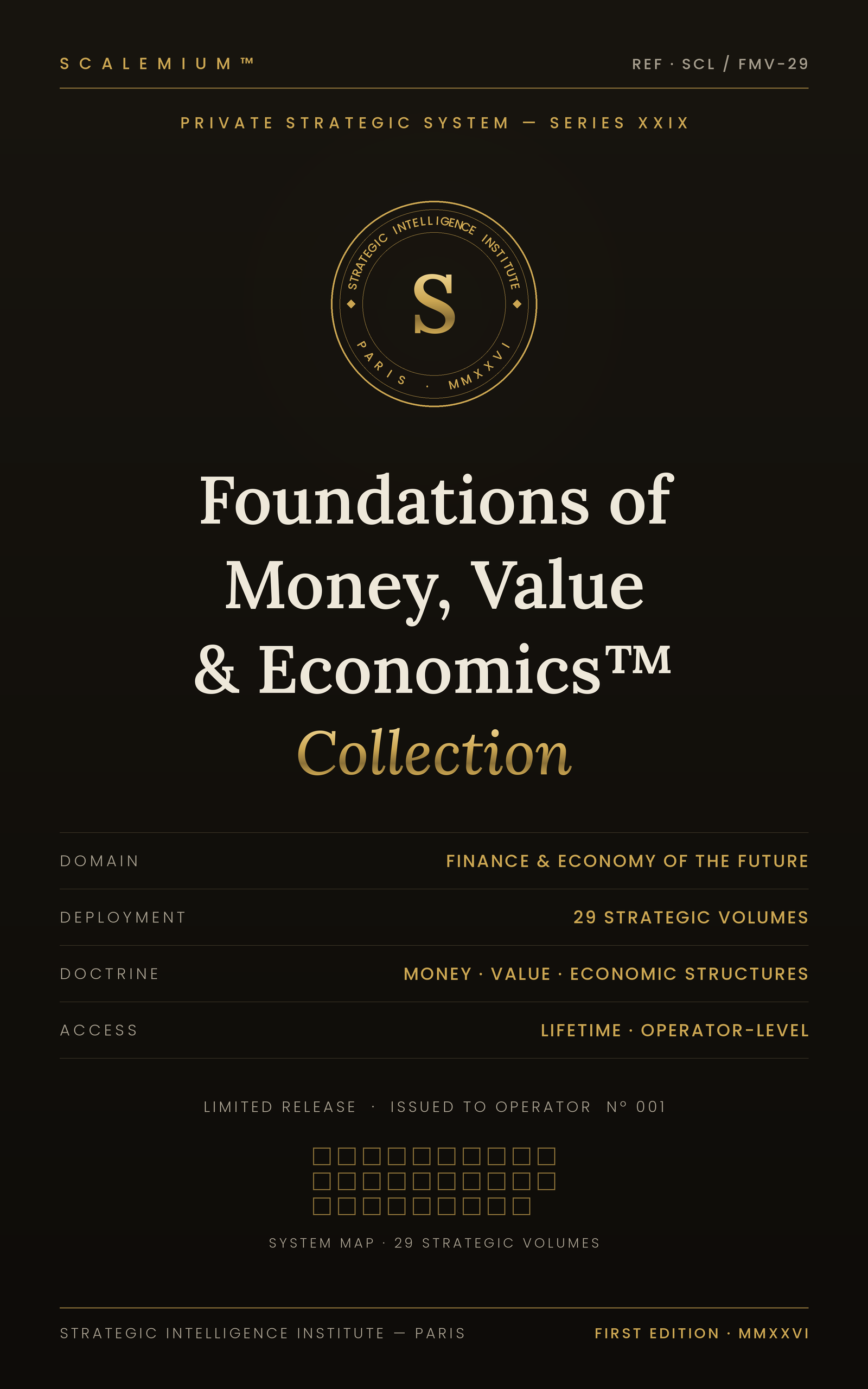
€ 6997
Money is the most universally used and least universally understood instrument in human civilization.
For approximately three thousand years, humans have used money. For approximately two hundred and fifty years, serious thinkers have systematically engaged the questions money raises: What is money? What is value? How do economic systems actually operate? Why does capital accumulate in certain configurations and dissipate in others? What are the structural conditions producing prosperity, and what conditions produce its dissolution? What is the relationship between money and political power, between markets and institutions, between economic incentives and human behavior across populations larger than direct relationships can encompass?
These questions have been engaged by Adam Smith and David Ricardo, by John Stuart Mill and Karl Marx, by Carl Menger and Ludwig von Mises, by John Maynard Keynes and Friedrich Hayek, by Milton Friedman and Joseph Schumpeter, by John Kenneth Galbraith and Hyman Minsky, by contemporary thinkers extending and refining the canonical analysis. The accumulated body of economic inquiry represents one of humanity’s most substantial intellectual achievements — engaged through disciplined work across centuries, tested against the practical operation of markets, governments, and the broader institutional infrastructure within which actual economic activity occurs.
Yet the canonical understanding of money, value, and economics remains largely unavailable to most strategic operators.
Most contemporary engagement with economic questions operates through inadequate registers. Popular financial discourse addresses money primarily through tactical investment advice that lacks foundational economic understanding. Political discourse engages economic questions through ideological frameworks calibrated to particular political agendas rather than to canonical analysis. Educational infrastructure provides foundational economic education insufficient for sophisticated strategic operation. The result is a discursive environment in which economic questions are discussed continuously while the canonical foundations supporting sophisticated economic engagement remain largely outside the analytical infrastructure of strategic operators.
This gap has substantial strategic consequences.
The strategic operators of significance — investment principals making capital allocation decisions across multiple decades, family office principals positioning across generations, corporate leaders navigating economic environments substantially shaped by monetary policy, sovereign-adjacent operators engaging economic dimensions of geopolitical positioning — operate within economic environments whose foundational mechanics most contemporary discourse inadequately addresses. Operating these environments through fragmentary economic intelligence produces strategic positioning calibrated to surface phenomena rather than to structural conditions, with the predictable result that operators are systematically surprised by structural developments whose dynamics canonical understanding would have illuminated.
The canonical foundations provide substantial strategic value.
They provide interpretive infrastructure. The volume of contemporary economic and financial commentary substantially exceeds what any operator can engage critically without analytical foundations. Canonical economics provides the interpretive infrastructure enabling operators to engage commentary critically rather than passively, to extract structural intelligence from analyses calibrated to particular agendas, and to distinguish economic substance from economic advocacy.
They provide historical perspective. Contemporary economic developments frequently recapitulate patterns observable across centuries of economic history. Operators with canonical foundations recognize these patterns as they emerge; operators without canonical foundations encounter them as novel events whose dynamics are unclear.
They provide integrative understanding. Money, value, capital, markets, prices, incentives, monetary systems, and the broader economic infrastructure operate as integrated phenomena that canonical analysis articulates as connected dimensions of unified subject. Operators with canonical foundations engage economic questions as integrated phenomena; operators without canonical foundations engage them as isolated topics.
They provide strategic depth. The depth of strategic positioning that operators can construct correlates substantially with the depth of foundational understanding from which positioning derives. Operators with canonical economic foundations construct strategic positioning that operators without these foundations cannot construct, regardless of operational sophistication.
This collection addresses that engagement.
Foundations of Money, Value & Economics operates as the canonical foundation of the Scalemium Finance & Economy of the Future library. Together with Finance, Capital & Wealth Systems (the architectural foundation), this collection establishes the canonical infrastructure from which all other Finance collections derive their analytical foundations. The collection extends across 30 volumes covering the canonical foundations of economic thought — from the nature of money through the first principles of economics, from the architecture of markets through the structural mechanics of value creation, from the wealth cycle through the foundational laws governing capital flow across timescales operators must navigate strategically.
This collection occupies a specific position within the Scalemium Strategic Intelligence library. It operates as canonical foundation alongside the architectural foundation provided by Finance, Capital & Wealth Systems.
The Finance edition operates through two foundational collections that complement each other:
Finance, Capital & Wealth Systems addresses the architectural foundations — how capital operates structurally, how wealth is constructed and preserved, how investment functions as integrated discipline. This collection is more operationally oriented, focused on the mechanics through which capital deployment produces sustained value.
Foundations of Money, Value & Economics addresses the canonical foundations — what money is, what value is, what economic systems are, and the first principles operating across two and a half centuries of serious economic inquiry. This collection is more theoretically oriented, focused on the foundational understanding from which all serious financial engagement derives.
Both collections operate as foundations. Operators planning systematic engagement with the Finance library benefit from engaging both — the architectural foundations supporting operational sophistication, the canonical foundations supporting interpretive depth and strategic foresight.
The other Finance collections address specific dimensions of contemporary financial reality. Each rests on canonical economic foundations that, if absent, limit the depth of engagement possible with the specialized material. Without canonical economic foundations, specialized engagement with monetary systems, investment infrastructure, and emerging financial domains operates as fragmentary intelligence rather than as integrated knowledge.
Foundations of Money, Value & Economics establishes these canonical foundations. It articulates the principles operating across all serious economic engagement — the principles that connect money to value, value to capital, capital to markets, markets to institutions, and the institutional infrastructure within which all of these operate to the broader social and political conditions within which economic activity occurs.
The collection addresses the foundational dimensions of money, value, and economic systems essential to strategic operation involving financial decisions.
The collection articulates money as foundational phenomenon — what money is, why it exists, how it functions across institutional and social contexts, why its forms have evolved across centuries while its core functions remain consistent. Strategic operators receive structural recognition of money distinguished from the fragmentary monetary commentary dominating contemporary discourse.
The collection articulates the first principles operating across two and a half centuries of serious economic inquiry. These principles — scarcity, choice, opportunity cost, marginal analysis, incentive structures, price signals, market coordination — recur across economic traditions with substantial consistency and provide foundational analytical infrastructure applicable across economic contexts.
The collection addresses value as foundational economic category. Value operates differently from price, from cost, from utility, from accumulated capital. The structural understanding of value — what produces it, how it transfers, why agreed-upon valuations form and dissolve — provides analytical capacity substantial economic operation requires.
The collection articulates markets as integrated institutional phenomena. Markets are not merely transaction venues — they are structural arrangements through which information aggregation, price discovery, capital allocation, and economic coordination occur across populations larger than direct relationships can encompass. The collection addresses these structural dimensions with appropriate analytical depth.
The collection addresses the structural reality that economic value rests partly on collective agreement — humans agree something is worth something, and economic operation depends on this agreement. The fragility of these agreements, the conditions under which they form and dissolve, and the strategic implications of their structural characteristics operate as foundational economic dimensions.
The collection articulates the structural conditions producing economic power and wealth concentration. These conditions recur across markets, generations, and historical periods. The operators who understand these structural dynamics operate with strategic intelligence that pattern-blind economic engagement cannot provide.
The collection addresses the structural logic governing capital flow. Capital does not move randomly — it follows structural conditions, incentive arrangements, and the broader institutional infrastructure that determines where capital accumulates and where it dissipates. The collection articulates this logic with the analytical depth its strategic implications require.
The collection articulates the structural evolution of monetary systems — from barter through commodity money, from precious metal standards through fiat currency, from fiat currency through emerging digital monetary infrastructure. The structural continuities and discontinuities across these forms produce strategic intelligence operators benefit from engaging systematically.
The collection addresses prices as foundational information infrastructure. Prices coordinate economic activity across populations larger than any central planning capacity can encompass. The structural significance of price mechanism, its conditions of operation, and the consequences of its distortion or suppression operate as foundational economic considerations.
The collection articulates the structural drivers governing capital flow across jurisdictions, asset classes, and historical periods. These drivers operate with substantial consistency and provide predictive intelligence for operators positioning strategically.
The collection addresses scarcity as foundational economic principle. Scarcity is not merely the absence of abundance — it is the structural condition producing economic activity itself. The strategic implications of scarcity dynamics, control over scarce resources, and the broader economics of abundance and scarcity produce substantial strategic considerations.
The collection articulates the structural conditions producing economic growth. Economies do not grow uniformly or automatically — growth emerges from structural conditions whose presence or absence determines whether sustained value creation occurs. The collection addresses these conditions with analytical depth.
The collection articulates the structural reality of wealth cycles. Wealth construction operates through cycles whose dynamics recur across historical periods with substantial consistency. The operators who recognize these cycles operate with strategic intelligence calibrated to cyclical reality.
The collection addresses trust as foundational economic infrastructure. Financial systems operate substantially on confidence — confidence in monetary stability, in institutional reliability, in the structural arrangements supporting economic activity. The conditions producing and eroding economic trust operate as foundational considerations across economic operation.
The collection articulates economic incentives as foundational behavioral architecture. Incentive structures shape behavior across populations more reliably than explicit instruction. The strategic implications of incentive recognition extend across institutional design, market analysis, and the broader operation of economic systems.
The collection addresses risk and uncertainty as foundational economic categories. Distinguishing risk from uncertainty — and engaging both analytically — operates as foundational capability for sophisticated economic operation.
The collection articulates long-term economic thinking as integrated capability. Most contemporary economic discourse operates within cyclical horizons that systematic long-term analysis transcends. The strategic operators of significance engage economic questions across timescales substantially longer than contemporary discourse typically addresses.
The collection operates across 30 volumes structured through three canonical pillars — each addressing an essential dimension of foundational economic understanding.
The opening pillar establishes the foundational nature of money, value, and economic systems — the first principles operating across centuries of serious economic inquiry, the architectural foundations of markets and prices, and the structural conditions producing economic power and wealth concentration.
Volume 1 — The Nature of Money: What Value Really Is and Why It Changes
Volume 2 — First Principles of Economics: The Timeless Laws Behind Wealth and Scarcity
Volume 3 — The Value Equation: How Economic Worth Is Created and Destroyed
Volume 4 — Money Without Illusions: Separating Financial Reality from Myth
Volume 5 — The Architecture of Markets: How Economic Systems Are Built
Volume 6 — The Psychology of Value: Why Humans Agree Something Is Worth Something
Volume 7 — Economic Power: Why Wealth Concentrates Over Time
Volume 8 — The Logic of Capital: How Money Moves to Multiply Itself
Volume 9 — The Foundations of Wealth: What Always Creates Long-Term Prosperity
Volume 10 — The Monetary System Explained: From Barter to Algorithms
The second pillar addresses the structural reality of markets and economic cycles — price discovery mechanisms, the gravitational dynamics of capital flow, scarcity as foundational economic principle, value creation systems, and the wealth cycle across creation, expansion, collapse, and renewal.
Volume 11 — The Price of Everything: How Markets Decide Worth
Volume 12 — Economic Gravity: Why Capital Flows Where It Does
Volume 13 — The Scarcity Engine: Supply, Demand, and Control
Volume 14 — Value Creation Systems: How Economies Actually Grow
Volume 15 — The Wealth Cycle: Creation, Expansion, Collapse, Renewal
Volume 16 — The Economics Canon: Core Ideas That Shape Global Finance
Volume 17 — Money as Power: Control Through Capital
Volume 18 — The Market Mind: Collective Behavior in Economics
Volume 19 — Economic Reality: What Numbers Hide and Reveal
Volume 20 — The Structure of Financial Systems: Banks, Markets, States
The closing pillar addresses the structural significance of trust as economic infrastructure, the architecture of capital flow, the foundational dynamics of economic stability and fragility, and the long-term economic thinking operators of significance require for strategic positioning across substantial timescales.
Volume 21 — The Economics of Trust: Why Confidence Is a Currency
Volume 22 — Value Beyond Money: Intangibles That Drive Economies
Volume 23 — The Flow of Capital: Understanding Financial Circulation
Volume 24 — Economic Stability and Fragility: Why Systems Break
Volume 25 — The Wealth Illusion: Paper Gains vs Real Value
Volume 26 — Money and Time: Why Patience Wins Economically
Volume 27 — Economic Incentives: The Hidden Drivers of Behavior
Volume 28 — The Economics of Risk: Uncertainty as Opportunity
Volume 29 — The Financial Map: Navigating Global Capital
Volume 30 — Economics for the Long Term: Thinking Beyond Cycles
The collection delivers institutional intelligence value across the foundational dimensions of money, value, and economics essential to strategic operation.
Operators receive the foundational canon of economic thought — the structural architecture from which specialized engagement with financial and economic questions derives. The canonical infrastructure enables engagement with specialized questions as integrated knowledge rather than as fragmented insight.
The collection provides the analytical infrastructure enabling critical engagement with the substantial volume of contemporary economic and financial commentary. Operators receive distinguishing capacity — the ability to extract structural intelligence from analyses calibrated to particular agendas, to distinguish economic substance from economic advocacy.
The collection provides historical perspective enabling recognition of contemporary patterns as instances of structural dynamics observable across centuries. The recognition provides predictive intelligence that contemporary-only engagement cannot match.
The collection provides integrative frameworks enabling engagement with money, value, capital, markets, prices, incentives, and broader economic phenomena as connected dimensions of unified subject. The integrative perspective supports strategic operation across economic dimensions simultaneously.
The collection provides the first principles of economic analysis anchoring decision-making across the diverse contexts in which economic decisions occur. Operators receive foundational principles applicable across investment, business strategy, capital allocation, and broader economic operation.
The collection provides frameworks for economic positioning across multi-decade timescales. Operators positioning strategically for the coming decades benefit from intelligence calibrated to long-term economic dynamics rather than to cyclical-horizon engagement that fails over substantial periods.
The collection supports multi-generational economic positioning. Family principals, dynastic operators, and institutional architects receive intelligence for engaging economic dynamics across timescales substantially longer than individual operator engagement.
The collection serves as foundational access alongside Finance, Capital & Wealth Systems to the rest of the Finance & Economy of the Future library. Operators having engaged both foundational collections are positioned to engage specialized Finance collections with substantially greater analytical depth than would otherwise be possible.
The collection provides foundational capacity to distinguish institutionally rigorous economic analysis from analysis calibrated to commercial, political, or ideological agendas. The canonical foundations enable critical engagement with the substantial volume of economic commentary serving particular interests — an increasingly valuable capacity in contemporary economic discourse.
The collection operates as reserved infrastructure for operators whose strategic positioning depends on understanding money, value, and economic systems.
Senior investment principals whose strategic positioning operates within economic environments substantially shaped by monetary, fiscal, and broader economic dynamics. The depth of economic understanding shapes strategic positioning across investment domains.
Family office principals navigating multi-generational positioning across economic environments that will substantially restructure across coming decades. Multi-generational economic positioning requires canonical foundations supporting engagement across timescales no individual operator can fully oversee.
Senior corporate leadership whose strategic decisions operate within economic environments shaped by monetary policy, market cycles, regulatory environments, and broader economic conditions. The integration of corporate strategy with economic understanding requires canonical foundations.
Senior governmental operators, sovereign principals, central bank operators, and political principals whose work involves substantial economic dimensions. The collection provides institutional-grade synthesis at the depth these positions require.
Senior wealth advisors, private bankers, family office advisors, and financial professionals whose work involves substantial client capital. Canonical economic foundations support professional engagement at depths fragmentary economic intelligence cannot match.
Founders and operators whose strategic positioning involves substantial economic considerations — capital allocation decisions, business strategy operating within macroeconomic environments, multi-generational considerations affecting personal and institutional positioning.
Academic researchers in economics, finance, political economy, and adjacent fields whose work requires institutional-grade synthesis of foundational economics as canonical research infrastructure.
Operators planning systematic engagement with the Finance & Economy of the Future library benefit from engaging both foundational collections (this collection alongside Finance, Capital & Wealth Systems). The specialized Finance collections become substantially more accessible when engaged from both foundational sources rather than from either alone.
Operators of significance recognizing that the economic environments of the coming decades will operate under conditions substantially different from those of recent decades. The canonical foundations provide intelligence calibrated to actual structural conditions rather than to assumptions about continuity that historical experience does not support.
The collection operates as canonical foundation rather than as introductory economics or popular financial commentary. The reserved positioning operates through strategic standards rather than through commercial accessibility.
This collection occupies a foundational position within the broader Scalemium Strategic Intelligence library. The Finance & Economy of the Future edition extends across five collections, with two collections serving as foundations:
— Finance, Capital & Wealth Systems — the architectural foundation
— Foundations of Money, Value & Economics — the canonical foundation (this collection)
Additional collections within the Finance edition address specialized dimensions of monetary systems, investment infrastructure, economic transformation, and the financial systems of the coming decades.
Each collection operates independently as comprehensive intelligence on its specific domain. The two foundational collections together serve as canonical and architectural infrastructure from which engagement with the specialized collections derives substantially greater depth.
Operators considering systematic engagement with the Finance & Economy of the Future library benefit from engaging both foundational collections. Multi-collection institutional access addresses operators planning systematic engagement across the full edition or across the broader Strategic Intelligence library.
Access: €6,997
Access operates through institutional channels. The collection delivers across the 30 volumes with continuing institutional support for operators integrating the foundational intelligence into their strategic infrastructure.
Reserved for operators recognizing that canonical economic understanding operates as foundational strategic dimension across investment, institutional, dynastic, and civilizational horizons. Not all applications warrant access.
→ Access This Collection — €6,997
Submit access request for institutional review.
→ Multi-Collection Institutional Access
For operators considering institutional access across the complete Finance & Economy of the Future edition or across the broader Strategic Intelligence library.
→ Private Advisory
For operators whose strategic situations warrant direct engagement at substantial depth.
Full access, delivered instantly upon acquisition.
For operators acquiring several collections within the Strategic Intelligence library. Submit your selection — we structure a single institutional access, priced accordingly.
For operators whose strategic situation warrants direct counsel at substantial depth.
SCALEMIUM™
Collections → Finance & Economy of the Future → Volume 2 — Canonical Foundation
If you understand money:
you understand value
you understand exchange
you understand leverage
 That’s foundational power.
Most people use money.
Very few understand it.
This collection gives you:
clarity on the system that shapes everything else
We use cookies to ensure the site functions properly, understand how it is used, and improve your experience. You can accept, reject, or manage your preferences at any time.